Compare
Compression Boots vs Ice Bath
These two get recommended as if they were interchangeable recovery options, and they are not. Cold is the more effective soreness treatment and the one with a documented cost: twelve weeks of post-session cold water immersion produced less strength and less muscle than active recovery. Boots are gentler, weaker, and the one you will still be doing in March.
By Stephen V.Published
Disclosure:Grip & Gait earns a commission when you buy through links on this page, at no extra cost to you. It never changes what we recommend or the order we rank things in — here is exactly how we’re funded.
Quick picks
Ranked on published manufacturer specs and what they mean for the job, not on testing we have not done. Tap a row for the full reasoning. How we score.
| # | Product | Best for | Score | Price |
|---|---|---|---|---|
| 1 |  FIT KING Air Compression Recovery Boots Genuinely sequential - chambers fire ankle-upward rather than squeezing all at once - at a third of the category leader's price. The one to buy if you want a recovery habit rather than an event. | Best overall boots for home use | 8.5 | |
| 2 |  Musugy Sequential Leg Compression Massager The entry point at which boots stop being an aspiration. Basic controls and build, same mechanism, full-leg coverage. | Cheapest sequential system | 7.9 | |
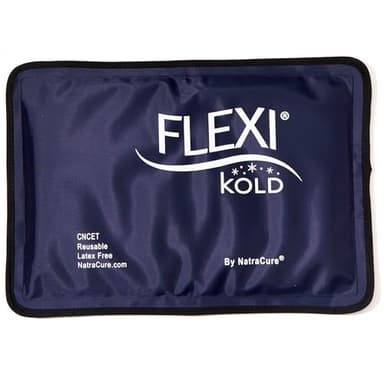
| 3 |  FlexiKold Gel Ice Pack, Medium For the person who wants the cold effect on one angry area rather than a bath: freeze it, wrap it in a towel, twenty minutes. No plumbing, no willpower. | The cold option without a tub | 8.0 | $11.99 · View on Amazon Price as of October 20, 2026. #ad How we’re funded |
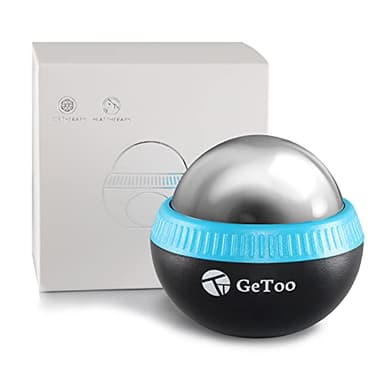
| 4 |  GeToo Cryosphere Cold Massage Roller Ball Rolls cold into a calf, quad or IT band instead of resting on top of it. The closest thing here to the ice-massage protocol that produced the one strong result in the knee thermotherapy review. | Cold plus pressure on one spot | 7.8 | $39.99 · View on Amazon Price as of October 20, 2026. #ad How we’re funded |
The short answer
If you are lifting to get stronger or bigger, use the boots and keep the cold for injuries — a 12-week trial found strength and muscle mass increased more with active recovery than with cold water immersion after every session. If you have to perform again tomorrow— a tournament, a stage race, back-to-back matches — cold is the better-ranked tool for soreness and jump recovery and the adaptation question does not apply to a competition week. If what you want is something you will genuinely do several times a week at home, buy the boots: the evidence for them is thinner, and a thin effect you actually apply beats a stronger one you avoid because it is miserable.
What each one does, mechanically
An ice bath cools tissue. Blood vessels constrict, nerve conduction slows, perceived soreness drops, and the inflammatory signalling that follows hard exercise is damped down. That last part is both the benefit and the problem, because some of that signalling is the message that tells muscle to adapt.
Compression boots inflate sleeves around your legs in a sequence, usually ankle-upward, at pressures in the tens of millimetres of mercury. The mechanism is fluid movement: push venous blood and interstitial fluid toward the trunk, repeat for twenty to thirty minutes. Nothing is cooled, nothing is damped, and nothing about the adaptation signal is touched. The boots are also, unlike a bath, pleasant — which matters more than it should in a category where compliance is most of the effect.
| The situation | Use | Why |
|---|---|---|
| Strength or hypertrophy training block | Boots | Cold immersion after every session measurably reduced 12-week strength and type II fibre growth versus active recovery. Boots have no such cost on record. |
| Competing again in under 24 hours | Cold | Cryotherapy ranked highest for delayed-onset soreness and jump-ability recovery in a 57-study network meta-analysis. Tomorrow's performance beats this month's adaptation. |
| Heavy legs after a long run, no race imminent | Boots | This is the use case boots were built for and the one most home buyers are actually in. Twenty to thirty minutes, feet up, no dread. |
| One angry calf, quad or IT band | Cold, locally | A gel pack or a cold roller puts the cold where the problem is. A whole-leg sleeve or a whole-body bath is a blunt instrument for a single structure. |
| You will only keep up a habit that is comfortable | Boots | Both interventions have modest effects. Only one of them is something people still do in week six. |
| Swollen, heavy legs from standing all day | Boots | Fluid movement is the mechanism, and this is the complaint it fits. Cold does nothing for it. |
| An acute injury - a rolled ankle, a pulled calf | Cold, and a clinician | Neither device is a diagnosis. Cold for comfort in the first days; get the injury assessed rather than inflating a sleeve over it. |
The evidence, including the part nobody mentions
Cold wins on symptoms. A 2024 network meta-analysis in BMC Musculoskeletal Disorders pooled 57 studies and 1,220 healthy participants across four interventions — cold water immersion, contrast water therapy, thermoneutral or hot immersion, and cryotherapy. Ranked by surface under the cumulative ranking curve, cryotherapy came out highest for relieving delayed-onset muscle soreness (88.3%) and highest for restoring jump ability (83.7%), while contrast water therapy ranked best for clearing the blood marker creatine kinase (79.9%). The authors recommended cold water immersion and cryotherapy for reducing exercise-induced muscle damage.
And then there is the bill. A 2015 study in the Journal of Physiology had 21 physically active men strength train for 12 weeks, twice a week, with either 10 minutes of cold water immersion or active recovery after every session. Strength and muscle mass increased more in the active recovery group. Isokinetic work rose 19%, type II muscle fibre cross-sectional area 17% and myonuclei per fibre 26% in the active recovery group — and not in the cold group. If your reason for training is to get stronger, icing every session is working against the reason.
The boots, meanwhile, are the weaker intervention and we have said so on every page that mentions them. A 2025 systematic review with meta-analysis looked at intermittent pneumatic compression alongside photobiomodulation and neuromuscular electrical stimulation for muscle recovery, and a 2026 placebo-controlled randomized trial in international-level youth soccer players found pneumatic compression did not improve post-match neuromuscular, biochemical or perceptual recovery at all. That is the honest state of the boot evidence: modest at best, absent in at least one well-controlled test.
Put the three together and you get a conclusion that is unusual for a comparison page. The better-evidenced tool is the one with a documented cost, and the tool with the weaker evidence has no cost beyond its price. Which you should buy therefore depends less on the effect sizes than on what you are training for.
What to read next
If you have decided on compression, the buying questions are answered at compression boots, the budget roundup and when to use them — and are they worth it is the page that argues against the purchase. If the cold side is what interests you, ice vs heat settles the everyday version of the question in one table. If you are comparing boots against the other big-ticket option, massage gun vs compression boots is the head-to-head, and compression boots vs TENS covers the electrical alternative. Runners specifically should start at the best compression boots for runners.
Every pick, in full
Specs below are the manufacturer’s own published figures, each linked to the page it came from. Where a maker does not publish a number, the table says so and names the page we checked — that absence is information too.
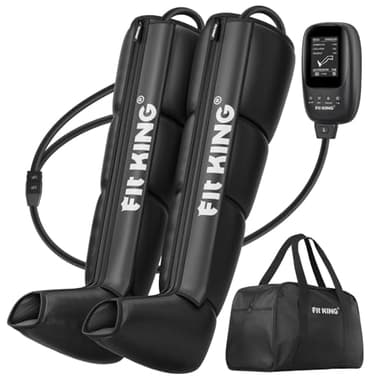
FIT KING Air Compression Recovery Boots
Sequential chamber inflation — the mechanism that actually distinguishes recovery boots from a leg-shaped pressure cuff — at a third of what the category leader charges.
What it gets right
- Genuinely sequential: chambers fire ankle-upward rather than all at once
- Sized options rather than one-size-fits-nobody
- A fraction of the premium system price
What it does not
- Louder pump than the premium units
- Bulky to store and not remotely portable
- Sizing runs specific — measure before buying
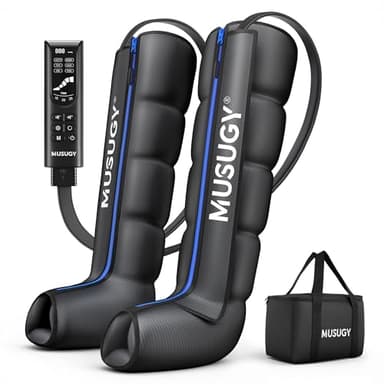
Musugy Sequential Leg Compression Massager
The cheapest genuinely sequential system here — the entry point at which compression boots stop being an aspiration and start being a thing you own.
What it gets right
- Sequential inflation at the lowest price in the category
- Full-leg coverage
What it does not
- Basic controls
- Build quality reflects the price
Price as of October 20, 2026. #ad How we’re funded
FlexiKold Gel Ice Pack, Medium
The cheap half of the ice-or-heat question. It stays pliable out of the freezer, which is the only property that matters — a pack that freezes into a board does not contact a shoulder or a knee.
What it gets right
- Stays flexible at freezer temperature, so it wraps a joint instead of bridging it
- 7.5 × 11 in covers a knee, a shoulder or a lower back without being unwieldy
- Reusable indefinitely, with nothing to charge
What it does not
- A bag of frozen peas is free and does most of this, which the ice vs heat page says plainly
- Needs a thin layer between it and skin — it is cold enough to burn
- Only useful if it lives in the freezer where you will reach for it
Price as of October 20, 2026. #ad How we’re funded
GeToo Cryosphere Cold Massage Roller Ball
Cold and pressure in a single pass, and the stainless ball holds temperature long enough to finish a session rather than warming up in ninety seconds.
What it gets right
- Holds cold for hours rather than minutes
- Rolls freely in its housing so you are not dragging a frozen lump across skin
What it does not
- Costs several times a frozen water bottle that does most of the same job
- Needs freezer space
Common questions
Are compression boots better than an ice bath?
Better for different things. Cold ranks higher for symptoms — cryotherapy came out top for delayed-onset soreness and jump recovery in a 57-study network meta-analysis — but cold water immersion after every strength session reduced 12-week gains in strength, muscle mass and type II fibre size compared with active recovery. Compression boots have weaker evidence for recovery and no documented cost to adaptation. If you lift to grow, use boots. If you compete tomorrow, use cold.
Do ice baths really reduce muscle gains?
In the trial that tested it directly, yes. Twenty-one physically active men strength trained for 12 weeks with either 10 minutes of cold water immersion or active recovery after each session; strength and muscle mass increased more in the active recovery group, which also gained 19% in isokinetic work, 17% in type II fibre cross-sectional area and 26% in myonuclei per fibre — gains the cold group did not show. That is one trial in a specific population, not a law of nature, but it is the best test available and it points one way.
Should you use compression boots before or after an ice bath?
No trial has tested the sequence, so treat any confident answer with suspicion. The one combination that makes no mechanical sense is doing both at once: cold constricts blood vessels and the boots work by moving fluid through them. Separating them is sensible — cold shortly after the session, boots later that evening or the next day — so each does the job it is good at.
Which is cheaper, boots or an ice bath?
Cold is cheaper to start and harder to keep up: a gel pack costs a few dollars and a bathtub plus ice costs whatever your ice costs, while a dedicated tub and chiller costs more than any boots on this site. Sequential compression boots are a one-off purchase in the low hundreds with no consumables and nothing to fill. The relevant arithmetic is not the sticker price though, it is how many sessions you will actually complete.
Sources
- 1.The effects of hydrotherapy and cryotherapy on recovery from acute post-exercise induced muscle damage - a network meta-analysis - BMC Musculoskeletal Disorders 2024 (PMC11409518) — 57 studies, 1,220 participants; cryotherapy ranked first for DOMS (SUCRA 88.3%) and jump ability (83.7%)
- 2.Post-exercise cold water immersion attenuates acute anabolic signalling and long-term adaptations in muscle to strength training - Journal of Physiology 2015 (PubMed 26174323) — 12 weeks, 21 men; strength and mass increased more with active recovery than cold water immersion
- 3.Effects of photobiomodulation, intermittent pneumatic compression and neuromuscular electrical stimulation on muscle recovery: systematic review with meta-analysis - Journal of Bodywork and Movement Therapies 2025 (PubMed 40954632) — the pneumatic compression side of the comparison
- 4.Intermittent pneumatic compression does not improve post-match neuromuscular, biochemical or perceptual recovery in international-level youth soccer players: a randomized placebo-controlled trial - BMC Sports Science, Medicine and Rehabilitation 2026 (PMC12983609) — placebo-controlled trial finding no post-match recovery benefit from pneumatic compression