Feet & Gait
The Best Heated Foot Massager
Heat is the feature everyone wants and the one worth being clearest about: it is comfort, not treatment. This page ranks the machines that deliver warmth well, explains enclosed versus open-top and compression versus kneading, and is honest about when a few-dollar tool does the job instead.
By Stephen V.Published
Disclosure:Grip & Gait earns a commission when you buy through links on this page, at no extra cost to you. It never changes what we recommend or the order we rank things in — here is exactly how we’re funded.
Quick picks
Ranked on published manufacturer specs and what they mean for the job, not on testing we have not done. Tap a row for the full reasoning. How we score.
| # | Product | Best for | Score | Price |
|---|---|---|---|---|
| 1 |  RENPHO Foot Massager with Heat Compression plus kneading plus heat, enclosed to hold warmth, and FSA eligible. | All-round heated unit | 8.0 | |
| 2 |  Nekteck Shiatsu Foot Massager with Heat Heat and kneading in an open design you can lift your foot out of if a node lands wrong. | Open-top escape | 7.6 | |
| 3 |  RENPHO Foot Massager Machine with Heat Three kneading levels, three compression intensities and a 15 or 30 minute timer, for when you cannot trust pain as feedback. | Adjustable intensity | 7.4 | |
| ✕ |  THERABAND Foot Roller A few-dollar freezable roller does the arch job. A machine only earns its price for whole-foot warmth and kneading. Skip this | Skip the machine if you only need the arch | 7.0 | $19.57 · View on Amazon Price as of October 21, 2026. #ad How we’re funded |
What heat actually adds, and what it does not
Almost every foot massager sold now includes heat, and it is the feature most people are shopping for. It is worth being clear about what it does. Warmth on a tired, stiff foot is comforting: it feels pleasant, it helps the foot and the muscles around it relax, and — the part that matters most in practice — it makes you more likely to sit down and actually use the machine. A tool that gets used beats a better tool that does not, and heat is a large part of why these machines get used at the end of a long day.
What heat does not do is treat a specific structural problem. It will not resolve plantar fasciitis, it will not fix an arch, and it will not do anything for the fascia that pressure and a stretch will not do better. If you came here because your heel hurts, read the honest routing on the best foot massager for plantar fasciitis first — the answer there is a cheap ball and a stretch, not a heated appliance. Buy a heated machine because you want warm, effortless comfort for a whole tired foot, which is a real and legitimate reason. Do not buy it expecting it to be a treatment, because it is not one, and we are not going to tell you otherwise.
Enclosed versus open-top: the choice that decides everything
This is the design distinction that matters most and that almost no listing frames clearly.
Enclosed, boot-style machines wrap the foot in a cavity. Because the warmth is trapped around the whole foot rather than radiating off an open surface, they hold heat better and feel more thorough and more enveloping. If heat is genuinely the feature you are buying, an enclosed unit delivers it best. The trade is that you have to slide your foot out to disengage, which takes a second or two, and they are bulkier to store.
Open-top machineslet your foot rest on a surface rather than sliding into a cavity. They do not hold heat as well, but they let you lift your foot away the instant something is wrong — a kneading node landing on a tender spot, heat that is more than you expected. That instant escape is worth a great deal to some people, and it is worth more than better warmth to anyone whose sensation is reduced. For most buyers with normal sensation the enclosed unit is the better heated experience; for anyone who wants to be able to stop instantly, the open-top is the safer buy.
Compression versus shiatsu-only
The second real difference is how the machine applies pressure. Shiatsu machines use rotating nodes that knead the sole at their contact points; the sensation is firm and localized, and on the better units there is no genuinely gentle setting. Compression machines add air bladders that squeeze the whole foot, spreading load across it rather than driving it through a few points. Compression plus kneading plus heat is the fullest, most enveloping experience, and it is the reason the all-round pick sits at the top of this list. If you find rotating nodes too pointed, a machine with compression is the more comfortable whole-foot option; if you like firm, targeted pressure, shiatsu nodes are what you want. If the reason you want compression is swollen feet and ankles rather than comfort, the best foot massager for circulation ranks the machines on that job and says who should ask a doctor first.
How we ranked these
Criteria first, in this order.
- How well it delivers and holds heat. This is a heated-massager roundup, so an enclosed design that keeps the warmth around the foot ranks above one that lets it escape.
- Independent heat control.Being able to run the massage with heat off — and heat with the massage off — is not a minor convenience. It is a safety feature for anyone with altered sensation and a comfort feature for everyone else.
- Intensity range, especially the bottom of it. Most listings quote the top setting. The number that actually matters is how gentle the lowest setting is, because an irritated foot does not want to be attacked. A machine that adjusts down as well as up ranks higher.
- Open-top escape versus enclosed warmth. We rank both, and tell you which suits which person, rather than pretending one wins outright.
- FSA/HSA eligibility and cost. Eligibility genuinely changes the price for a lot of buyers, and it is easy to miss.
The picks, and who each is for
The all-round enclosed unit is the pick for most people who want a heated machine. It combines air compression, kneading and heat in an enclosed body that holds warmth well, and it is FSA/HSA eligible, which quietly changes the real price. The compression is what separates it from a machine that only presses on the sole. Its limitations are the ones inherent to the type: you cannot pull your foot out instantly, and it is bulky to store.
The open-top shiatsu unit is the pick if you value being able to stop instantly over maximum warmth. Its heat and kneading are good, and the open design means you can lift your foot out the moment a node lands wrong. The nodes are firm and there is no soft setting worth the name, so it suits someone who wants firm pressure rather than a gentle rub, and it is our default recommendation for anyone with any doubt about how much a machine they can tolerate.
The adjustable machineis the pick if adjustability is the thing you care about most. It offers a wider intensity range than most — three kneading levels and three compression intensities, so it adjusts down as well as up — and it publishes a 15 or 30 minute timer, which is the control that limits heat exposure when you cannot trust pain as a feedback signal. It does not document running the kneading with the heat off; none of the machines here does, and we checked on 27 September 2026. It is the most expensive of the machines here and has the largest footprint, and for a person who simply wants warmth and comfort it is more than they need. For anyone who needs to dial a machine down carefully, it is the right one.
The freezable roller is our skip — and that is a compliment to it. If the only thing you actually need is the arch, a few-dollar contoured roller does that job, and it can be chilled for the first-step pain that heat does nothing for. We include it as the skip precisely to make the point: a machine only earns its price when you want whole-foot warmth and kneading, not when you want a targeted tool for one structure. If the arch is your whole problem, keep your money.
When a cheap tool beats a machine
For a specific structure — the arch, the plantar fascia, one tender spot — a targeted tool beats a heated machine, and it is not close. The evidence on plantar fasciitis points away from gadgets entirely: a trial with two-year follow-up found a plantar fascia-specific stretch substantially outperformed the alternatives, and a double-blind randomized trial found the same stretch gave the best function-score improvement of the modalities compared. A heated machine is comfort layered over the top of that work, not a replacement for it. Where the machine genuinely wins is general fatigue: a whole foot that is tired and stiff after standing all day, which broad kneading and warmth address pleasantly and effortlessly. We lay out that whole-foot, all-day case on the best foot tools for standing all day, route the heel-pain case on the plantar fasciitis page, and if warmth is truly all you are after, a plain heating paddelivers it over the foot and ankle for a fraction of a powered massager’s price.
Getting the most out of the heat
A few habits make a heated machine both better and safer, and none of them cost anything. Warmth is most useful as a relaxant before you do something else — a stretch, a walk, getting on with the evening — rather than as an end in itself, so a warm-up session followed by a plantar fascia or calf stretch gets more out of it than sitting in it indefinitely does. Keep sessions to a sensible length rather than running the heat for an hour: a machine with a short auto-shutoff timer does that for you, and it is the feature that matters most if there is any chance you will doze off in it. Do not use a heated machine on a foot with an open wound, a fresh injury, active swelling or redness — warmth on an inflamed or damaged foot is the wrong direction. And because the foot sweats in an enclosed cavity, a removable, washable cover is worth having; foot hygiene matters more, not less, when you are using the machine daily.
One more habit that quietly improves the experience: run the heat and the massage separately at least once so you know what each feels like on its own. It tells you whether you actually want both at full strength together, and it is the same independent-control feature that makes a machine safer for anyone whose sensation is reduced. Most people discover they want a lot less kneading intensity than the top setting once the heat is doing the relaxing.
A heated machine or a heating pad?
If you strip the question back, a lot of people who search for a heated foot massager actually want warmth more than they want kneading. It is worth naming the cheaper alternative honestly. A plain heating pad wraps the foot and ankle in warmth for a fraction of a powered massager’s price, with nothing to break and no motor to wear out, and it reaches the ankle and lower calf that a foot cavity does not. What it cannot do is knead or compress, which is the whole reason to pay for a machine. So the split is simple: if warmth is genuinely all you are after, a heating padis the better spend; if you want warmth plus the sensation of the sole being worked, a heated massager earns its price. We would rather you knew that before spending on a machine you did not need. The same reasoning, applied to targeted pressure rather than warmth, is why a cheap roller beats a machine for the arch — comfort and treatment are different purchases.
Enclosed or open, in one line each
- You want the best warmth and full comfort: the all-round enclosed unit with compression, kneading and heat.
- You want to be able to stop instantly: the open-top shiatsu unit.
- You need to dial the intensity carefully down: the adjustable machine, with three kneading levels, three compression intensities and a timer.
- You only need the arch: skip the machine and buy the freezable roller.
If you are torn between the two most common machines specifically, we put them head to head on Nekteck vs RENPHO, which comes down to exactly the enclosed-versus-open and compression-versus-shiatsu choices this page describes.
Every pick, in full
Specs below are the manufacturer’s own published figures, each linked to the page it came from. Where a maker does not publish a number, the table says so and names the page we checked — that absence is information too.
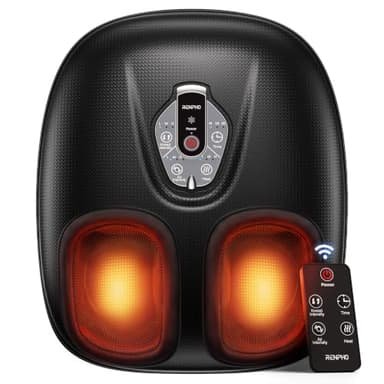
RENPHO Foot Massager with Heat
Compression plus kneading plus heat in one enclosed unit, and FSA eligible — the compression element is what separates it from a machine that only presses on the sole.
What it gets right
- Air compression works the whole foot, not only the contact points
- FSA/HSA eligible
- Enclosed design holds heat better than an open-top unit
What it does not
- Enclosed means you cannot pull your foot out instantly
- Bulky to store
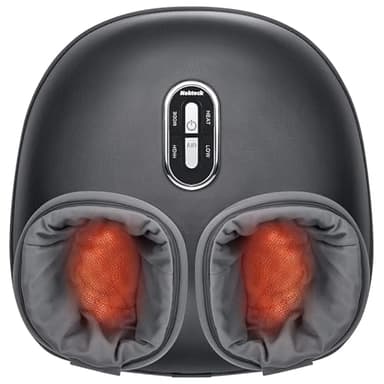
Nekteck Shiatsu Foot Massager with Heat
The entry point where shiatsu foot machines stop being a novelty — deep kneading nodes plus heat, in an open-top design your foot can leave instantly if a node lands wrong.
What it gets right
- Open-top design means you can lift your foot out immediately — not true of enclosed boot-style units
- Heat plus kneading, which is the combination that works on stiff morning feet
- Washable, removable cover
What it does not
- Kneading nodes are firm; there is no gentle setting worth the name
- Works the sole and not the arch specifically
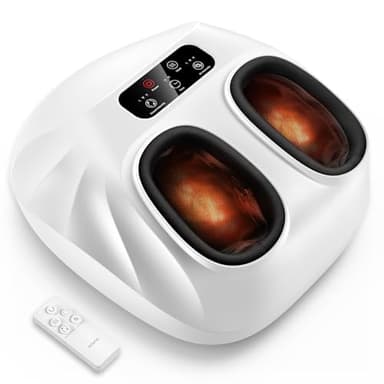
RENPHO Foot Massager Machine with Heat
Adjustable intensity across a wider range than most, which is the specification that actually matters when sensation is altered and you cannot trust pain as a feedback signal.
What it gets right
- Three kneading levels and three compression intensities, so it adjusts down as well as up
- A 15 or 30 minute timer, which is the control that limits heat exposure on this machine
- FSA/HSA eligible
What it does not
- Expensive
- Large footprint — RENPHO publishes 18.5 × 16.9 × 11.8 in and 12 lb
- RENPHO does not document a way to run the kneading with the heat off
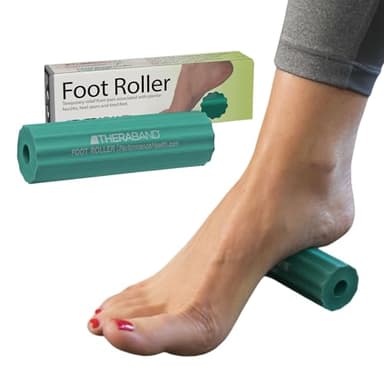
Price as of October 21, 2026. #ad How we’re funded
THERABAND Foot Roller
Shaped for the arch specifically rather than being a general-purpose ball, and it can be chilled — which covers both jobs a first-thing-in-the-morning heel needs.
What it gets right
- Contoured to the arch instead of a plain sphere
- Freezes, so you get cold and pressure in one pass
- Costs less than a takeaway lunch
What it does not
- Fixed shape suits some arches better than others
- Not usable anywhere but the foot
Common questions
Does heat help a foot massager work better?
Heat adds comfort, not treatment. Warmth helps a tired, stiff foot relax and makes people far more likely to actually use the machine, which is a real benefit. What it does not do is treat a specific problem like the plantar fascia — pressure and a stretch do that. Buy a heated machine for effortless whole-foot comfort, and if you have a specific structure that hurts, add a cheap targeted tool for that job.
Is an enclosed or open-top heated foot massager better?
Enclosed units hold heat better and feel more thorough, so if warmth is the feature you are buying, they deliver it best. Open-top units do not retain heat as well but let you lift your foot out instantly if a node lands wrong or the heat is more than you expected. For most people with normal sensation the enclosed unit is the better heated experience; for anyone who wants to stop instantly, or whose sensation is reduced, the open-top is the safer choice.
Are heated foot massagers safe if I have diabetes or neuropathy?
Be very careful and ask the clinician managing it first. Reduced sensation removes the stop signal every safety assumption in a heated machine depends on, and low-temperature burns happen from prolonged contact you may not feel. If you use one, buy a machine where heat runs independently so you can turn it off, use a short auto-shutoff timer, and inspect the skin after every session. If a clinician has said no heat, that is the answer.
Sources
- 1.Plantar fascia-specific stretching improves outcomes in chronic plantar fasciitis — two-year follow-up (PubMed 16882901) — stretching outperformed alternatives at two years
- 2.Comparing the Role of Different Treatment Modalities for Plantar Fasciitis: A Double Blind Randomized Controlled Trial (PubMed 32257015) — best function-score improvement among modalities