Symptoms
How to Get Rid of Muscle Knots
Sustained pressure, then movement. A hard ball against a wall generates more pressure into a knot than any handheld device, and the whole procedure takes about ninety seconds — most of which people spend pressing too hard.
By Stephen V.Published
Disclosure:Grip & Gait earns a commission when you buy through links on this page, at no extra cost to you. It never changes what we recommend or the order we rank things in — here is exactly how we’re funded.
To work a muscle knot: apply sustained pressure to the tender point for 60–90 seconds, then move the muscle through its range. A hard ball against a wall or floor is the most effective tool for this because your body weight concentrates into a coin-sized contact patch — more pressure than any handheld motor produces.
What a knot probably is
The common term for a tender, palpable band in a muscle is a myofascial trigger point. The experience is consistent: a spot that feels denser than the tissue around it, is tender out of proportion to its size, and sometimes refers sensation elsewhere.
What is actually happening at the tissue level is less settled than the confident explanations you will read. What is not in dispute is what tends to help: sustained pressure, followed by movement. We will describe that, and we will not pretend to explain the mechanism with more certainty than exists.
The arithmetic that decides the tool
Pressure is force divided by contact area. A 175 lb person lying on a lacrosse ball loads roughly one square inch with a large fraction of their body weight — call it 50–60 lb per square inch.
The best-specified massage gun on this site publishes over 44 lb of stall force, and that figure is the point at which the motor stops, spread across a head larger than a lacrosse ball’s contact patch. The working pressure is lower still.
The ball wins, and it costs under ten dollars. That is the whole reason a $6 rubber sphere outranks a $330 device on this page.
Which class of tool fits
| Tool class | Cost | Why it does or doesn’t work here | Verdict |
|---|---|---|---|
| Massage ball | Cost: Budget | Maximum pressure per square inch, and the only tool that reaches under a shoulder blade against a wall. If you can locate the knot, this is the answer.Where it fails: Unforgiving. Sixty to ninety seconds is a session, and eight minutes is a bruise. | Start here |
| Massage gun | Cost: Mid-range | For a knot you cannot get body weight onto - your own upper trapezius, a forearm - or when you need to turn the intensity down.Where it fails: Less pressure than a ball at the same spot. And parking the head on the knot rather than moving it is how people bruise themselves. | Start here |
| Foam roller | Cost: Budget | Good for finding roughly where the problem is across a large muscle before switching to something more precise.Where it fails: Too broad to concentrate pressure on a single point. It passes over knots rather than into them. | Sometimes |
| Heat | Cost: Budget | Before pressure, on a muscle that is guarding. Warm tissue tolerates pressure better than cold tissue.Where it fails: Does nothing to the knot on its own. It is a preparation step. | Sometimes |
| Scraper / gua sha | Cost: Budget | Some people prefer shearing along the muscle to pressing into it, and practitioners use it this way.Where it fails: Thinner evidence base than pressure, and very easy to bruise yourself with. | Sometimes |
| Stretching alone | Cost: Budget | Valuable as the movement half of the pressure-then-move sequence.Where it fails: On its own it does not address a specific tender point. Stretching a muscle with a knot in it frequently just moves the tension elsewhere. | Not for this |
What we would actually buy
Buy this first
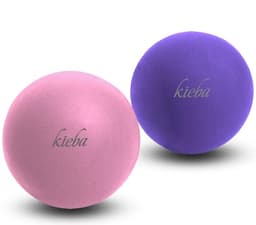
Kieba Massage Lacrosse Balls
More pressure per square inch than any motorized device, reaches under a shoulder blade against a wall, and costs less than a sandwich. Buy a pair.
Price as of October 21, 2026. #ad How we’re funded
For what you cannot reach
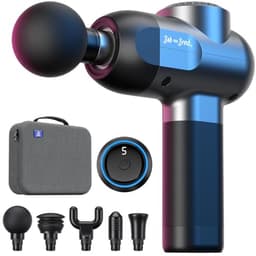
Bob and Brad C2 Massage Gun
Your own upper trapezius and the back of your shoulder are the two places a ball cannot properly load. Light enough to hold overhead, and it turns down.
For beside the spine
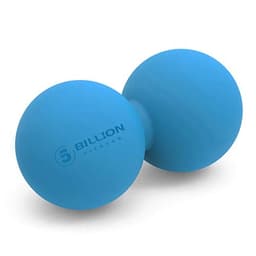
5BILLION Peanut Massage Ball
Knots in the paraspinal muscles are common and a single ball rolls onto the bone. The peanut shape straddles it.
The procedure
- Find it. Press around the area until you find the spot that is tender out of proportion to everything around it. That is the target — not the general area.
- Apply sustained pressure. Ball against a wall or on the floor, leaning in until it is a strong but tolerable ache. Roughly a 6 or 7 out of 10, not a 9.
- Hold 60–90 seconds. Breathe normally. Holding your breath tenses everything, including the thing you are working on.
- Then move the muscle through its range. This is the step people skip and it may be the more important half. Pressure changes tolerance; movement is what uses it.
- Stop. Do not go back four more times. Once a day is plenty.
The shoulder blade problem
The most-searched knot location is between or under the shoulder blade, and it is genuinely awkward. You cannot reach it with your hands, a foam roller passes over the blade rather than under it, and a massage gun cannot get beneath the bone.
A ball against a wall can. Place it between your spine and the inside edge of the shoulder blade, then reach your opposite arm across your chest — that action slides the shoulder blade outward and opens the space underneath. Lean back into the ball and work slowly.
This is the single technique on this website that most reliably produces a “how did nobody tell me that” reaction, and it requires an eight-dollar ball.
Why they keep coming back
Because you are treating the symptom and not the load that produces it. A knot in an upper trapezius that returns every week is usually reporting on a posture, a workstation, a sleep position or a training imbalance.
Tools manage it. Something else caused it. This is the case where a trained person genuinely earns their fee — palpating and finding that the painful spot traces to somewhere you were not thinking about is the thing no device can do.
What the evidence says about the tools
Percussive therapy reduces measured tissue stiffness and improves range of motion in the short term, and a systematic review supports gains in acute muscle strength. A meta-analysis of massage supports an effect on perceived soreness.
We have not found evidence that any of these tools structurally resolves a trigger point, and we are not going to claim it. What they reliably do is reduce how it feels and improve how the muscle moves — which, applied consistently alongside fixing whatever caused it, is a reasonable plan.
Common questions
How do you get rid of a muscle knot?
Apply sustained pressure to the tender point for 60–90 seconds at a strong but tolerable intensity, then move the muscle through its range. The movement step is the one people skip and may be the more important half — pressure changes tolerance and movement is what uses it. Once a day is plenty.
Is a massage gun or a ball better for knots?
A ball, on the arithmetic. Your body weight through a coin-sized contact patch generates roughly 50–60 lb per square inch; the best-specified gun on this site publishes over 44 lb of stall force spread across a larger head, and that figure is where the motor stops. The gun wins for knots you cannot get body weight onto — your own trapezius, a forearm — and when you need to turn the intensity down.
How do you reach a knot under your shoulder blade?
A ball against a wall. Place it between your spine and the inside edge of the shoulder blade, then reach your opposite arm across your chest — that slides the blade outward and opens the space underneath. Lean back into the ball and work slowly. No massage gun head gets beneath the bone and a foam roller passes over it.
Why do my muscle knots keep coming back?
Because tools manage the symptom and something else caused it — usually a posture, a workstation, a sleep position or a training imbalance. A knot returning to exactly the same spot for months is reporting on a load you have not changed. This is the case where a trained person genuinely earns their fee, because finding the cause is the thing no device can do.
How long should you press on a muscle knot?
Sixty to ninety seconds, at roughly a 6 or 7 out of 10 intensity rather than a 9. Breathe normally — holding your breath tenses everything including the thing you are working on. Do not go back four more times in the same session.
Sources
- 1.Acute Effects of Theragun Percussive Therapy on Viscoelastic Tissue Dynamics and Hamstring Range of Motion (PMC10499144)
- 2.The Effect of Percussive Therapy on Musculoskeletal Performance and Experiences of Pain: A Systematic Literature Review (PubMed 37020441)
- 3.Massage Alleviates Delayed Onset Muscle Soreness after Strenuous Exercise: A Systematic Review and Meta-Analysis (PMC5623674)
- 4.Bob and Brad — C2 massage gun product page — published stall force used in the arithmetic above