Recovery Tech
The Best TENS Units for Back Pain
A TENS unit changes how much pain you feel while it runs; it does not touch the cause. For a back that means the right unit is cheap, the placement matters more than the model, and the pads are the real cost of owning one.
By Stephen V.Published Updated
Disclosure:Grip & Gait earns a commission when you buy through links on this page, at no extra cost to you. It never changes what we recommend or the order we rank things in — here is exactly how we’re funded.
Quick picks
Ranked on published manufacturer specs and what they mean for the job, not on testing we have not done. Tap a row for the full reasoning. How we score.
| # | Product | Best for | Score | Price |
|---|---|---|---|---|
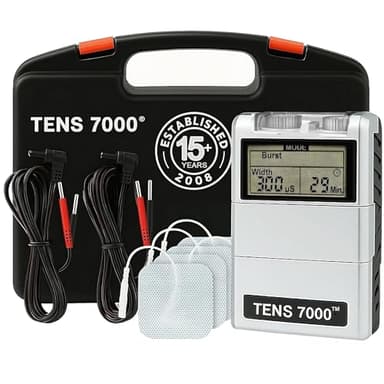
| 1 |  TENS 7000 Digital TENS Unit Manual pulse-width and rate control instead of presets, and the clinic default so pads are everywhere. | Manual control | 8.2 | $38.88 · View on Amazon Price as of October 21, 2026. #ad How we’re funded |
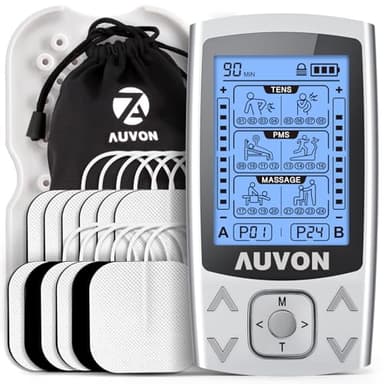
| 2 |  AUVON Dual Channel TENS Unit Two independent channels, rechargeable, and cheap enough to find out whether TENS helps you. | First unit | 8.0 | $35.99 · View on Amazon Price as of October 21, 2026. #ad How we’re funded |
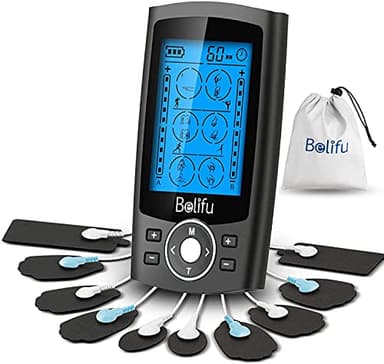
| 3 |  Belifu Dual Channel TENS EMS Unit Competent dual-channel hardware. The 24-mode count is marketing, not a feature. | Cheapest dual channel | 7.2 | $35.99 · View on Amazon Price as of October 21, 2026. #ad How we’re funded |
| ✕ |  KingPavonini Wireless TENS + EMS Muscle Stimulator Wireless pods running TENS and EMS, but it is more unit than most back-pain buyers need. Skip it unless you specifically want EMS too. Skip this | Only if you also want EMS | 7.4 |
The short version
A TENS unit is one of the few devices in this category where the cheap model does the same job as the expensive one, so the decision is fast. For a back, buy a dual-channel unit, place the pads to bracket the sore band rather than sitting them on the spine, and understand from the outset that the pads are the running cost and the unit is not. What a TENS unit does is real but narrow: it changes how much pain you feel while the current is running. It does nothing to the thing causing the pain, and no unit on this page pretends otherwise.
What a TENS unit actually does to back pain
A TENS unit sends a mild electrical current through pads stuck to the skin, stimulating the nerves underneath. The long-standing rationale is gate-control: the stimulation floods the same nerve pathways that carry the pain signal, and while those pathways are busy the brain registers less of the ache. Some people also report relief that outlasts the session, usually attributed to the current nudging the body’s own pain-damping chemistry.
The honest position is that the evidence for TENS is mixed, the effect tends to be modest and temporary, and it varies enormously between people and between problems. It is a mask, and for some backs a genuinely useful one — but it is a mask. It manages the symptom while it runs and leaves the cause exactly where it found it. That is not really a criticism; it is the correct expectation to buy with. A unit that quiets a nagging lower back enough to sleep, or enough to get through a shift on your feet, has earned its very low price even though it has repaired nothing. The mistake is buying it expecting the ache to be gone for good, because that is not what the device is for. If your back pain is mechanical — stiffness that eases once you move, a joint that has been loaded badly, muscle that has been guarding for weeks — the fix is graded movement and time, and the TENS unit is only there to make that stretch of time more bearable.
Why dual channel is the first thing to confirm for a back
Back pain is rarely a single point. It sits as a band across the lower back, or it runs down one side, or it refers into a buttock or a hip. A single-channel unit forces you to treat one small area at one intensity at a time, which is the wrong shape for the problem. Two independent channels let you bracket a whole band with a pad on each side, or treat the low back and a referred area at once, each at its own strength — the two sides of a back very often do not want the same intensity.
Nearly everything worth buying is dual channel now, so this is less a filter than a floor. It is still the first box to tick, and it is the reason the single-channel bargains that surface in search are a false economy for a back specifically.
Manual control, and when it starts to matter
Most units offer a menu of named preset programs. Some also let you set the stimulation parameters — how wide each pulse is and how fast they arrive — directly. That distinction is invisible on your first day and decisive a month in. Responses to TENS vary a lot between people, and once you discover that one particular sensation genuinely helps your back while another does nothing, manual control lets you return straight to it. A preset-only unit makes you hunt back through numbered programs hoping to land on the same one.
This is the single specification that separates the unit clinics hand out from the one that looks nicer on a shelf. The TENS 7000 is the manual one, which is exactly why it is our top pick for anyone who intends to use TENS for a back over months rather than test it for a week. The AUVON is the opposite trade and no worse for it: preset-driven, rechargeable, and friendly enough that you can put pads on and start without understanding a single parameter. Both are correct answers to different questions.
The running cost is the pads, and nobody says so
The unit is not the cost of ownership. The pads are.Electrode pads lose their tack after a number of applications — how many depends on your skin, how hairy the area is, and how you store them — and they are a permanent consumable. Over a couple of years of regular use the pads cost more than the unit did, and that is true of every model here.
Two habits keep that cost down. First, buy a unit that takes standard pin-connector pads, so you can buy replacements from any manufacturer rather than being locked into one supplier for the life of the device. The clinic-standard units win here because their accessories are everywhere. Second, put the pads on clean, dry skin — lotion and oil kill adhesion faster than anything — and peel them from the edge afterward and return them to their backing sheet in a sealed bag. That one habit roughly doubles how long a set lasts. Judge these units on the pad supply you are signing up for, not the sticker price, because the sticker price is the smaller number.
Where to put the pads on a back, and where never to
Bracket the sore area rather than covering the worst point directly. Put one pad on either side of the painful band so the current passes through the region between them; that is the conventional placement and it is what the two channels are for. Turn the intensity up only until you feel a strong but comfortable tingle. If the muscle starts to twitch or contract you have wandered out of TENS and into stimulation meant to make muscle fire, and if it hurts you have gone too far — more current is not more relief, it is just more current.
The placement rules that matter most are the ones about where the pads must never go. Do not put pads directly over the spine itself— it is bony, there is little muscle over it, and the current runs across bone rather than through the tissue you are trying to reach. Never place electrodes over the front of the neck or the carotid area, never across the chest in a way that lets current cross the heart, and never on the abdomen or lower back during pregnancy without medical guidance. Do not use TENS over broken, infected or numb skin, where you cannot feel the current well enough to judge it safely.
What to ignore
- Mode count.The big number printed on the box is a firmware line, not a feature. Each extra “mode” is a slightly different pulse pattern a microcontroller generates for nothing, and adding one costs the manufacturer a line of code and gains a line on the listing. It tells you nothing about whether the unit will help your back.
- Named body-part programs.“Back,” “Waist,” “Shoulder.” These are marketing labels on frequency patterns, not distinct clinical protocols. Fine as starting points, meaningless as specifications.
- App control. It adds a phone dependency to a device with a handful of buttons.
- Anything advertising muscle building.That is EMS, a different function entirely — it makes muscle contract rather than talking to nerves about pain. The KingPavonini runs both, which is a legitimate thing to want from one device; see TENS vs EMS for why the distinction matters.
Which unit, in a line each
- Want to dial in a setting and go straight back to it: the TENS 7000, with manual pulse-width and rate control and accessories available everywhere.
- Buying your first unit to find out whether TENS helps you at all: the AUVON, dual channel and rechargeable, at a price where the experiment costs less than one appointment.
- Lowest possible price for competent dual-channel hardware: the Belifu, understanding the mode count on the box is noise.
- Only if you specifically want EMS as well:the KingPavonini, which runs both TENS and EMS from wireless pods but is more unit than a back-pain buyer needs on its own — which is why it is our skip.
One more distinction worth making before you buy on this page: if the pain is widespread rather than lumbar — both sides, above and below the waist, with fatigue — the protocol that has randomized evidence behind it treats the upper and lower back at a specific setting, and the best TENS units for fibromyalgia ranks these same units on whether they can be set that way.
When a TENS unit is the wrong answer for a back
Often enough that it is worth saying plainly. For general stiffness and muscle guarding, a heating padsuits the problem better, costs less, and has no consumable pads to replace. For a back that is genuinely mechanical, the thing that changes it is graded movement and load over weeks, and nothing you plug in substitutes for that — the TENS unit only makes the interval more comfortable. And some back pain is not a shopping problem at all.
An acute flare and a chronic ache are not the same job
It is worth being clear about which back you have, because it changes how a TENS unit fits in. For an acute flare — a back that has seized up in the last few days — the useful role of TENS is narrow and temporary: it can take enough edge off the pain to let you keep moving gently, which is what an irritated back actually needs, rather than lying rigid and letting everything stiffen further. It is a bridge across a bad few days, not the treatment.
For a chronic ache — a back that has grumbled for months — the honest use is as a management tool you reach for around the parts of the day that provoke it, alongside the graded movement and strengthening that actually shift a long-standing problem. Some people genuinely find it earns a permanent place in that routine; others find the benefit fades and quietly stop. Both outcomes are normal, and neither is worth spending much to discover, which is the whole argument for starting cheap. What TENS is not, in either case, is the thing that makes the back better on its own. It buys comfort while the real work happens, or while the flare settles, and that is a job worth a small amount of money and no more.
An honest note on expectations
Responses to TENS vary enormously. Some people find it genuinely useful for a chronic back and use a unit for years; others feel the tingle and no benefit at all. There is no way to predict which you are, and no specification that changes the odds — not the mode count, not the price, not the brand. That is the whole argument for buying a cheap dual-channel unit first. It costs less than a single appointment, it answers the question in a week or two, and if the answer is yes you can move up to something with manual control. If the answer is no, you have lost very little.
Whichever way it goes, hold on to the one true thing about this device: it manages a symptom, it does not fix a cause. Used with that expectation it is a cheap, low-risk, sometimes genuinely helpful tool. Sold as a cure it is a disappointment waiting to happen. For the wider ranking that is not back-specific, see the best TENS units, and if you are weighing a stimulator against a mechanical tool entirely, read massage gun vs TENS.
Two neighbouring problems get confused with this one. If the pain travels down a leg it is a nerve referral and the pads go somewhere else — see the best TENS units for sciatica. If it sits in your traps and the base of your neck instead, the ranking changes because wearability starts to matter more than control: the best TENS units for neck and shoulder pain has that order.
Every pick, in full
Specs below are the manufacturer’s own published figures, each linked to the page it came from. Where a maker does not publish a number, the table says so and names the page we checked — that absence is information too.
Price as of October 21, 2026. #ad How we’re funded
TENS 7000 Digital TENS Unit
The unit clinics hand out, with manual control over pulse width and rate rather than a menu of preset programs — which is what you want once you know what setting helps.
What it gets right
- Manual pulse-width and rate control instead of fixed presets
- The long-standing clinic default, so accessories are everywhere
What it does not
- Runs on a 9 V battery
- Manual control is only an advantage if you know what you are adjusting
Price as of October 21, 2026. #ad How we’re funded
AUVON Dual Channel TENS Unit
Two independent channels so you can treat both sides of a problem at once, at a price where trying TENS costs less than one session of anything else.
What it gets right
- Two independent channels with separate intensity control
- Rechargeable rather than eating 9 V batteries
- Cheap enough to find out whether TENS does anything for you
What it does not
- Pad adhesive life is the real running cost, not the unit
- Interface is fiddly with cold hands
Price as of October 21, 2026. #ad How we’re funded
Belifu Dual Channel TENS EMS Unit
Twenty-four modes at the lowest price in the category, and the mode count is marketing — but the hardware underneath is a competent dual-channel stimulator.
What it gets right
- Cheapest dual-channel unit here
- Rechargeable
- Pads and leads included
What it does not
- Mode count is noise, not a feature
- Thin documentation of what each mode does
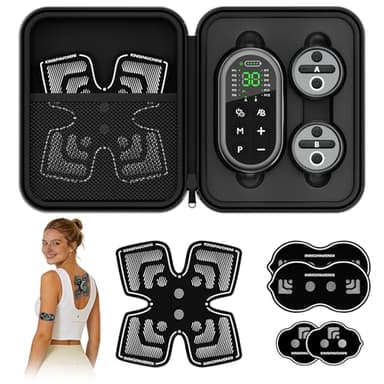
KingPavonini Wireless TENS + EMS Muscle Stimulator
TENS and EMS from two pods you stick on and wear, with no lead wires anywhere — which is the whole reason to pay this much, because it is the only version of the device you can use under a shirt and still move around in. The 48-mode count is marketing; the dual-zone independent control underneath it is not.
What it gets right
- Wireless pods rather than lead wires, so it works under clothing and while moving
- Two pods run independently — separate mode and intensity each, so a shoulder and a leg can run different settings at once
- Published 20 hours per pod on the 1040 mAh cell, charged over USB-C rather than off a disposable battery
- Ships with three pad sizes including a 4.3 in butterfly pad, which is the one that actually covers a lower back
What it does not
- Forty-eight modes is a mode count, not a specification — the same marketing this site flags on every cheap unit
- Several times the price of a wired dual-channel unit that treats a back just as well
- Two pods and a remote are three things to keep charged and not lose
- Listed only in December 2025 and rated 4.1 across 69 reviews, so there is very little ownership history behind it
Common questions
Where do you put TENS pads for lower back pain?
Bracket the sore band rather than covering the worst point directly — one pad on each side of the painful area so the current passes through the region between them, which is what the two channels are for. Do not place pads directly over the spine itself, where the current runs across bone rather than through muscle. Turn the intensity up only to a strong but comfortable tingle, never to a muscle twitch or to pain.
Does a TENS unit fix back pain or just mask it?
It masks it. A TENS unit changes how much pain you feel while the current is running and, for some people, for a while afterward, but it does nothing to the cause. For mechanical back pain the thing that actually changes it is graded movement and load over weeks; the TENS unit only makes that interval more comfortable. That is a genuinely useful job at a very low price, as long as you buy it expecting symptom relief rather than a cure.
What is the real cost of running a TENS unit?
The electrode pads, not the unit. Pads lose their tack after a number of applications and are a permanent consumable, and over a couple of years they cost more than the device did. Buy a unit that takes standard pin-connector pads so you can replace them from any manufacturer, apply them to clean dry skin, and store them on their backing sheet in a sealed bag — that habit roughly doubles their life.
Sources
- 1.Therabody — Product Safety & Precautions — a published device precautions list; the implanted-device, altered-sensation and broken-skin cautions overlap with TENS