Compare
TENS vs EMS
They look identical, they are sold in the same box, and they do fundamentally different things. One is aimed at how you perceive pain. The other makes muscle contract. Buying the wrong one is the most common mistake in this category.
By Stephen V.Published Updated
Disclosure:Grip & Gait earns a commission when you buy through links on this page, at no extra cost to you. It never changes what we recommend or the order we rank things in — here is exactly how we’re funded.
Quick picks
Ranked on published manufacturer specs and what they mean for the job, not on testing we have not done. Tap a row for the full reasoning. How we score.
| # | Product | Best for | Score | Price |
|---|---|---|---|---|
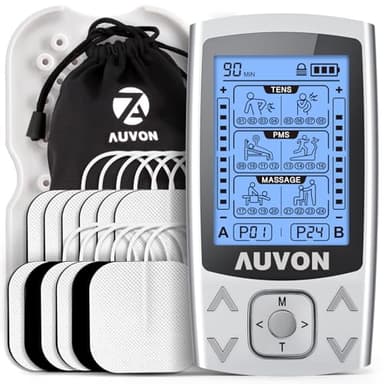
| 1 |  AUVON Dual Channel TENS Unit Two independent channels with separate intensity control, rechargeable, cheap enough to find out whether TENS does anything for you. | First TENS unit | 8.4 | $35.99 · View on Amazon Price as of October 21, 2026. #ad How we’re funded |
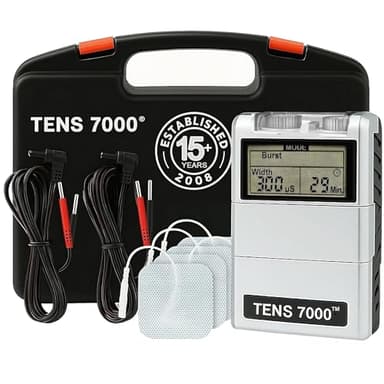
| 2 |  TENS 7000 Digital TENS Unit Manual pulse width and rate rather than fixed presets. The clinic default, so accessories are everywhere. | Manual parameter control | 8.2 | $38.88 · View on Amazon Price as of October 21, 2026. #ad How we’re funded |
| 3 |  KingPavonini Wireless TENS + EMS Muscle Stimulator Runs both TENS and EMS from two pods you wear, each on its own mode and intensity. | Both, without lead wires | 7.8 | |
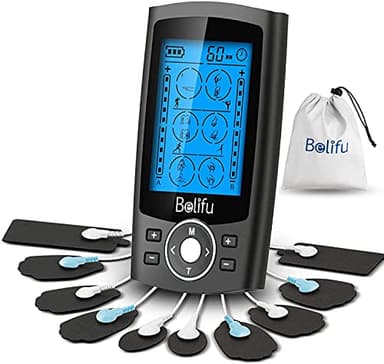
| 4 |  Belifu Dual Channel TENS EMS Unit Twenty-four modes at the cheapest price here. The mode count is marketing; the hardware underneath is competent. | Lowest cost dual channel | 7.3 | $35.99 · View on Amazon Price as of October 21, 2026. #ad How we’re funded |
The difference, in one table
| Question | TENS | EMS |
|---|---|---|
| What it stands for | Transcutaneous Electrical Nerve Stimulation | Electrical Muscle Stimulation |
| What it targets | Sensory nerves | Motor nerves |
| What you feel | Tingling, buzzing, prickling. Muscle stays still. | Visible muscle contraction. The muscle twitches or tightens. |
| What it is for | Changing how pain is perceived | Making muscle contract when you cannot or will not |
| Typical use | Chronic back pain, arthritis, nerve-related pain | Post-injury muscle activation, disuse atrophy, rehab |
| Who it suits | Anyone managing ongoing pain at home | Mostly people in a supervised rehab program |
| Session length | 20-30 minutes, repeatable through the day | Shorter, and it fatigues muscle like exercise does |
| Buy it for | Pain you already have | Muscle that is not firing properly |
TENS, explained properly
A TENS unit sends a low-voltage current through skin electrodes to stimulate sensory nerves. The muscle does not contract; you feel a tingling or buzzing. The mechanism most commonly described for it is that stimulating large sensory fibers interferes with the transmission of pain signals along smaller fibers — the “gate control” explanation — and there is a secondary account involving the body’s own pain-modulating chemistry at certain frequencies.
What matters practically: TENS is aimed at pain you already have. It is not treating a cause, it is not repairing anything, and its effect is generally while it is on and for some period afterward. That is genuinely useful for ongoing pain and it is a different claim from healing.
Two specifications are worth caring about. Dual channel means two independent electrode pairs with separate intensity — necessary if you want to treat both sides of a lower back at once. Manual parameter control means you can set pulse width and rate rather than picking from named presets, which only matters once you know what setting helps you, and then matters a lot.
EMS, explained properly
An EMS unit stimulates motor nerves hard enough to make the muscle contract. You can see it happen. It is doing mechanically what a voluntary contraction does, without you deciding to do it.
The legitimate use is rehabilitation: a muscle that has stopped firing properly after injury or immobilization, where the goal is to re-establish activation. That is a clinical application and it is normally run as part of a supervised program with a plan attached.
The illegitimate use is the abdominal-belt genre — the promise that electrical stimulation substitutes for training. It does not. A contraction produced by a machine is not progressively overloaded, is not coordinated with anything, and does not produce the adaptations that structured resistance training does.
Why almost every unit sells you both
Because the hardware is nearly identical. The difference between TENS and EMS output is pulse characteristics — width, frequency, pattern — and a microcontroller can produce either. Adding EMS to a TENS unit costs a manufacturer a firmware mode and adds a line to the listing.
This is why you see units advertising 24 modes, 32 modes, 40 modes. The count is a marketing artifact. What actually matters is whether the unit labels which modes are TENS and which are EMS and tells you what each does. A device that blends them into an undifferentiated menu of numbered programs has made it impossible to know what you are applying, and that is a real defect rather than a stylistic complaint.
Which do you actually need?
Almost certainly TENS. If you arrived at this page because something hurts — a back, a knee, arthritic hands, nerve pain — TENS is the one aimed at that. EMS is for muscle that is not firing, which is a rehabilitation situation rather than a pain one.
Buy a dual-channel TENS unit at the bottom of the market first. These are cheap enough that finding out whether electrical stimulation does anything for you costs less than a single appointment, and responses vary enormously between people — some find it transformative for chronic pain, others feel nothing useful at all. There is no way to know in advance which you are.
If you get on with it and want more control, move up to a unit with manual pulse-width and rate control. If a clinician has specifically recommended EMS as part of a rehab program, buy a unit that labels its EMS modes clearly and follow their protocol rather than the device’s menu.
The running cost nobody mentions
The unit is not the expense. Electrode pads are. They lose adhesion after somewhere between 10 and 30 applications depending on skin, hair and how carefully you store them, and they are consumables you will keep buying.
Two practical consequences: buy a unit that takes standard connector pads rather than a proprietary shape, and store pads on their backing sheet in a sealed bag. Both meaningfully change what the device costs to own over three years, and neither appears in any comparison we could find.
Where TENS fits among the other tools
It is the only tool on this site that addresses pain signaling rather than tissue mechanics, which makes it complementary rather than competitive. It is the reasonable option when pressure is unwelcome — inflamed tissue, an area too tender to touch, or nerve-related pain where percussion is a bad idea. See the sciatica page for the case where that distinction matters most, and TENS for arthritis for the other.
There is one problem on this site where the EMS half is the half that matters, which is unusual enough to be worth naming: a 2026 randomized trial found neuromuscular electrical stimulation of both calves raised the measured cramp threshold more than stretching did. The protocol is in leg and night cramps.
Every pick, in full
Specs below are the manufacturer’s own published figures, each linked to the page it came from. Where a maker does not publish a number, the table says so and names the page we checked — that absence is information too.
Price as of October 21, 2026. #ad How we’re funded
AUVON Dual Channel TENS Unit
Two independent channels so you can treat both sides of a problem at once, at a price where trying TENS costs less than one session of anything else.
What it gets right
- Two independent channels with separate intensity control
- Rechargeable rather than eating 9 V batteries
- Cheap enough to find out whether TENS does anything for you
What it does not
- Pad adhesive life is the real running cost, not the unit
- Interface is fiddly with cold hands
Price as of October 21, 2026. #ad How we’re funded
TENS 7000 Digital TENS Unit
The unit clinics hand out, with manual control over pulse width and rate rather than a menu of preset programs — which is what you want once you know what setting helps.
What it gets right
- Manual pulse-width and rate control instead of fixed presets
- The long-standing clinic default, so accessories are everywhere
What it does not
- Runs on a 9 V battery
- Manual control is only an advantage if you know what you are adjusting
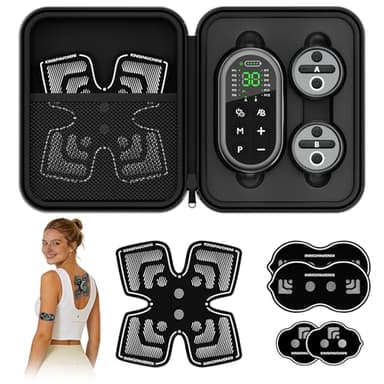
KingPavonini Wireless TENS + EMS Muscle Stimulator
TENS and EMS from two pods you stick on and wear, with no lead wires anywhere — which is the whole reason to pay this much, because it is the only version of the device you can use under a shirt and still move around in. The 48-mode count is marketing; the dual-zone independent control underneath it is not.
What it gets right
- Wireless pods rather than lead wires, so it works under clothing and while moving
- Two pods run independently — separate mode and intensity each, so a shoulder and a leg can run different settings at once
- Published 20 hours per pod on the 1040 mAh cell, charged over USB-C rather than off a disposable battery
- Ships with three pad sizes including a 4.3 in butterfly pad, which is the one that actually covers a lower back
What it does not
- Forty-eight modes is a mode count, not a specification — the same marketing this site flags on every cheap unit
- Several times the price of a wired dual-channel unit that treats a back just as well
- Two pods and a remote are three things to keep charged and not lose
- Listed only in December 2025 and rated 4.1 across 69 reviews, so there is very little ownership history behind it
Price as of October 21, 2026. #ad How we’re funded
Belifu Dual Channel TENS EMS Unit
Twenty-four modes at the lowest price in the category, and the mode count is marketing — but the hardware underneath is a competent dual-channel stimulator.
What it gets right
- Cheapest dual-channel unit here
- Rechargeable
- Pads and leads included
What it does not
- Mode count is noise, not a feature
- Thin documentation of what each mode does
Common questions
What is the difference between TENS and EMS?
TENS stimulates sensory nerves to change how pain is perceived — you feel tingling and the muscle stays still. EMS stimulates motor nerves hard enough to make the muscle visibly contract, and its legitimate use is rehabilitation where a muscle has stopped firing properly. TENS is for pain you already have; EMS is for muscle that is not activating.
Do I need TENS or EMS?
If something hurts, TENS. If a clinician has told you a specific muscle is not activating after an injury and has prescribed stimulation as part of a program, EMS. Most people arriving at this question want TENS, and most units sell both because the hardware is nearly identical and adding a mode costs the manufacturer almost nothing.
Does EMS build muscle?
Not in the way the abdominal-belt marketing implies. EMS produces a contraction, but a machine-driven contraction is not progressively overloaded, is not coordinated with anything, and does not produce the adaptations structured resistance training does. Its real use is re-establishing activation in a muscle that has stopped firing after injury or immobilization.
How many modes does a TENS unit need?
Far fewer than the box advertises. The mode count is a marketing artifact — the difference between programs is pulse characteristics a microcontroller generates for free. What matters is whether the unit clearly labels which modes are TENS and which are EMS, whether it has two independent channels, and whether you can set pulse width and rate manually once you know what helps you.
Who should not use a TENS unit?
Anyone with a pacemaker or implanted defibrillator. Do not place electrodes over the front of the neck or carotid sinus, across the chest or over the heart, over the eyes, on or near the abdomen and lower back during pregnancy, over a malignancy, over broken or infected skin, or over an area with significantly reduced sensation. Do not use while driving. Read your unit’s own manual — it governs your specific device.
How long do TENS electrode pads last?
Between roughly 10 and 30 applications depending on skin, hair and storage — and they, not the unit, are the real cost of owning a TENS device. Buy a unit that takes standard connector pads rather than a proprietary shape, and store pads on their backing sheet in a sealed bag.