Compare
Compression Boots vs TENS Unit
One is a plumbing tool for a whole heavy leg; the other is a volume knob for a specific ache. They get shelved together as recovery gadgets and they solve completely different problems, so the honest answer is almost never a straight choice between them.
By Stephen V.Published
Disclosure:Grip & Gait earns a commission when you buy through links on this page, at no extra cost to you. It never changes what we recommend or the order we rank things in — here is exactly how we’re funded.
Quick picks
Ranked on published manufacturer specs and what they mean for the job, not on testing we have not done. Tap a row for the full reasoning. How we score.
| # | Product | Best for | Score | Price |
|---|---|---|---|---|
| 1 |  FIT KING Air Compression Recovery Boots Sequential compression moves fluid up the whole leg. The tool for heavy, swollen legs after volume. | Whole-leg swelling and circulation | 7.7 | |
| 2 |  TENS 7000 Digital TENS Unit Electrical stimulation masks a specific pain. It does nothing for swelling. | Localized nerve pain | 8.0 | $38.88 · View on Amazon Price as of October 21, 2026. #ad How we’re funded |
| ✕ |  AUVON Dual Channel TENS Unit Two channels and rechargeable, cheap enough to test whether stimulation helps. Skip it only if you already know you want boots. Skip this | Cheapest way to try TENS | 7.9 | $35.99 · View on Amazon Price as of October 21, 2026. #ad How we’re funded |
These two get filed together under “recovery gadgets,” and they have almost nothing to do with each other. Compression boots move fluid. A TENS unit changes how a nerve reports pain. One is a mechanical pump for a whole heavy leg; the other is a volume knob for a specific ache. Buy the wrong one for your problem and it will not disappoint you a little — it will do nothing at all for the thing you bought it for.
So the useful question is not which is better. It is what your problem actually is: a puffy, heavy leg after a hard block of training, or a localized pain you want quieted while you get on with the day. The table answers it case by case, and the rest of the page explains why each answer falls the way it does.
| Use case | Winner | Why |
|---|---|---|
| Swollen, heavy legs after training | Boots | Sequential inflation moves fluid up the whole limb. A TENS pad on one spot does nothing for a swollen leg. |
| Localized nerve pain (e.g. sciatica) | TENS | Electrical stimulation aimed at a specific pain pathway is the whole point of TENS. Boots cannot target anything, and this is a clinician conversation first. |
| General DOMS | Neither really | Ordinary next-day soreness is not what either device is for, and the evidence that either shortens it is thin. |
| Circulation while sitting for hours | Boots | Passive, whole-leg, sequential pressure is exactly the mechanism for legs that sit still and pool. |
| Drug-free pain masking at a desk | TENS | Pads under your clothes, quiet, and no drugs. Boots need you strapped in and going nowhere. |
| Lowest cost to try | TENS | A basic dual-channel unit costs a fraction of any compression system worth owning. |
What each one actually does
Compression boots are a passive, whole-limb, mechanicalsystem. You zip a leg into a sleeve, a pump inflates a series of chambers from the ankle upward, and pressure travels up the limb like a wave rather than squeezing everywhere at once. That directional, sequential squeeze is the entire mechanism, and it is the difference between a recovery system and a leg-shaped pressure cuff. What it moves is fluid — the swelling and pooled blood that make a leg feel heavy and tight after a long day on your feet or a hard training week. It asks nothing of you but sitting still while it runs. We go deeper into the category on our compression boots guide.
A TENS unit is a local, electricaldevice. It sends a low-voltage current through pads stuck on the skin to stimulate the nerves underneath, with the aim of changing how pain is perceived — the long-standing idea being that stimulating the nerves can “close the gate” on pain signals traveling to the brain. It does not move fluid, it does not work muscle mechanically, and it is not a circulation tool. It masks a specific pain in a specific place for as long as it runs, and often for a while afterward. We cover units and settings in full on the TENS units page.
Nothing about those two descriptions overlaps. One is plumbing for a whole limb; the other is signal-jamming for one sore patch. That is why comparing them is more useful than most head-to-heads — it is really a way of working out which problem you have.
Boots are for swelling; TENS is for a pain you can point to
The clearest way to decide is to ask whether your complaint is distributed or localized. A leg that feels generally heavy, puffy and tired all over — after a long run, a day standing, or a flight — is a distributed, whole-limb problem, and moving fluid up and out is the thing that helps. That is boots. A pain you can put a finger on, or a nerve pain that radiates along a known line, is a localized problem, and a mechanism that quiets that particular signal is the thing that helps. That is TENS.
This is also why buying the wrong one is such a dead end. A TENS pad on a swollen calf does not make the swelling go anywhere; it just sits on top of it. And boots do not know where your sciatic pain is — they inflate the whole leg evenly and cannot aim at anything. Neither device is bad. They are answers to different questions, and the mistake is treating them as two brands of the same thing.
What the evidence supports, honestly
For compression boots, we are not going to overstate the case. The underlying mechanism — sequential external compression moving fluid up a limb — is well established and was used clinically long before anyone marketed it to runners. Whether that meaningfully accelerates recovery in an otherwise healthy athlete, as opposed to simply feeling good and making a heavy leg feel lighter for a while, is a much less settled question, and the published evidence we can find is thin. Rather than gesture at “studies show,” we would rather say that plainly: the mechanism is real, the recovery-acceleration claim is not something the evidence firmly supports.
For TENS, the honest position is similar. The evidence for pain relief is mixed, and the effects that do show up tend to be modest and temporary, varying a great deal between people and between conditions. That is exactly why the sensible way to buy one is a cheap unit to find out whether it helps you specifically, rather than an expensive one bought on faith.
And for the case people most often ask about — ordinary next-day soreness — neither device is really the tool. Even hands-on massage, which has been studied far more than either boots or stimulation, only modestly and temporarily eases delayed-onset soreness in a meta-analysis, and a controlled trial of percussion found immediate relief without actually speeding recovery. Boots and TENS are less studied still for this. Promising you they shorten DOMS would be borrowing certainty nobody has. If soreness is your real concern, start with our DOMS page, which is blunt about what does and does not help.
Cost and hassle, which pull in opposite directions
These two also sit at opposite ends on price and convenience, and that matters more than people expect. A basic dual-channel TENS unit is cheap enough that trying it is barely a decision, and it is small, quiet and wearable — you can run it with pads hidden under a shirt at a desk and nobody knows. Its real running cost is not the unit at all; it is replacing the adhesive pads as they wear out.
Compression boots are the opposite proposition. Even a sensibly priced system costs several times a TENS unit, the pump is not silent, and you are strapped in and going nowhere for the length of a session. That passivity is a feature when the appeal is lying still while it works, and a drawback when you want to keep moving. If cost or portability is the deciding factor, TENS wins by default — and if you want the cheapest possible way to find out whether stimulation does anything for you at all, that is the whole argument for a budget two-channel unit. When you are ready to spend on boots, our budget compression boots guide covers where the sequential mechanism starts and the marketing stops.
The one that decides more purchases than any spec
Whatever the mechanism says, the device that helps you is the one you will actually use, and these two ask very different things of you. Boots reward people who genuinely enjoy sitting still with their legs up for the length of a session; if that sounds like a chore rather than a treat, the honest odds are you use them a handful of times and then resent the storage space. TENS rewards people who will stick and re-stick the pads, learn a setting or two, and keep spare adhesives on hand. Neither is better in the abstract — but one of them is better suited to how you actually behave on a tired evening, and it is worth being honest about which before you spend.
If you can only buy one
Buy the bootsif your problem is a whole leg — heavy, swollen, tired after long efforts or long hours on your feet — and if the passive, sit-still nature is the appeal rather than a chore. Make sure the system is genuinely sequential and, ideally, that it includes the foot, because the foot is where a lot of the swelling actually sits.
Buy the TENS unitif your problem is a specific, localized pain you want quieted drug-free while you carry on with your day — and start cheap, because whether TENS helps you is genuinely individual. A basic unit tells you the answer for the price of a takeaway.
Buy neither yet if a limb tingles, goes numb, or the pain radiates in a way you cannot account for. That is a nerve and vascular conversation, not a shopping one, and no amount of either device is the answer to it. If you are not sure which bucket your problem falls in, start from our symptom pages, which route each complaint to the tool that actually fits it.
Every pick, in full
Specs below are the manufacturer’s own published figures, each linked to the page it came from. Where a maker does not publish a number, the table says so and names the page we checked — that absence is information too.
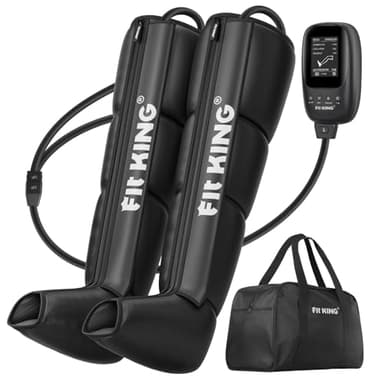
FIT KING Air Compression Recovery Boots
Sequential chamber inflation — the mechanism that actually distinguishes recovery boots from a leg-shaped pressure cuff — at a third of what the category leader charges.
What it gets right
- Genuinely sequential: chambers fire ankle-upward rather than all at once
- Sized options rather than one-size-fits-nobody
- A fraction of the premium system price
What it does not
- Louder pump than the premium units
- Bulky to store and not remotely portable
- Sizing runs specific — measure before buying
Price as of October 21, 2026. #ad How we’re funded
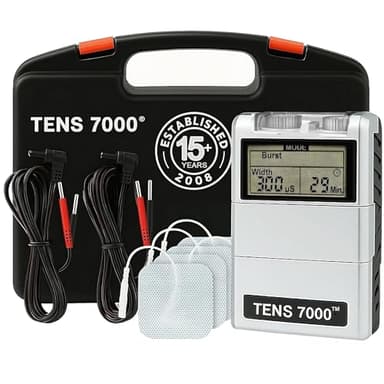
TENS 7000 Digital TENS Unit
The unit clinics hand out, with manual control over pulse width and rate rather than a menu of preset programs — which is what you want once you know what setting helps.
What it gets right
- Manual pulse-width and rate control instead of fixed presets
- The long-standing clinic default, so accessories are everywhere
What it does not
- Runs on a 9 V battery
- Manual control is only an advantage if you know what you are adjusting
Price as of October 21, 2026. #ad How we’re funded
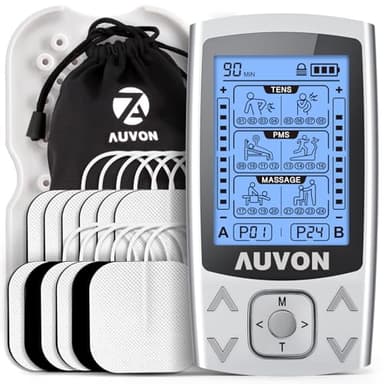
AUVON Dual Channel TENS Unit
Two independent channels so you can treat both sides of a problem at once, at a price where trying TENS costs less than one session of anything else.
What it gets right
- Two independent channels with separate intensity control
- Rechargeable rather than eating 9 V batteries
- Cheap enough to find out whether TENS does anything for you
What it does not
- Pad adhesive life is the real running cost, not the unit
- Interface is fiddly with cold hands
Common questions
Are compression boots or a TENS unit better for sore legs after running?
It depends on what “sore” means. If your legs feel heavy, swollen and tired all over, that is a whole-limb fluid problem and compression boots are the tool — sequential inflation moves fluid up and out. If it is a specific, localized ache or a nerve pain you can point to, a TENS unit aimed at that spot fits better. For ordinary next-day soreness, honestly neither is well supported, and the evidence that either shortens it is thin.
Can you use compression boots and a TENS unit together?
They address different things, so owning both is reasonable — boots for a heavy, swollen leg and TENS for a localized pain. Do not run TENS pads inside a compression sleeve at the same time, and follow each device’s own precautions, which differ a lot: TENS in particular is ruled out over a pacemaker, across the front of the neck, and in pregnancy without guidance, while compression has vascular cautions like clots and peripheral arterial disease. When in doubt, use them at different times and ask a clinician.
Do compression boots help nerve pain like sciatica?
Not really. Boots apply broad, even pressure to a whole limb and cannot target a nerve pathway, so they are the wrong mechanism for radiating nerve pain. A TENS unit is designed to modulate a specific pain signal and is the more logical of the two to try — but nerve pain that radiates, tingles or causes numbness should be assessed by a clinician before you treat it with anything. Start with our sciatica page rather than a purchase.
Sources
- 1.Massage Alleviates Delayed Onset Muscle Soreness after Strenuous Exercise: A Systematic Review and Meta-Analysis (PMC5623674) — even well-studied massage only modestly eases DOMS
- 2.Percussion massage therapy and recovery from delayed onset muscle soreness — randomized controlled trial (PMC11979224)
- 3.Therabody — Product Safety & Precautions — vascular and circulation contraindications