Recovery Tech
The Best Heating Pads for Back Pain
The cheapest genuinely useful device on this website, and the one where the spec sheet is almost entirely noise. Two things matter: how much of you it covers, and whether it turns itself off.
By Stephen V.Published Updated
Disclosure:Grip & Gait earns a commission when you buy through links on this page, at no extra cost to you. It never changes what we recommend or the order we rank things in — here is exactly how we’re funded.
Quick picks
Ranked on published manufacturer specs and what they mean for the job, not on testing we have not done. Tap a row for the full reasoning. How we score.
| # | Product | Best for | Score | Price |
|---|---|---|---|---|
| 1 |  Boileau XXXL Electric Heating Pad (17 × 33 in) 17 x 33 in covers the full lumbar span and both sides of it. Area is the spec that changes the experience. | Whole lower back at once | 8.6 | |
| 2 |  GENIANI Electric Heating Pad Moist-heat capable with auto shutoff and a washable cover. The sensible default. | Everyday use with moist heat | 8.4 | |
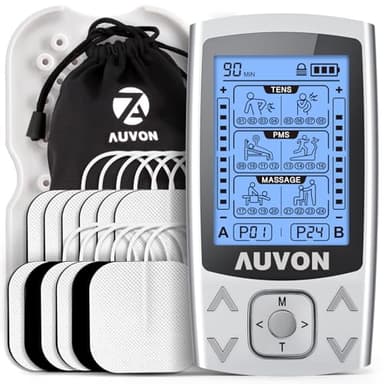
| 3 |  AUVON Dual Channel TENS Unit For pain with a nerve component rather than plain stiffness, TENS addresses something heat does not. | When heat isn't enough | 8.0 | $35.99 · View on Amazon Price as of October 21, 2026. #ad How we’re funded |
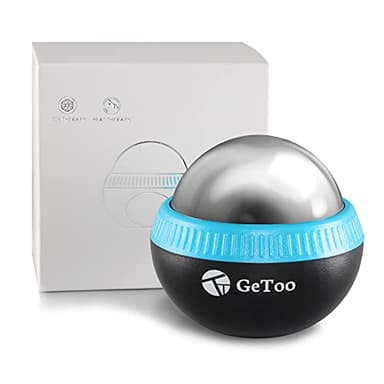
| 4 |  GeToo Cryosphere Cold Massage Roller Ball Fresh strain in the first 48 hours wants cold, not heat. Included so the page is honest about it. | When heat is the wrong idea | 7.6 | $39.99 · View on Amazon Price as of October 21, 2026. #ad How we’re funded |
The two specifications that matter
1. Coverage area
This is the whole product. A standard heating pad covers roughly a patch of one side of a lower back. An extra-large pad at around 17 × 33 inches covers the entire lumbar region and both sides of it simultaneously.
If the problem is a broad, stiff, aching back — which is what most back problems actually feel like — a small pad means moving it around and never having the whole area warm at once. Buy larger than seems necessary. It is the single decision that changes the experience.
The exception: for a specific spot — one shoulder, a neck — a large pad is unwieldy and a smaller one is better. Match the pad to the area, and most people underestimate their area.
2. Auto shutoff
Non-negotiable, and the reason is boring and important. Lying on a warm pad with a sore back is extremely conducive to falling asleep. That is not a hypothetical — it is what the product is for.
Low-temperature burns come from prolonged contact with a surface that is not hot enough to make you move. They are a documented hazard of heating pads and they do not require the pad to feel dangerously hot. Auto shutoff, typically at 30–120 minutes, removes the whole category of risk.
Anything without it is not a candidate, at any price.
Worth having, in descending order
- Moist heat option. Moist heat penetrates better than dry. Usually done by dampening a removable cover. Genuinely worth having.
- Washable removable cover. Mundane and it is the difference between a pad lasting three years and one year.
- A long enough cord. Sounds trivial until you discover the pad does not reach the sofa. Six feet minimum.
- Heat settings. Three is plenty. Six is fine. This is the number printed largest and it matters least.
- Weight. A heavier pad conforms and stays put; a light one slides off.
When heat beats every other tool on this site
- Muscle spasm or guarding. A muscle that is contracting involuntarily does not want percussion — that adds stimulus to something already over-stimulated, and the common result is that it guards harder. Heat is passive input that reduces stiffness without demanding anything of the tissue. This is the most useful distinction on the page.
- Broad, general stiffness. A pad warms everything under it at once. No targeted device covers that area in that time.
- When pressure is intolerable. Sometimes an area is too sore to be touched. Heat requires no contact pressure at all.
- Morning stiffness. Especially in arthritic joints, where heat is the oldest and still one of the better answers. See TENS for arthritis.
- Before anything else. Heat then movement then percussion then stretching is a genuinely better sequence than any of those alone — see massage gun vs heating pad.
When heat is the wrong idea
Heat versus cold, briefly
The conventional framing: cold for the first 48 hours after an acute injury, heat afterward and for chronic stiffness. It is a simplification and the evidence is less tidy than the rule suggests, but as a default it is sound and it keeps people out of the one situation that clearly goes wrong — heat on a fresh, inflamed injury.
For anything ongoing, aching and stiff, with no recent injury: heat. For anything that happened in the last two days and is swollen: cold, and a clinician if it is severe.
How to use one properly
- 15–20 minutes. Long enough to warm tissue rather than just skin. Longer is not better and increases burn risk.
- A layer of clothing between the pad and skin on the higher settings. Not a thick one — enough to prevent a hot spot.
- Move afterward. Heat opens the door; movement walks through it. Warm tissue that then sits still for two hours gains you very little.
- Check your skin after. Persistent redness in a pattern matching the pad means it was too hot or too long.
- Never sleep on it without auto shutoff, and preferably not even with it.
Why this is the best-value device on the site
A large heating pad costs a fraction of any massage gun, has no consumables, no battery, no proprietary parts, and it does something no percussion device can — it warms a broad area passively while you do nothing.
For back pain specifically, which is the most searched problem in this whole category, it is frequently the correct first purchase and it is almost never the one people make. If you are deciding between a heating pad and a massage gun for a generally sore back, we would tell you to buy the pad, and we earn less by saying so.
For a whole back rather than one spot, the other cheap passive option people weigh against a heating pad is an acupressure mat — same price bracket, no cable, and a very different mechanism. Acupressure mats sets out what it is reasonable to expect from one.
One region needs a different shape rather than a different spec. A flat rectangle is the right object for a lumbar spine and the wrong one for a pair of shoulders, which slope — it spends the session sliding off. The best heating pads for neck and shoulders ranks the pads that are cut for that job, and leads with the 2026 systematic review that found only two small trials on heat for neck pain.
A pad is also the wrong shape for some jobs. For a joint that bends rather than a flat back, see the best heating pads for knee pain, which ranks these same pads on contact rather than coverage.
A hip pushes the logic the other way. The ache usually spans the bony point on the outside, the glute behind it and the lower back above it, so area beats shape and the biggest pad here wins — the best heating pads for hip pain ranks them for that span.
Every pick, in full
Specs below are the manufacturer’s own published figures, each linked to the page it came from. Where a maker does not publish a number, the table says so and names the page we checked — that absence is information too.
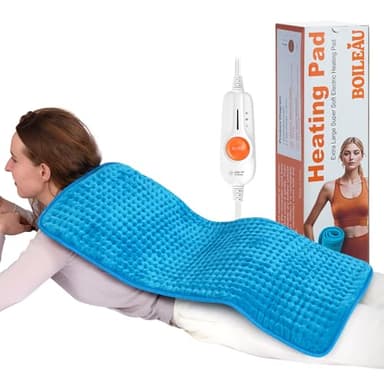
Boileau XXXL Electric Heating Pad (17 × 33 in)
Large enough to cover a whole lumbar region and both sides of it at once, which a standard pad cannot do — and area is the only heating-pad spec that changes the experience.
What it gets right
- 17 × 33 in covers the full lumbar span rather than a patch of it
- Multiple heat settings with auto shutoff
What it does not
- Bulky to store
- Takes longer to reach temperature
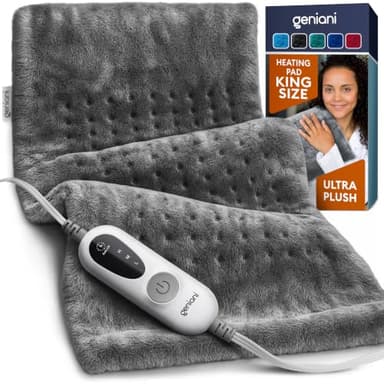
GENIANI Electric Heating Pad
Moist-heat capable with an auto-shutoff, which is the specification that decides whether a heating pad is safe to use lying down — and lying down is when you want it.
What it gets right
- Auto shutoff — the safety feature that matters if you fall asleep on it
- Moist-heat option penetrates better than dry
- Machine-washable cover
What it does not
- Corded, so your position is fixed
- Smaller than the XXL pads
Price as of October 21, 2026. #ad How we’re funded
AUVON Dual Channel TENS Unit
Two independent channels so you can treat both sides of a problem at once, at a price where trying TENS costs less than one session of anything else.
What it gets right
- Two independent channels with separate intensity control
- Rechargeable rather than eating 9 V batteries
- Cheap enough to find out whether TENS does anything for you
What it does not
- Pad adhesive life is the real running cost, not the unit
- Interface is fiddly with cold hands
Price as of October 21, 2026. #ad How we’re funded
GeToo Cryosphere Cold Massage Roller Ball
Cold and pressure in a single pass, and the stainless ball holds temperature long enough to finish a session rather than warming up in ninety seconds.
What it gets right
- Holds cold for hours rather than minutes
- Rolls freely in its housing so you are not dragging a frozen lump across skin
What it does not
- Costs several times a frozen water bottle that does most of the same job
- Needs freezer space
Common questions
What size heating pad should I buy for back pain?
Larger than seems necessary. A standard pad covers roughly a patch of one side of a lower back; a 17 × 33 in pad covers the whole lumbar region and both sides at once. Since most back problems are broad and aching rather than pinpoint, coverage area is the one decision that genuinely changes the experience.
Is it safe to sleep with a heating pad?
Not without auto shutoff, and preferably not even with it. Low-temperature burns come from prolonged contact with a surface that is not hot enough to make you move — they do not require the pad to feel dangerously hot. Lying on a warm pad with a sore back is exactly the situation where people fall asleep, which is why auto shutoff is non-negotiable.
Heat or ice for back pain?
Cold for the first 48 hours after an acute injury; heat afterward and for chronic stiffness. It is a simplification and the evidence is less tidy than the rule implies, but as a default it is sound and it keeps you out of the situation that clearly goes wrong, which is heat on a fresh inflamed injury.
How long should you use a heating pad?
Fifteen to twenty minutes — long enough to warm tissue rather than just skin. Longer is not more effective and increases burn risk. Move afterward: heat opens the door and movement walks through it, so warm tissue that then sits still for two hours gains you very little.
Is moist heat better than dry heat?
Moist heat penetrates better, and on most pads it is achieved by dampening a removable cover. It is a genuinely worthwhile feature and it costs very little. It also means the cover needs to be washable, which you want anyway.