Recovery Tech
The Best Heating Pads for Knee Pain
A knee is a small, bony, moving joint, and almost every heating pad sold is a flat rectangle designed for a lumbar spine. The pad we would buy for a knee is the cordless one, because contact and the freedom to bend the leg matter more than any number on the box. Here is the ranking, and the honest size of what heat does for a knee.
By Stephen V.Published
Disclosure:Grip & Gait earns a commission when you buy through links on this page, at no extra cost to you. It never changes what we recommend or the order we rank things in — here is exactly how we’re funded.
Quick picks
Ranked on published manufacturer specs and what they mean for the job, not on testing we have not done. Tap a row for the full reasoning. How we score.
| # | Product | Best for | Score | Price |
|---|---|---|---|---|
| 1 |  Comfytemp Cordless Heating Pad with Massager No cord, so you can bend the knee, prop the leg up or walk to the kitchen mid-session instead of sitting next to an outlet with a leg held straight. | Best overall for a knee | 8.4 | |
| 2 |  GENIANI Electric Heating Pad Small enough to sit on one knee rather than drape over the whole leg, with the moist-heat option and the auto shutoff that make it safe to use lying down. | Cheapest pad the right size | 8.1 | |
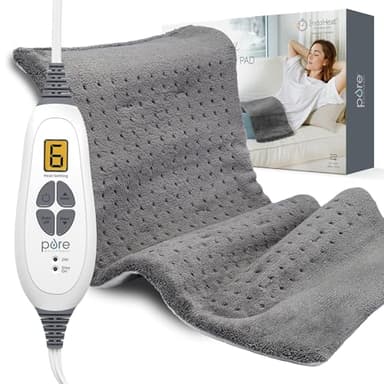
| 3 |  Pure Enrichment PureRelief XL Heating Pad (12 × 24 in) Twelve by twenty-four inches wraps the knee and keeps going up the thigh, which is what you want when the knee ache is really a tight quad pulling on the kneecap. | Knee plus the quad above it | 7.7 | $37.99 · View on Amazon Price as of October 21, 2026. #ad How we’re funded |
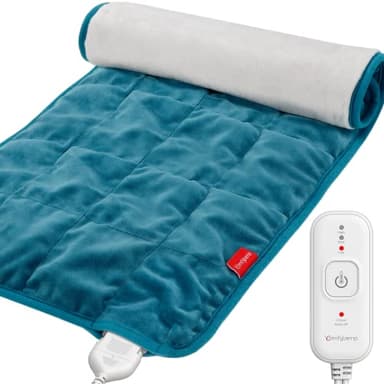
| 4 |  Comfytemp Weighted Heating Pad (12 × 24 in) The weight holds the pad against the front of a bent knee instead of tenting off it. Good on a sofa with the leg up, awkward anywhere else. | Treating it lying down | 7.4 | $29.99 · View on Amazon Price as of October 21, 2026. #ad How we’re funded |
| ✕ |  Boileau XXXL Electric Heating Pad (17 × 33 in) Seventeen by thirty-three inches is a brilliant pad for a whole lower back and far too much pad for one joint. You end up heating a thigh, a shin and a sofa cushion. Skip this | The one to skip here | 6.2 |
The short version
For most people with an aching knee, the pad to buy is the Comfytemp cordless— not because battery heat is hotter, but because a knee is the one joint you cannot sensibly treat while tethered to a wall. You want to bend it, straighten it, prop it on a cushion and get up without unplugging anything. If you want to spend as little as possible, the GENIANI is the cheapest pad here that is physically the right size for one joint. The XXXL pad is the wrong shape for this job entirely, and the honest footnote on all of it is below: on knee osteoarthritis specifically, the review evidence is kinder to ice than to heat.
Why a knee is a harder problem than a back
Heating pads are designed around the lumbar spine. That is a large, flat-ish, stationary surface you press a rectangle against while sitting still, and it is why almost every pad on the market is twelve by twenty-four inches of flat fabric with a cord coming out of one corner. A knee breaks all three assumptions. It is small, so most of a big pad is wasted heat. It is curved and bony at the front, so a flat pad bridges across the kneecap and makes contact only at the edges. And it moves — the most common reason a knee hurts at all is that it has to bend several hundred times a day, which means the useful pad is the one still touching skin after you shift position.
That is the whole ranking logic on this page. Contact and freedom of movement beat every spec on the box, and heat settings past three are a marketing feature. The one hard requirement we will not waive is auto shutoff.
How we ranked these for a knee
- Does it stay on a joint that bends? Either it is cordless and can be wrapped and moved with, or it is weighted and holds contact while you sit still, or it is small enough that it is not fighting the curve of the joint in the first place.
- Auto shutoff, no exceptions. Knee pain is an evening and overnight complaint, which means people fall asleep on these. A pad without a timer that cuts the element is not something we will rank at all.
- Right size, not maximum size. A pad that covers a knee and the thigh above it is useful. A pad that covers a knee, a shin, a thigh and the furniture is just harder to position and slower to warm up.
- Moist-heat option, where offered. Not magic, and it does make the heat feel like it is reaching deeper rather than sitting on the skin. Two of these offer it.
- Washable cover and a real cord length. Unglamorous, and the difference between a pad you keep using and a pad that lives behind the sofa.
What the evidence actually says about heat on a knee
This is the part the category does not advertise. The Cochrane review of thermotherapy for osteoarthritis pooled three randomized controlled trials covering 179 patients with knee osteoarthritis and compared heat and cold against control. The clearest result in it was not about heat at all: twenty minutes of ice massage, five days a week for three weeks, produced a clinically important 29% relative improvement in quadriceps strength, along with statistically significant but smaller gains in knee flexion range of motion (8%) and functional status (11%). Cold packs reduced knee swelling. Hot packs, in the reviewers’ own summary, had no beneficial effect on swelling compared with placebo or with cold application, and ice packs did not change pain significantly against control. The authors closed by asking for larger, better-designed trials, which tells you how thin the base is in both directions.
So why buy a heating pad for a knee at all? Because the thing heat is good at is not on that outcome list. Heat makes a stiff joint feel looser and more willing to move, which is why the separate Cochrane review of thermotherapy for rheumatoid arthritis treats it as a safe palliative adjunct rather than a disease treatment. A warm knee before a walk, before stairs, or before the strengthening work that actually moves the needle is a cheap, low-risk thing to own. A warm knee instead of that work is not.
Read the two together and the rule is simple. Stiff, achy, cold-feeling knee: heat, before you move it. Swollen, hot, recently tweaked knee: cold, and the review above is the reason. We cover both, and we would rather you bought the right one.
Which pad for which knee, in one line each
- You want one pad and you want to keep moving:the Comfytemp cordless. No outlet, so the knee can be propped on a stool, bent, or carried to the kitchen, and the vibration on top of the heat is pleasant on a stiff joint. Check the current listing for runtime per charge — that is the spec that decides whether it covers a twenty-minute session twice in an evening.
- You want the cheapest thing that works: the GENIANI. Smaller than the back pads, which is a virtue here, with moist heat and an auto shutoff. Corded, so this is the sofa-and-footstool option.
- Your knee pain is really quad and kneecap pain: the PureRelief XL. The extra length lets you wrap the joint and keep going up the thigh, which is the right coverage when the ache sits around or under the kneecap. Pair it with the rolling work on our quad page.
- You treat it lying down with the leg up: the Comfytemp weighted pad. The weight is what keeps it pressed to the front of a bent knee. The same weight is why nobody wants it draped over a knee while sitting upright at a desk.
- Skip the XXXL for this.It is the right answer for a whole lower back and a waste of pad on one joint — see our heating pad guide if a back is what you are actually treating.
Where a heating pad is the wrong purchase
If the knee pain is nerve-flavoured rather than stiff — burning, tingling, worse at rest — electrical stimulation is the better-studied option for symptom relief, and the TENS roundup for knee pain is the page for that. If what hurts is the muscle around the joint rather than the joint itself, a gun or a ball does more for less; start at knee pain and compare the classes at massage gun vs heating pad. If both legs are heavy and swollen at the end of the day rather than one knee being sore, that is a circulation problem and compression boots are the category. And if you cannot decide between the warm thing and the cold thing, ice vs heat settles it in one table.
Every pick, in full
Specs below are the manufacturer’s own published figures, each linked to the page it came from. Where a maker does not publish a number, the table says so and names the page we checked — that absence is information too.
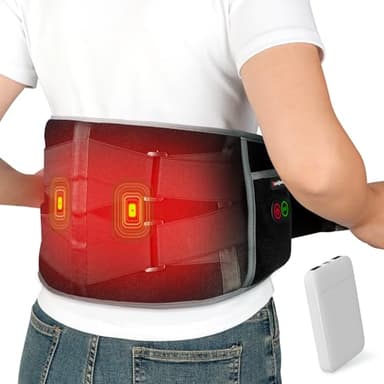
Comfytemp Cordless Heating Pad with Massager
Battery heat plus vibration, aimed at people who want to walk around while treating a back — which is the one thing a sore lower back is usually least interested in doing.
What it gets right
- No cord, so it works in a car, at a desk away from a socket, or standing at a counter
- Adds vibration on top of heat, which some people prefer to heat alone
- Listed as FSA and HSA eligible
What it does not
- Runtime per charge is the limiting factor for a 20-30 minute session; check the current listing figure before buying for that
- Costs more than a corded pad of the same size
- A lower back is usually treated sitting or lying down, which is where a cord is not a problem
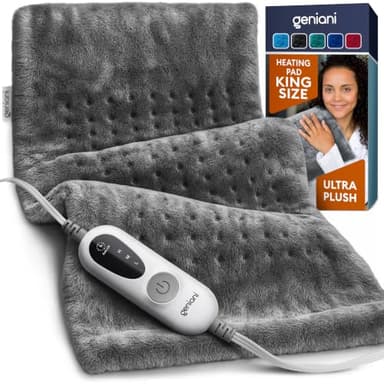
GENIANI Electric Heating Pad
Moist-heat capable with an auto-shutoff, which is the specification that decides whether a heating pad is safe to use lying down — and lying down is when you want it.
What it gets right
- Auto shutoff — the safety feature that matters if you fall asleep on it
- Moist-heat option penetrates better than dry
- Machine-washable cover
What it does not
- Corded, so your position is fixed
- Smaller than the XXL pads
Price as of October 21, 2026. #ad How we’re funded
Pure Enrichment PureRelief XL Heating Pad (12 × 24 in)
The default answer in this category: standard 12 × 24 in footprint, multiple heat settings, auto shutoff, and a washable cover — nothing clever, everything you actually need for a back.
What it gets right
- 12 × 24 in is the size that spans a lower back rather than treating a patch of it
- Auto shutoff, which is the one feature that matters if you fall asleep on it
- Machine-washable microplush cover
What it does not
- Corded, so you are treating your back wherever the outlet is
- No weight to it, so it lifts away from the curve of your back when you sit upright
Price as of October 21, 2026. #ad How we’re funded
Comfytemp Weighted Heating Pad (12 × 24 in)
The weight is the whole point and it is not a gimmick: a weighted pad stays in contact with the curve of a lower back when you are sitting, which is exactly where an unweighted pad lifts off.
What it gets right
- Weighted, so it holds contact against a lumbar curve instead of tenting away from it
- Listed as FSA and HSA eligible, which changes the real price for a lot of buyers
- Auto shutoff and a washable cover
What it does not
- The weight is the reason to buy it and the reason some people dislike it on a sore back
- Heavier to hold in place anywhere other than a back
- Corded
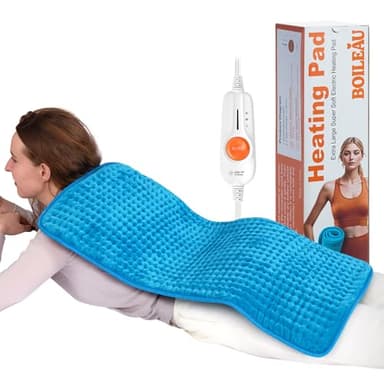
Boileau XXXL Electric Heating Pad (17 × 33 in)
Large enough to cover a whole lumbar region and both sides of it at once, which a standard pad cannot do — and area is the only heating-pad spec that changes the experience.
What it gets right
- 17 × 33 in covers the full lumbar span rather than a patch of it
- Multiple heat settings with auto shutoff
What it does not
- Bulky to store
- Takes longer to reach temperature
Common questions
Is heat or ice better for knee pain?
It depends which knee problem you have, and for knee osteoarthritis the trial evidence leans toward cold. The Cochrane review of thermotherapy for osteoarthritis found that twenty minutes of ice massage five days a week for three weeks gave a clinically important 29% relative gain in quadriceps strength plus smaller gains in flexion and function, and that cold packs reduced swelling, while hot packs had no beneficial effect on swelling against placebo or cold. Heat is still the right choice for a stiff, cold-feeling knee you are about to move; cold is the right choice for a hot, swollen, recently aggravated one.
How long should you put a heating pad on your knee?
Fifteen to twenty minutes at a comfortably warm setting, with fabric between the pad and bare skin, and no more than a few sessions a day. Longer is not better: the skin habituates, so people turn the heat up, and that is how low-temperature burns happen. Never fall asleep on it, even with auto shutoff.
Can you use a heating pad on a knee replacement?
Ask the surgeon who did it first. The hardware changes how heat moves through the joint and a surgical scar can have altered sensation, which is exactly the situation where a burn happens without being felt. Plenty of people are told it is fine once healing is complete, but that is a decision for the person holding your notes, not a product page.
Does a bigger heating pad work better on a knee?
No. Area helps on a lower back, where there is a lot of flat surface to cover. On a knee the limiting factor is contact: a pad that bridges across the kneecap heats the air under it. A smaller pad that sits on the joint, or a cordless one you can wrap, beats a bigger pad every time.
Sources
- 1.Thermotherapy for treatment of osteoarthritis - Cochrane Database of Systematic Reviews 2003 (PMC6669258) — 3 RCTs, 179 knee OA patients; ice massage 29% relative strength gain; hot packs no benefit on swelling
- 2.Thermotherapy for treating rheumatoid arthritis - Cochrane Database of Systematic Reviews (PubMed 11406046) — the companion Cochrane review treating heat as a safe palliative adjunct
- 3.Transcutaneous electrostimulation for osteoarthritis of the knee - Cochrane Database of Systematic Reviews (PubMed 19821296) — the Cochrane position on the other home electrical option for the same joint
- 4.camelcamelcamel — GENIANI heating pad price history — price history for the budget pick