Rollers & Balls
Foam Roller vs Massage Stick
The whole difference is where the force comes from. A foam roller uses your body weight and your position to control it; a massage stick uses your arms. That single distinction decides which one suits your calves, your control, and whether getting down on the floor is even an option.
By Stephen V.Published Updated
Disclosure:Grip & Gait earns a commission when you buy through links on this page, at no extra cost to you. It never changes what we recommend or the order we rank things in — here is exactly how we’re funded.
Quick picks
Ranked on published manufacturer specs and what they mean for the job, not on testing we have not done. Tap a row for the full reasoning. How we score.
| # | Product | Best for | Score | Price |
|---|---|---|---|---|
| 1 |  TriggerPoint GRID Foam Roller (13 in) Body weight through a multi-density surface covers a quad in three passes. The default for legs and back. | Broad muscle, most people | 8.5 | |
| 2 |  THERABAND Roller Massager+ You set the pressure with your arms and can treat a calf sitting in a chair. The answer when floor work is the barrier. | Control and getting off the floor | 8.0 | $35.50 · View on Amazon Price as of October 21, 2026. #ad How we’re funded |
| 3 |  Tiger Tail 18 in Massage Stick A smooth one-piece sleeve that will not pinch skin or hair, which matters more on a hairy calf than it sounds. | Calves without pinching | 7.9 | $39.95 · View on Amazon Price as of October 21, 2026. #ad How we’re funded |
The one difference that decides everything
A foam rolleris loaded by your body weight, and you regulate the pressure by your position — how much of your weight you put over it, whether you stack the other leg on top. It is powerful, cheap and broad, and it also requires you to get down onto the floor and arrange yourself over it.
A massage stick is loaded by your arms. You hold it in two hands and press it into the muscle, which means you set the pressure directly and can back off instantly. You can use it sitting in a chair, fully clothed, without getting on the ground. The trade is that your arms cannot generate the pressure your body weight can, so a stick is gentler by nature.
Which wins, by use case
| Use case | Winner | Why |
|---|---|---|
| Quads, hamstrings, back | Foam roller | Broad muscles that want body-weight pressure over a large area. |
| Calves, seated | Massage stick | You can treat them in a chair and control depth precisely with your arms. |
| Getting on the floor is hard | Massage stick | The entire point of a stick: no floor, no getting down and up. |
| Deepest possible pressure | Foam roller | Body weight beats arms every time for raw force. |
| Precise, controllable intensity | Massage stick | Instant, fine control by how hard you push. |
| Thoracic mobility work | Foam roller | A stick cannot do extension over a fulcrum; a roller can. |
| Travel | Massage stick | Packs flatter and needs no floor space to use. |
| Absolute lowest cost | Foam roller | A plain cylinder is the cheapest way to do the mechanical job. |
What both of them do, and do not
Mechanically they are the same intervention — sustained pressure rolled along a muscle — applied two different ways. The evidence base is the rolling evidence: a comparison of foam rolling and percussive massage found rolling accelerated the recovery of muscle properties disrupted by soreness, while finding that it did not reduce pain significantly more than resting, and a warm-up study looked at its effect on performance. Both tools improve short-term mobility and feel good; neither is a proven shortcut through soreness. Choose on ergonomics and access, because the evidence does not separate them.
If you can only buy one
Buy the roller if floor work is not a problem for you: it is cheaper, it hits harder, it covers the biggest muscles in your body, and it does mobility work a stick cannot. Add a massage ball for the spots it misses and you have covered nearly everything.
Buy the stick if getting onto the floor is the real barrier, if you want to treat calves seated at a desk, or if precise, gentle, controllable pressure is what you are after. Those are genuine cases the roller does not serve. And if you are deciding between rolling and a powered device altogether, start from massage gun vs foam roller.
If this page has convinced you the stick is your tool, the next question is which one, and it comes down to a single design detail: segmented beads roll nicely and can catch skin and leg hair, while a smooth one-piece sleeve cannot pinch at all. The best massage sticks ranks them on that, on working length, and on how much pressure your arms can actually apply.
Every pick, in full
Specs below are the manufacturer’s own published figures, each linked to the page it came from. Where a maker does not publish a number, the table says so and names the page we checked — that absence is information too.
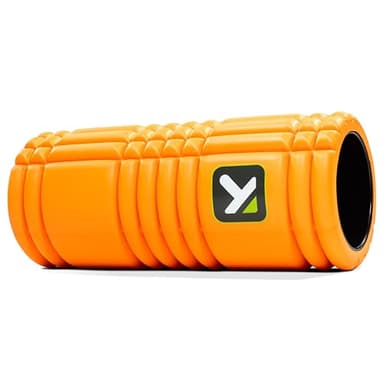
TriggerPoint GRID Foam Roller (13 in)
The multi-density surface is the reason to buy this over a plain foam cylinder: the raised sections concentrate pressure in strips instead of spreading it flat, which is what makes it usable on an IT band without needing to hold your breath.
What it gets right
- Hollow rigid core does not compress into a soft log the way plain EVA foam does after a year
- Multi-density surface gives you three pressure intensities on one roller
- 13 in length fits in a gym bag; the 26 in version does not
What it does not
- Costs roughly three times a plain high-density cylinder that also works
- The hollow core makes it noisier on a hard floor
Price as of October 21, 2026. #ad How we’re funded
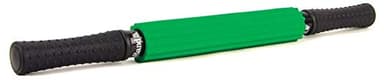
THERABAND Roller Massager+
A handheld stick lets you control the pressure with your arms instead of your body weight, which is the whole argument for it — you can treat a calf sitting in a chair, and you can back off instantly.
What it gets right
- You set the pressure with your arms, so you can stop the instant it is too much
- Usable on a calf without getting on the floor — a genuine accessibility point
- Nothing to charge
What it does not
- Cannot generate the pressure body weight on a ball produces
- Awkward on your own back
Price as of October 21, 2026. #ad How we’re funded
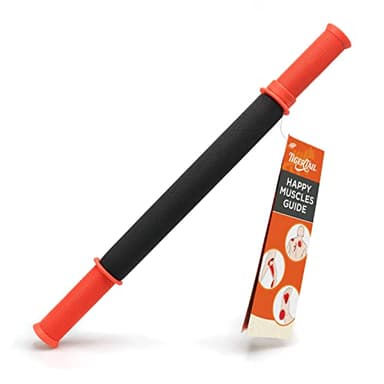
Tiger Tail 18 in Massage Stick
A single smooth sleeve rather than segmented beads, which means it will not pinch skin or hair — a small design decision that turns out to matter a lot on hairy calves.
What it gets right
- Smooth one-piece sleeve does not pinch
- Rigid enough to apply real pressure
What it does not
- Costs more than segmented sticks
- No texture variation
Common questions
Is a foam roller or a massage stick better for calves?
Both work; the stick is often the more practical choice. A roller gives deeper body-weight pressure, but a stick lets you treat calves sitting in a chair with fine control over intensity and no need to get on the floor. If you want maximum pressure and do not mind the floor, roll; if control and convenience matter more, use the stick. A smooth one-piece stick also avoids pinching hair on the calf.
Does a massage stick work as well as a foam roller?
For the same muscles, it applies the same kind of pressure with less force, controlled by your arms instead of your body weight. That makes it gentler and more precise but less deep. It cannot do thoracic mobility work over a fulcrum the way a roller can. For broad, deep work the roller is better; for controlled, seated, accessible work the stick is better.
Which is better for someone who can't get down on the floor?
The massage stick, clearly. Its entire advantage is that you use it seated or standing, fully clothed, without getting down and back up. For older users or anyone with a knee or hip that makes floor work difficult, that is the deciding factor, and the stick is the tool that will actually be used.