Compare
Massage Gun vs Cupping
These are mechanically opposite. Percussion drives force into tissue; cupping applies negative pressure and lifts it away from what is underneath. That difference is the entire comparison, and it is more interesting than either marketing claim.
By Stephen V.Published
Disclosure:Grip & Gait earns a commission when you buy through links on this page, at no extra cost to you. It never changes what we recommend or the order we rank things in — here is exactly how we’re funded.
Quick picks
Ranked on published manufacturer specs and what they mean for the job, not on testing we have not done. Tap a row for the full reasoning. How we score.
| # | Product | Best for | Score | Price |
|---|---|---|---|---|
| 1 |  Bob and Brad C2 Massage Gun Published amplitude, stall force, speed and noise. The best-documented device in the comparison. | The percussion side | 8.6 | |
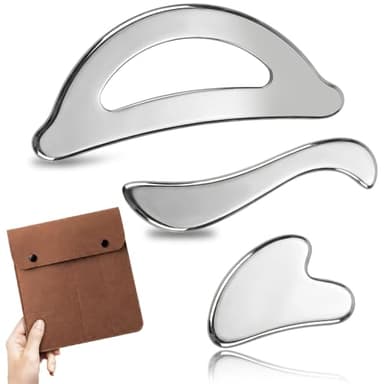
| 2 |  Rena Chris Gua Sha & Muscle Scraper Tool Scraping rather than cupping, but the closest well-made tool in the same tradition - and we are honest about the evidence. | The manual-therapy side | 7.5 | $14.99 · View on Amazon Price as of October 21, 2026. #ad How we’re funded |
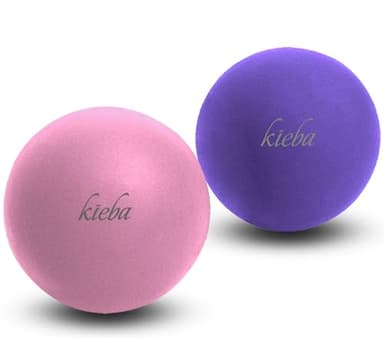
| 3 |  Kieba Massage Lacrosse Balls If the goal is deep local pressure on a specific spot, this does it better than either and costs almost nothing. | What most people actually want | 8.8 | $7.99 · View on Amazon Price as of October 21, 2026. #ad How we’re funded |
The mechanical difference, which is the whole thing
Percussion is compressive. A head strikes into tissue repeatedly, driving force inward. Everything about how a massage gun works follows from that: amplitude is how far in it goes, stall force is how hard you can push it, and the contraindications are all about tissue that should not be compressed.
Cupping is decompressive. A cup creates negative pressure that lifts skin and superficial tissue upward, away from the structures beneath. It is the mechanical opposite. The characteristic circular marks are drawn-up blood in the superficial tissue — which is exactly what negative pressure would be expected to produce.
Because they act in opposite directions, they are not interchangeable and cannot be compared on a single scale of “how deep does it go.”
| Use case | Winner | Why |
|---|---|---|
| A deep, specific muscle knot | Massage gun | Compressive force into a small area is the mechanism. Cupping lifts rather than presses. |
| Broad superficial tightness | Cupping | Superficial tissue is the layer cupping actually acts on. |
| Large muscle groups, quickly | Massage gun | Faster coverage, no setup, no marks. |
| Reaching your own back | Massage gun | Cupping on your own upper back is close to impossible alone. |
| You bruise easily | Massage gun, gently | Cupping produces visible marks by design. On a blood thinner it is worse. |
| You dislike percussion | Cupping | A completely different sensation, and some people tolerate one and not the other. |
| Something bony | Neither | No cup seals over a shin and no gun belongs on one. |
| You want checkable specifications | Massage gun | At least one brand publishes amplitude, stall force, PPM and dB. Cupping sets publish nothing comparable. |
| Nerve pain or numbness | Neither | See a clinician before applying either. |
About the marks
The circular discoloration cupping leaves is frequently presented as evidence — of toxins released, of stagnation cleared, of how much you needed it. It is worth being direct: the marks are what negative pressure does to superficial blood vessels. Their presence tells you suction was applied and how strongly. It does not tell you anything about what was in the tissue beforehand or how much benefit was obtained.
That is not an argument against cupping. It is an argument against reading the marks as a result. A treatment can be worth doing without its most visible side effect being its proof.
What the evidence actually supports
For percussion, the picture is documented and modest. A systematic review of percussive therapy supports improvements in acute and explosive muscle strength. A study on percussive therapy and hamstring range of motion found significant reductions in tissue stiffness. On soreness, a randomized controlled trial found temporary relief without accelerated recovery until 72 hours.
For cupping, we are not going to summarize a literature we have not read properly for this page, and we are not going to imply we have. What we can say honestly: the research base is smaller and more heterogeneous than the percussion literature, blinding a cupping trial is genuinely difficult because the intervention leaves visible marks, and that difficulty is a real methodological problem rather than a rhetorical point.
Where evidence is thin, saying so is more useful than borrowing certainty. That principle is set out in how we research and it applies here in both directions — including to the tools we earn a commission on.
A note on scraping tools, since people arrive here looking for them
Gua sha and muscle-scraping tools sit in the same manual-therapy family as cupping and get searched alongside it. They apply shearing pressure along tissue rather than negative pressure into it, which is a third distinct mechanism. The evidence base is similarly thin and we say so on the scrapers and gua sha page. They are cheap, they are widely used by practitioners, and they can bruise you badly if you are heavy handed.
Which should you buy?
If you want one tool that does the most jobs: the massage gun. It is documented, it is versatile, it requires no partner, it leaves no marks, and at least one brand publishes every spec that matters.
If percussion specifically does not agree with you: cupping is a genuinely different sensation and some people tolerate it far better. That is a legitimate reason to try it, and it is a better reason than any claim about toxins.
If what you actually want is deep pressure on one specific spot: neither. Buy a massage ball, which generates more pressure per square inch than either and costs under ten dollars — see massage gun vs massage ball.
Every pick, in full
Specs below are the manufacturer’s own published figures, each linked to the page it came from. Where a maker does not publish a number, the table says so and names the page we checked — that absence is information too.
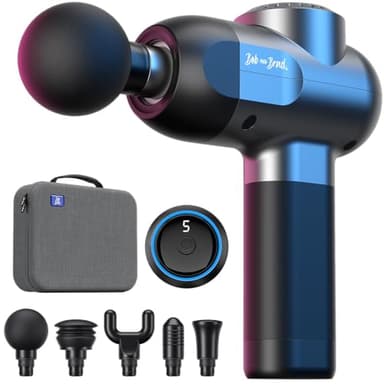
Bob and Brad C2 Massage Gun
The only gun in this roundup whose maker publishes all four numbers that decide whether it reaches the muscle — amplitude, stall force, speed range and noise — and the stall-force figure is higher than the premium units that hide theirs.
What it gets right
- Publishes amplitude, stall force, speed range and noise — the two market leaders publish none of the first three
- Published stall force of over 44 lb is higher than the figure Therabody publishes for the Prime
- 1.5 lb is light enough to hold overhead against your own shoulder without your arm giving out first
- FSA/HSA eligible, which quietly makes it cheaper again for a lot of buyers
What it does not
- 10 mm amplitude is genuinely shorter than a 16 mm premium stroke — that difference is real for glutes and thick back muscle
- No app, no pressure-feedback screen, no ecosystem
- Five fixed speeds rather than a continuous range
Price as of October 21, 2026. #ad How we’re funded
Rena Chris Gua Sha & Muscle Scraper Tool
Stainless rather than the jade sold for facial use — the edge profile is the whole product, and a stone tool will not hold one against a plantar fascia.
What it gets right
- Stainless holds a consistent edge profile; stone chips
- Multiple edge radii for different structures
- Wipes clean
What it does not
- Very easy to bruise yourself with — this needs emollient and a light hand
- The evidence base for scraping is thin and we say so on the page
Price as of October 21, 2026. #ad How we’re funded
Kieba Massage Lacrosse Balls
The highest work-per-dollar tool on this entire site. A hard rubber sphere concentrates all your body weight into one square inch, which is more pressure than any handheld gun can generate.
What it gets right
- Concentrates body weight into a single point — more local pressure than any percussion device
- Nothing to charge, nothing to break, fits in a coat pocket
- Reaches under the shoulder blade against a wall, which a roller physically cannot
What it does not
- Unforgiving — very easy to overdo on a first session
- Wrong tool for broad surfaces like quads or lats
Common questions
Is cupping or a massage gun better?
They are mechanically opposite, so neither is better in general. Percussion drives force into tissue and suits deep, specific targets. Cupping applies negative pressure and lifts superficial tissue away from what is beneath it. If you want one versatile documented tool, the gun. If percussion specifically does not agree with you, cupping is a genuinely different sensation.
Do the cupping marks mean it is working?
The marks are drawn-up blood in superficial tissue, which is what negative pressure does to small vessels. They tell you suction was applied and how strongly. They do not tell you what was in the tissue beforehand or how much benefit was obtained. A treatment can be worth doing without its most visible side effect being its proof.
Can you use a massage gun and cupping together?
Not on the same area in the same session. Cupping already produces visible bruising by design, and adding percussive micro-trauma on top of freshly marked tissue is asking for a much worse result than either alone. If you use both, give an area several days between them.
Is cupping safe if I take blood thinners?
It is a recognized caution. Cupping produces visible bruising by design and anticoagulant medication makes that more pronounced and slower to clear. Percussion has the same problem for the same reason — Therabody explicitly names blood-thinning medication in its published precautions — so one is not a safe alternative to the other. Ask the clinician who prescribed the medication.
Sources
- 1.The Effect of Percussive Therapy on Musculoskeletal Performance and Experiences of Pain: A Systematic Literature Review (PubMed 37020441)
- 2.Acute Effects of Theragun Percussive Therapy on Viscoelastic Tissue Dynamics and Hamstring Range of Motion (PMC10499144)
- 3.Percussion massage therapy and recovery from delayed onset muscle soreness — randomized controlled trial (PMC11979224)
- 4.Therabody — Product Safety & Precautions