Rollers & Balls
The Best Foam Roller for Beginners
The good news for a first-time buyer is that the cheapest dense cylinder here does the same mechanical work as the branded rollers costing several times more. Firmness is the one specification that matters, and this is how to spend the least to get it.
By Stephen V.Published Updated
Disclosure:Grip & Gait earns a commission when you buy through links on this page, at no extra cost to you. It never changes what we recommend or the order we rank things in — here is exactly how we’re funded.
Quick picks
Ranked on published manufacturer specs and what they mean for the job, not on testing we have not done. Tap a row for the full reasoning. How we score.
| # | Product | Best for | Score | Price |
|---|---|---|---|---|
| 1 |  Amazon Basics High-Density Foam Roller (18 in) A plain dense cylinder does the mechanical work, and an 18-inch length lies along your spine. | First roller, lowest cost | 8.4 | $15.29 · View on Amazon Price as of October 21, 2026. #ad How we’re funded |
| 2 |  321 STRONG Foam Roller A multi-density surface at close to plain-cylinder money if flat feels too blunt. | Textured, on a budget | 8.0 | $25.99 · View on Amazon Price as of October 21, 2026. #ad How we’re funded |
| 3 |  TriggerPoint GRID Foam Roller (13 in) A rigid core that will not soften into a log, with a surface that concentrates pressure in strips. | The one to grow into | 8.3 | |
| 4 |  Kieba Massage Lacrosse Balls A cheap ball reaches the deep glute and under the shoulder blade that a cylinder rolls past. | For the spots a roller skims | 8.7 | $7.99 · View on Amazon Price as of October 21, 2026. #ad How we’re funded |
| ✕ |  Hyperice Vyper 3 Vibrating Foam Roller Vibration is a nice-to-have, not a starting point, at many times the price of a cylinder that does the work. Skip this | The one to skip as a beginner | 6.6 |
What a first foam roller actually has to do
A foam roller is a dense cylinder you lie on so that your own body weight presses into a muscle while you move slowly across it. That is the whole mechanism, and it is worth stating plainly, because the marketing around this category works hard to convince you otherwise. A first roller has one job: stay rigid under your weight and not collapse. Everything beyond that — a textured surface, a branded core, vibration, a companion app — is a refinement of how the work feels, not the reason the work happens.
So the first decision is not which roller to buy. It is accepting that the cheapest dense cylinder here does the mechanical part, and the pricier rollers change the experience rather than the outcome. For a beginner, that single reframing saves a surprising amount of money and an even larger amount of second-guessing. You are not buying performance you can measure; you are buying a comfortable enough way to put your body weight through a muscle.
The one specification that matters: firmness
Density is the property to buy for, and it is the one nobody puts on the box. A roller has to be firm enough that it does not visibly compress under you. The instant a roller squashes flat, your body weight is going into deforming foam instead of pressing on tissue, and you are lying on an expensive pillow. A dense cylinder stays a cylinder; a soft one turns your weight into give and quietly does nothing.
For a complete beginner this cuts both ways. A very firm, rigid-core roller delivers more honest pressure, but it can be too much on a first session — a tender calf or the outer thigh does not need maximum intensity on day one. A plain high-density cylinder is firm without being punishing, which is exactly why it is the sensible place to start for most people. If flat pressure later turns out to feel too blunt, a textured surface concentrates the same load into raised strips with gaps between them, and that is the honest reason to step up, rather than the badge on the end cap.
Firmness also decides how long the thing lasts. Solid foam softens slowly across years of use and stops working as well without ever obviously failing, while a rigid hollow core keeps its shape more or less indefinitely. For a first purchase this is a minor factor, but it is the real argument for a branded roller, and we would rather name it than pretend the premium buys nothing at all.
How we ranked these
Criteria first, in the order that matters for someone buying their first roller:
- Firmness that holds. A roller that stays rigid under load is doing the job; one that compresses is decoration. This is weighted above everything else.
- Forgiveness on day one. A first roller should let a beginner build tolerance, not scare them off in the first ninety seconds. Aggressive knobs are a reason to wait, not to start.
- Length. A cylinder long enough to lie along the spine unlocks gentle mid-back extension, which a short travel roller cannot do. It is an underrated spec for a first buy.
- Price against what it adds. Every step up in this category has to justify itself in something a beginner will actually feel. Most of the time, it does not.
How much to spend on your first roller
Very little, and here the honest recommendation runs downward. The plain dense cylinder is not the compromise option you settle for; it is the correct first purchase, and the reviews that push a beginner straight to a premium roller are quietly optimizing for something other than your wallet. Buy the cheap cylinder, spend the difference on a ball, and only move up if and when you discover you roll often enough that texture or a longer-lived core would genuinely change your week.
The one step up that can make sense on day one is the textured budget roller that sits close to plain-cylinder money. It gives you the raised-strip surface without the branded price, and if you already suspect that flat pressure will feel too vague, it is a reasonable place to begin. What almost never makes sense first is the most expensive roller on the page, and we say which one below.
The cheap ball belongs in the same basket
The best upgrade to a first roller is not a better roller. It is a hard rubber ball, and it costs almost nothing. A cylinder is broad by design, which is what makes it pleasant on a quad and useless on a deep glute, the muscle under the shoulder blade, or a specific knot buried inside a calf. The roller rolls straight past all of them. A ball drops your entire body weight into a coin-sized patch, which is more concentrated pressure than any handheld percussion device can produce, because a motor is not competing with gravity.
Together, a plain cylinder for broad muscle and a two-pack of balls for the spots it skims cover more ground than any single roller, and the pair still costs less than one branded textured roller. That is the actual beginner kit. The full breakdown of which shape suits which muscle is in foam roller vs massage ball, and if you are weighing individual balls, the best massage balls goes deeper.
The one caution is that a ball is far easier to overdo than a roller. Its whole advantage — concentrated pressure — is also its trap, and the most common first experience is spending far too long on one spot and deciding you hate massage balls. Keep the sessions short and the ball becomes the most valuable thing in the basket.
Technique, kept deliberately light
You do not need a routine to start; you need three habits. Roll slowly, at roughly an inch per second, rather than the fast scrubbing you see in gyms — the sustained, slow pressure is the point, and speed just skims the surface. When you find a tender spot, pause and hold on it rather than grinding back and forth, and let it ease before moving on. And control the load with your body: you regulate intensity by how much of your weight you put through the roller, so stack your other leg on top to add pressure and take it off to reduce it.
The mistake underneath all the other mistakes is believing more pressure is better. It is not. A useful level is a good hurt you can breathe through, not something you grit your teeth against, and if you are bruising you have overspent your tolerance for no extra benefit. The full technique, muscle by muscle, is on how to foam roll.
The shortlist, and the honest catch with each
Five tools, ranked for a beginner. Each earns its place, and each has a real drawback worth naming before you buy.
- The plain dense cylinder.The correct default. It does the actual work — sustained pressure across a broad contact area — with nothing to break and a length that lies along the spine. The catch is that a flat surface spreads pressure rather than concentrating it, so it can feel vague on a stubborn band like the outer thigh, and the solid foam softens over years of heavy use.
- The textured budget roller.A triple-density surface at close to plain-cylinder money, which is the sensible middle if flat feels too blunt. The catch is that its knobs are more aggressive than the branded roller’s, and some people simply cannot tolerate that on a sensitive band on day one.
- The branded textured roller.The one to grow into: a rigid hollow core that will not compress into a soft log after a year, and a surface that concentrates pressure in strips. The catch is the price — several times a plain cylinder that also works — and a hollow core is noisier on a hard floor.
- The two-pack of hard balls. The highest-value thing here, reaching the deep glute and the muscle under the shoulder blade that a cylinder rolls straight past. The catch is that it is unforgiving; a ball is very easy to overdo in a first session, and it is the wrong tool for broad surfaces like the quads.
- The vibrating roller. Genuinely reduces the discomfort of rolling, which means some people who would quit instead keep going. The catch is decisive for a beginner: it costs many times a foam cylinder that does the mechanical part, and it is a device with a battery to charge rather than a lump of foam that is always ready. That is why it is our skip.
What rolling does, and what it does not
It helps to start with honest expectations, because the disappointment people feel with foam rolling is usually a disappointment with a promise nobody should have made. Rolling reliably improves short-term range of motion, it feels good, and it is a legitimate part of a warm-up. A study on foam roller or massage gun use during a warm-up examined exactly that use in trained athletes. What rolling does not reliably do is shorten how long you stay sore. A direct comparison of foam rolling and percussive massage found that both helped recover the muscle properties disrupted by delayed onset soreness, while finding that neither reduced pain significantly more than simply resting did.
So the reason to buy a first roller is mobility and the plain fact that it feels good enough that you will actually do it — not a belief that it erases soreness. A cheap cylinder delivers everything the evidence actually supports, which is the whole argument for starting at the bottom of the price range.
That argument extends to firmness. A randomized trial that put soft, medium and hard density rollers head to head found no statistically significant difference between them on knee range of motion or pressure pain threshold, which makes density a comfort decision rather than a therapeutic one — the reasoning is in foam roller density, explained.
One shape sits outside this list. If the only thing you want to roll is a stiff mid-back, a back wheel does that one job better than any cylinder here, and nothing else nearly as well — foam roller vs Chirp Wheel is the comparison, and it still recommends buying the cylinder first.
Which first roller, in one line each
- The default first buy: the plain high-density cylinder. It does the mechanical work, it is long enough to lie along your spine, and it costs the least.
- Textured, without the branded price: the budget triple-density roller, if you already suspect flat pressure will feel too blunt.
- The one to grow into: the branded roller with a rigid hollow core that will not soften into a log, worth it once you roll often.
- For the spots a roller skims: a two-pack of hard balls, the cheapest and highest-value thing in the basket.
- The one to skip as a beginner: the vibrating roller. Vibration is a nice-to-have layered on top of a cylinder that already does the work, at many times the price.
If it turns out vibration is the feature you actually want, the honest version of that decision is in vibrating foam rollers. And if you are still deciding between a roller and a percussion gun in the first place, start with massage gun vs foam roller— for a beginner on a budget, the cylinder usually wins.
Every pick, in full
Specs below are the manufacturer’s own published figures, each linked to the page it came from. Where a maker does not publish a number, the table says so and names the page we checked — that absence is information too.
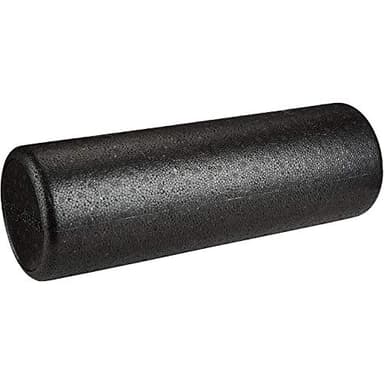
Price as of October 21, 2026. #ad How we’re funded
Amazon Basics High-Density Foam Roller (18 in)
A dense foam cylinder does the same mechanical job as a textured roller for a fraction of the money, and for a first roller that is the correct purchase.
What it gets right
- Does the actual mechanical work — sustained pressure across a broad contact area
- Nothing to break; no core, no seams, no electronics
- 18 in is long enough to lie along your spine, which the 13 in rollers are not
What it does not
- Flat surface spreads pressure rather than concentrating it
- Solid EVA softens over a few years of heavy use
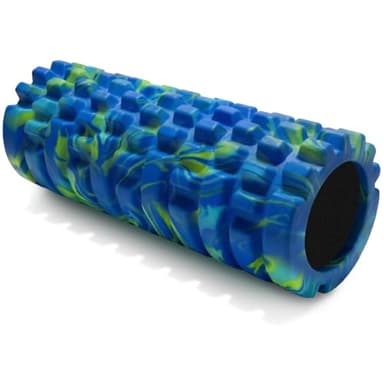
Price as of October 21, 2026. #ad How we’re funded
321 STRONG Foam Roller
Textured like the premium rollers at close to plain-cylinder money — the sensible middle purchase if the flat cylinder feels too blunt and the branded one feels too dear.
What it gets right
- Triple-density surface at roughly a third of the branded price
- Rigid core holds shape
What it does not
- Knobs are more aggressive than the GRID's, which some people cannot tolerate on the IT band
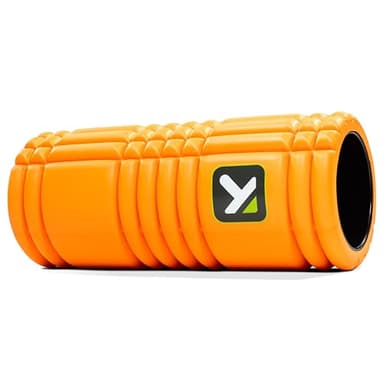
TriggerPoint GRID Foam Roller (13 in)
The multi-density surface is the reason to buy this over a plain foam cylinder: the raised sections concentrate pressure in strips instead of spreading it flat, which is what makes it usable on an IT band without needing to hold your breath.
What it gets right
- Hollow rigid core does not compress into a soft log the way plain EVA foam does after a year
- Multi-density surface gives you three pressure intensities on one roller
- 13 in length fits in a gym bag; the 26 in version does not
What it does not
- Costs roughly three times a plain high-density cylinder that also works
- The hollow core makes it noisier on a hard floor
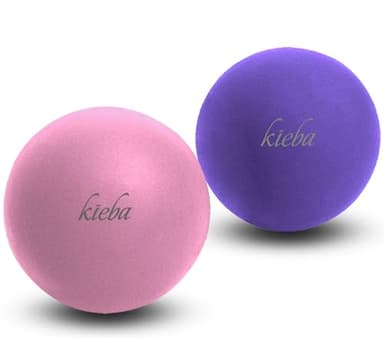
Price as of October 21, 2026. #ad How we’re funded
Kieba Massage Lacrosse Balls
The highest work-per-dollar tool on this entire site. A hard rubber sphere concentrates all your body weight into one square inch, which is more pressure than any handheld gun can generate.
What it gets right
- Concentrates body weight into a single point — more local pressure than any percussion device
- Nothing to charge, nothing to break, fits in a coat pocket
- Reaches under the shoulder blade against a wall, which a roller physically cannot
What it does not
- Unforgiving — very easy to overdo on a first session
- Wrong tool for broad surfaces like quads or lats
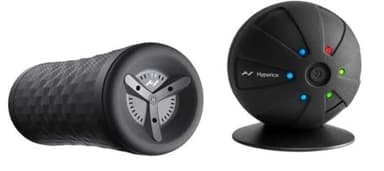
Hyperice Vyper 3 Vibrating Foam Roller
Three speeds of vibration on a 34 W motor, and the honest question is whether vibration adds enough over a $13 cylinder to justify twenty times the price — for most people it does not.
What it gets right
- Published motor, weight, dimensions and battery — more transparency than Hyperice gives its guns
- Vibration genuinely reduces the discomfort of rolling, which means people actually do it
What it does not
- Twenty times the price of a foam cylinder that does the mechanical part
- 2.7 lb and a 2-hour battery — it is a device, not a lump of foam
Common questions
What is the best foam roller for a beginner?
A plain high-density foam cylinder. It does the same mechanical work as a branded roller — sustained pressure across a broad area — for a fraction of the price, it is firm without being punishing on a first session, and a full-length cylinder is long enough to lie along your spine for gentle mid-back work. Spend the money you save on a cheap pair of balls, which reach the deep spots a cylinder rolls straight past.
How firm should a beginner's foam roller be?
Firm enough that it does not visibly compress under your weight, but not the most aggressive option in the range. If a roller squashes flat, your body weight is going into deforming foam rather than into muscle, so softness is the real failure. A plain high-density cylinder is the sweet spot for a first buy: firm enough to work, forgiving enough to build tolerance on. Save the very hard, heavily textured rollers for once you know you can handle them.
Do I need a textured foam roller or a plain one?
Not to start. A plain cylinder and a textured roller do the same mechanical job; the texture concentrates pressure into raised strips instead of spreading it flat, which some people find lets them pick out a stubborn band like the outer thigh. That is a genuine reason to upgrade later, not a reason a beginner needs it on day one. Buy plain first, and step up to texture only if flat pressure starts to feel too blunt for you.