Guides
Recovery Tools for Climbers
A climber's problems are concentrated in the one part of the body no roller, ball or massage gun addresses: the fingers. That makes this a different shopping list from every other sport on this site. Here is what belongs in it, what the gun is actually for, and why the cheapest item on the page is the one that matters most.
By Stephen V.Published
Disclosure:Grip & Gait earns a commission when you buy through links on this page, at no extra cost to you. It never changes what we recommend or the order we rank things in — here is exactly how we’re funded.
The part of you that breaks is the part no tool reaches
A critical review of the incidence and risk factors for finger injuries in rock climbing is the paper to read before buying anything for this sport. Fingers are where climbing concentrates its injuries, and the structures involved — the flexor tendon pulleys, the small joints, the collateral ligaments — are millimeters across and sit directly over bone, under skin, with no muscle belly on top of them at all.
There is no muscle there to percuss. There is nothing a roller can press against. A massage gun on a finger joint is a vibrating object on a bone, and a gun on an inflamed pulley is the kind of thing that turns three weeks off into three months off. That is not caution for its own sake: the tissue simply is not the kind of tissue any device on this site acts on.
So the honest version of “best massage gun for climbers” is: a gun is a forearm tool and a back tool for a climber, nothing more, and it is the third thing you should buy rather than the first.
What climbing actually does to you
Flexors get enormously strong; extensors do not.Everything in climbing is a pull and a grip. The muscles on the palm side of the forearm are trained constantly and the ones on the back of the forearm are trained never. That imbalance is the mechanism behind most climber elbow pain and a lot of forearm stiffness, and no amount of massage changes a strength imbalance — only loading the weak side does.
Fingers take load no other sport applies. Crimping loads the pulleys that hold the flexor tendons against the bone. This is a load-management problem: volume, hold type and progression. A tool cannot fix a training plan.
Shoulders, lats and thoracic spine do the pulling. This is the part of a climber that behaves like a normal athlete, and the part where a roller, a ball and a gun all genuinely help.
Grip strength is worth caring about beyond climbing. Worth knowing that the PURE study found grip strength to be a prognostic marker in a large prospective cohort, and a network meta-analysis on resistance training dose has looked at what actually improves handgrip strength. Climbers are unlikely to be short of grip strength; it is the balancing work they are short of.
What to look for, in the order it matters
Something that loads finger extension. The cheapest and most neglected item. The muscles that open the hand are the antagonists to everything climbing trains, and simple extension bands or pinch clips load them with no equipment and no gym. Three sets, a few times a week, is the whole intervention.
A resistance bar for the elbow.Climber elbow — medial or lateral — is a tendon load-tolerance problem. The treatment with the best support in tendinopathy generally is slow, heavy, graded loading, and a flexible resistance bar is how that is done at home for a forearm. Start with the light resistance, not the stiff one; the common error is beginning at a resistance that provokes the tendon.
Putty, for the hand as a whole.Graded resistance putty lets you load flexion, extension, pinch and individual digits at a resistance you can actually control, which is useful both for rehab and for warming the hands up before touching a hold. Hand-exercise programs of this general kind have been tested in a clinical population — the SARAH randomized controlled trial is the reference point — which is more than can be said for most climbing finger gadgets.
A light gun, for forearms and lats only. Weight is the spec that matters, because you will use it one-handed on your own forearm. Published amplitude and stall force are the next two, and almost nobody publishes them.
The antagonist work
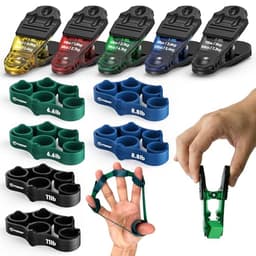
FitBeast Finger Exerciser Set (extension bands and pinch clips)
Extension bands and pinch clips load the muscles that open the hand - the ones climbing never trains. Cheapest item here and the one with the clearest rationale.
Climber elbow
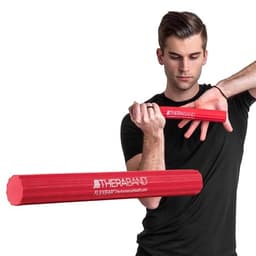
TheraBand FlexBar, Red (light resistance)
Slow, controlled twists load the forearm tendons rather than massaging them, which is what a tendinopathy responds to. Begin with the light resistance - most people start too stiff and flare it.
Price as of October 5, 2026. #ad How we’re funded
Hands, warm-up and rehab
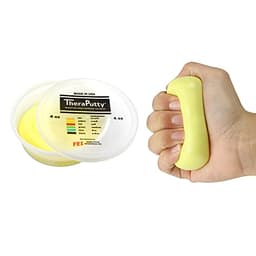
CanDo Theraputty Plus, X-Soft (4 oz)
Graded putty loads flexion, extension and pinch at a resistance you choose, and it is the one thing here you can use on a single stiff finger joint. Extra-soft is the right starting grade.
Price as of October 5, 2026. #ad How we’re funded
Forearms and lats, never fingers
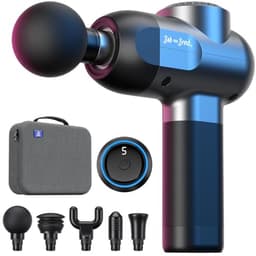
Bob and Brad C2 Massage Gun
At 1.5 lb it is light enough to run along your own forearm one-handed, and it publishes 10 mm of stroke and over 44 lb of stall force. Keep it on muscle and off every joint.
The routine
Before climbing. Warm the hands and forearms before the first hard move, not after it: putty or easy pulling, progressively, for ten minutes. Then easy climbing. Nothing percussive on the fingers at any point, and no long static stretching of a forearm you are about to load hard.
After climbing.Gun or ball on the forearm flexors and the lats for a minute or two each, roller on the thoracic spine. Rolling has reasonable support for range of motion and for post-exercise soreness — a meta-analysis on range of motion and a meta-analysis on soreness prevention are the two to know — and no support for anything structural. Use it for feel and range.
On rest days. Extension bands and the elbow bar, three times a week. This is the part that changes your injury rate, and it is the part everyone skips because it is boring and it does not feel like climbing.
“Deep vein thrombosis, osteomyelitis; bone fracture or myositis ossificans; bleeding disorders; peripheral vascular insufficiency or disease; medications that thin the blood or alter sensations; pacemaker, ICD.”
Where to go next
Hand and grip strength is the companion page and goes deeper on the tools for the hand itself. For the elbow, golfer’s elbow covers the inside and tennis elbowthe outside — climbers get both and the loading principle is the same. For the forearm and wrist, wrist and forearm pain has the boundaries. The pulling half of your body is covered by upper back pain and neck and shoulder pain. If you want the gun roundup rather than the kit, the best budget massage guns is the right bracket for a tool you will use on forearms, and the lifters roundup is the closest adjacent sport for the back and shoulder work.
Common questions
What is the best massage gun for climbers?
A light one, used only on the forearm muscles and the back — the Bob and Brad C2 at 1.5 lb is our pick, because weight is what lets you run it along your own forearm one-handed and it publishes the amplitude and stall force figures most brands leave off. But a gun is the third purchase for a climber, not the first. Finger extension bands and a resistance bar for the elbow do more for your injury rate and cost a fraction as much.
Can you use a massage gun on your fingers?
No. The structures climbing injures — flexor tendon pulleys, small joints, collateral ligaments — are millimeters across and sit directly over bone with no muscle on top of them. There is nothing there for percussion to act on, and a gun on an inflamed pulley risks turning a short layoff into a long one. Treat fingers with graded loading and, when something has actually been injured, with a clinician.
What should climbers do for antagonist training?
Load the muscles that open the hand and extend the wrist, because climbing trains only the flexors. Simple extension bands or pinch clips for the fingers, and controlled wrist extension against a flexible resistance bar, three times a week on rest days. It takes ten minutes, costs very little, and it is the single most commonly skipped part of a climber’s program.
When should a climber see someone about a finger?
Straight away for a pop or crack during a crimp, swelling around a joint, the tendon bowstringing away from the bone, pain at rest, lost range of motion, or numbness. Pulley injuries are graded and the grade decides the management, so the early assessment is the one that matters. Do not percuss it, do not stretch it hard, and do not test it on the wall to find out how bad it is.
Sources
- 1.A Critical Review of the Incidence and Risk Factors for Finger Injuries in Rock Climbing - Current Sports Medicine Reports (PubMed 27841811) — incidence and risk factors for finger injuries in rock climbing
- 2.Exercises to improve function of the rheumatoid hand (SARAH): a randomised controlled trial - The Lancet (PubMed 25308290) — randomized trial of a graded hand-exercise program in a clinical population
- 3.Prognostic value of grip strength: findings from the Prospective Urban Rural Epidemiology (PURE) study - The Lancet (PubMed 25982160) — grip strength as a prognostic marker in a large prospective cohort
- 4.Optimal dose of resistance training to improve handgrip strength in older adults with sarcopenia: a systematic review and Bayesian model-based network meta-analysis - Frontiers in Physiology (PMC12263917) — resistance training dose for improving handgrip strength
- 5.Foam Rolling Training Effects on Range of Motion: A Systematic Review and Meta-Analysis - Sports Medicine 2022 (PMC9474417) — foam rolling training effects on range of motion
- 6.Preventive effect of foam rolling on muscle soreness after exercise: a systematic review and meta-analysis - Journal of Bodywork and Movement Therapies 2024 (PubMed 39593540) — preventive effect of rolling on post-exercise soreness
- 7.Therabody — Product Safety & Precautions — contraindications, quoted above