Massage Guns
The Best Massage Guns for Travel
A travel massage gun is judged on one thing above all others: whether it is small enough that you actually bring it. Everything else — stroke length, speed count, attachments — is secondary to a device that fits the bag you were going to carry anyway.
By Stephen V.Published
Disclosure:Grip & Gait earns a commission when you buy through links on this page, at no extra cost to you. It never changes what we recommend or the order we rank things in — here is exactly how we’re funded.
Quick picks
Ranked on published manufacturer specs and what they mean for the job, not on testing we have not done. Tap a row for the full reasoning. How we score.
| # | Product | Best for | Score | Price |
|---|---|---|---|---|
| 1 |  Bob and Brad Q2 Mini Massage Gun Genuinely pocketable, FSA eligible, and from the one brand in this category whose full-size gun publishes complete specs. | Best value mini | 8.4 | |
| 2 |  Therabody Theragun Mini (3rd Gen) Small enough to throw in a bag and built to survive it. Priced like a full-size premium gun, and no published amplitude. | Premium pocket gun | 7.9 | $219.99 · View on Amazon Price as of October 21, 2026. #ad How we’re funded |
| 3 |  Bob and Brad C2 Massage Gun At 1.5 lb it travels fine in checked luggage and reaches what a mini cannot. Fully specified, which the minis are not. | If you check a bag | 8.5 | |
| 4 |  TOLOCO Massage Gun (EM26) Compact enough and cheap enough that losing it on a trip is not a financial event. Loud, and no published depth specs. | Cheapest travel option | 6.8 | |
| ✕ |  Therabody Theragun Pro A superb clinic device and completely the wrong thing to pack. Heavy, bulky, and built for a use case that has nothing to do with a carry-on. Skip this | The one that is not a travel gun | 5.8 |
What makes a gun a travel gun
Size and weight, then everything else. A mini gun earns its place by disappearing into the bag you already carry — a backpack, a gym holdall, a large coat pocket. The moment it needs its own case or a decision about whether to bring it, it stops being a travel gun and becomes a thing you leave at home. That is the single criterion that outranks all the others here.
The honest trade is physics: a short body cannot deliver a long stroke. A mini gun gives up amplitude to fit in a pocket, which means it is a superb tool for calves, forearms and shoulders and a poor one for deep glute or thick lower-back work. If your target muscle is a glute, a mini is the wrong tool and no amount of packing convenience changes that — see the deep-tissue roundup for what actually reaches thick muscle.
How we ranked these
- Actual portability. Weight and pocketability first. A gun you carry beats a better gun you leave behind.
- Battery you can trust on the road. A travel gun that needs charging every day is a liability in a hotel with one outlet. Simpler is better here.
- Reach for what you will actually treat traveling.On a trip you are realistically working a stiff neck, tight calves and a sore shoulder — exactly what a mini is good at.
- Cost against risk of loss. Travel gear gets lost. A cheaper unit you would not mourn is a legitimate consideration, not a compromise.
Mini or full-size for a trip?
If you carry only a backpack, buy the mini. If you check a bag anyway, a light full-size gun like the 1.5 lb C2 is the better tool: it fits fine in checked luggage, reaches your own mid-back in a way a short-handled mini cannot, and it is fully specified. The mini wins strictly on the carry-on and pocket case. Decide on your luggage, not on the spec sheet.
There is a middle size too. Hyperice’s small handheld is heavier than a true pocket mini but lighter than any full-size gun, and it is one of the few units at that size whose maker states a speed range and a decibel figure — we set it against the full-size Hypervolts in Hypervolt vs Hypervolt Go.
Whichever you pick, the effect you are buying is short-term. A systematic review of percussive therapy supports immediate improvements in range of motion and acute strength, and a controlled trial found percussion gives temporary relief in perceived soreness each time it is applied. That is a good match for travel — loosening a stiff neck after a long flight is precisely the short-term, feel-better-now job these devices do best.
When to leave the gun at home entirely
For a lot of travel problems, a gun is not even the lightest answer. A single lacrosse ball weighs nothing, costs a few dollars, needs no charging, and out-pressures any mini for a tight glute or a knot under the shoulder blade against a hotel wall. For a stiff back on a trip, it is hard to beat. We make the full case in foam roller vs massage ball and in the starter recovery kit— and for many travelers a ball plus a mini gun covers essentially everything.
Every pick, in full
Specs below are the manufacturer’s own published figures, each linked to the page it came from. Where a maker does not publish a number, the table says so and names the page we checked — that absence is information too.
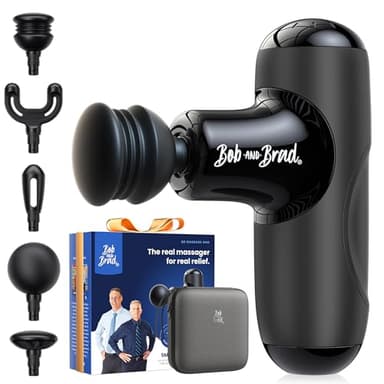
Bob and Brad Q2 Mini Massage Gun
Pocket-sized from the one brand in this category with a habit of publishing its numbers — the honest travel option at a third of what the premium minis cost.
What it gets right
- Genuinely pocketable
- From a brand whose full-size model publishes complete specs
- FSA/HSA eligible
What it does not
- A short body cannot deliver a long stroke — physics, not a flaw
- Not the tool for glutes or thick back muscle
Price as of October 21, 2026. #ad How we’re funded
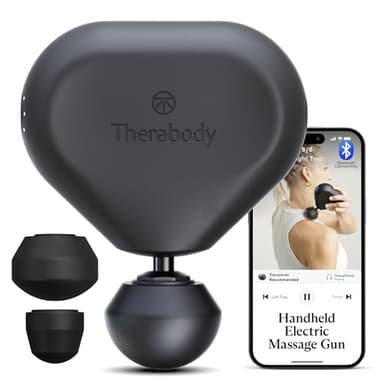
Therabody Theragun Mini (3rd Gen)
A genuinely pocketable gun that survives being thrown in a bag — the trade is that a short body has to give up stroke somewhere, and Therabody does not say where.
What it gets right
- Small enough to actually carry, which is the only spec that matters for a travel gun
- Simple three-speed operation
What it does not
- No published amplitude or stall force
- Priced like a full-size premium gun
- Short handle means you cannot reach your own mid-back with it
| Amplitude | Not published page we checked |
|---|---|
| Stall force | Not published page we checked |
| Speed range | 1,750–2,400 PPM source |
| Speed settings | 3 source |
| Weight | 0.9 lb source |
| Noise | Not published page we checked |
| Battery | 2.5 h source |
| Attachments | 3 source |
| Warranty | 1-year limited source |
| Dimensions | 116 × 135 × 96 mm source |
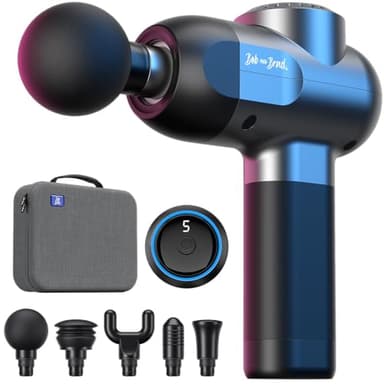
Bob and Brad C2 Massage Gun
The only gun in this roundup whose maker publishes all four numbers that decide whether it reaches the muscle — amplitude, stall force, speed range and noise — and the stall-force figure is higher than the premium units that hide theirs.
What it gets right
- Publishes amplitude, stall force, speed range and noise — the two market leaders publish none of the first three
- Published stall force of over 44 lb is higher than the figure Therabody publishes for the Prime
- 1.5 lb is light enough to hold overhead against your own shoulder without your arm giving out first
- FSA/HSA eligible, which quietly makes it cheaper again for a lot of buyers
What it does not
- 10 mm amplitude is genuinely shorter than a 16 mm premium stroke — that difference is real for glutes and thick back muscle
- No app, no pressure-feedback screen, no ecosystem
- Five fixed speeds rather than a continuous range
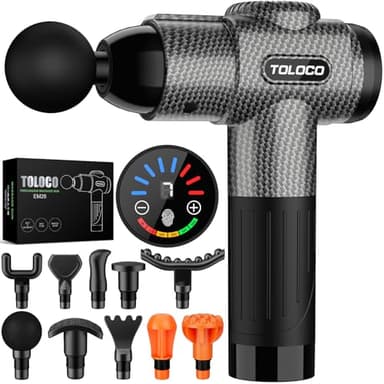
TOLOCO Massage Gun (EM26)
The cheapest gun worth owning, and the ten-attachment box is not the selling point the listing thinks it is — but if the alternative is not buying one at all, this is a real tool.
What it gets right
- Cheap enough that it is not a decision
- Ten attachments, of which you will use two
- Light enough for self-application
What it does not
- No published amplitude or stall force from the manufacturer
- Build quality is what the price implies — treat it as a two-year tool
- Loud relative to premium units
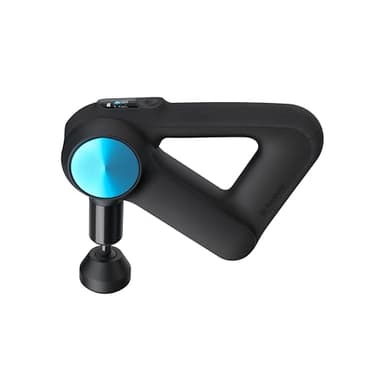
Therabody Theragun Pro
Built for a practitioner who runs it for hours a day across many bodies. For one person's own calves and shoulders it is the most expensive way to do a job a $70 gun does — which is why it is our skip.
What it gets right
- Rotating arm genuinely helps reach your own back
- Built for continuous professional use in a way the consumer models are not
What it does not
- The price gap over a fully-specified budget gun buys durability you will not consume at home
- Heavy in the hand for self-treatment
- Same unpublished-amplitude problem as the rest of the range
Common questions
Are mini massage guns worth it?
For travel and for calves, forearms and shoulders, yes. A mini gun’s whole value is that you actually carry it, and for superficial and mid-size muscles it does the job. The trade is real: a short body cannot deliver a long stroke, so a mini is a poor choice for deep glute or thick lower-back work. Buy one as a portable second gun, not as your only gun if thick muscle is the target.
Can you take a massage gun on a plane?
Generally yes, in carry-on. Massage guns contain lithium batteries, which airlines usually require in the cabin rather than checked luggage, and the exact rules vary by carrier and battery size. Check your airline’s lithium-battery policy before flying — this is an airline rule rather than anything specific to massage devices.
Mini massage gun or full-size for travel?
If you carry only a backpack, a mini. If you check a bag anyway, a light full-size gun is the better tool — it reaches your own mid-back, which a short-handled mini cannot, and it is usually better specified. Decide on the luggage you are already bringing rather than on the spec sheet.
Sources
- 1.The Effect of Percussive Therapy on Musculoskeletal Performance and Experiences of Pain: A Systematic Literature Review (PubMed 37020441)
- 2.Percussion massage therapy and recovery from delayed onset muscle soreness — randomized controlled trial (PMC11979224)
- 3.Bob and Brad — C2 massage gun product page — 1.5 lb weight, full specs