Recovery Tech
The Best TENS Unit for Knee Pain
A knee is the joint people most often buy a TENS unit for and the one the evidence is least sure about. Here is where the pads actually go, what the Cochrane review found, which unit suits a joint that bends every time you stand up, and the one to skip.
By Stephen V.Published
Disclosure:Grip & Gait earns a commission when you buy through links on this page, at no extra cost to you. It never changes what we recommend or the order we rank things in — here is exactly how we’re funded.
Quick picks
Ranked on published manufacturer specs and what they mean for the job, not on testing we have not done. Tap a row for the full reasoning. How we score.
| # | Product | Best for | Score | Price |
|---|---|---|---|---|
| 1 |  AUVON Dual Channel TENS Unit Two independent channels bracket one knee or run both at once, rechargeable, and cheap enough to find out whether TENS helps you. | First unit, both knees | 8.2 | |
| 2 |  KingPavonini Wireless TENS + EMS Muscle Stimulator Wireless pods with no lead wires to snag on a bending knee. The one version you can wear under trousers and keep moving. | Walking around with it on | 7.9 | |
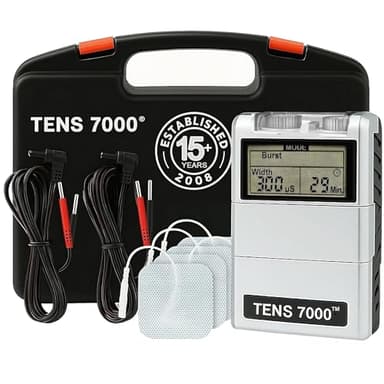
| 3 |  TENS 7000 Digital TENS Unit Pulse width and rate you set yourself, once you know what works. The unit clinics hand out, so pads are everywhere. | Manual control, clinic default | 7.8 | $38.88 · View on Amazon Price as of September 17, 2026. #ad How we’re funded |
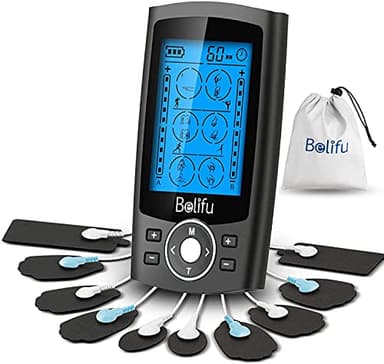
| ✕ |  Belifu Dual Channel TENS EMS Unit Competent hardware at the lowest price. The 24-mode count is marketing; the two channels underneath are what you are buying. Skip this | Cheapest dual channel | 7.0 | $32.99 · View on Amazon Price as of September 17, 2026. #ad How we’re funded |
The short version
A TENS unit does one narrow thing: it changes how much pain you feel while the current is running. It does nothing to cartilage, nothing to a meniscus, and nothing to whatever is making the knee hurt. For some people that in-the-moment relief is worth a great deal — it is the difference between a walk and no walk — and for others it does nothing at all, and the only way to find out which you are is to try one. That argues for a cheap dual-channel unit, pads placed properly, and honest expectations, which is what this page is.
What the evidence actually says about TENS and knees
Most pages on this topic quote “studies show” and move on. The most rigorous review we know of is the Cochrane review of transcutaneous electrostimulation for knee osteoarthritis, which pooled eighteen small trials in 813 patients. Its conclusion is worth quoting rather than summarizing: the authors “could not confirm that transcutaneous electrostimulation is effective for pain relief,” called the review “inconclusive, hampered by the inclusion of only small trials of questionable quality,” and asked for properly powered trials. The predicted difference in pain scores between stimulation and control, in trials the size of the largest one, was 0.2 cm on a 10 cm scale. It also found no excess of dropouts from adverse events, which is the honest half of the picture: TENS is safe, and the evidence that it works on an arthritic knee is weak.
That is for osteoarthritis specifically, and it is the knee pain most people over fifty are searching about. For the other common knee complaints — patellofemoral pain, a sore knee after running, a stiff knee after surgery — we have not found trial evidence we are prepared to summarize, and we would rather say that than pretend. What is consistently reported by users, and what the mechanism supports, is that TENS can take the edge off an aching knee for the duration of a session and a while after. We think that is real, we think it is modest, and we think a unit at this price is a reasonable way to find out whether you are someone it helps. We would not buy a premium one to find out.
Where the pads go on a knee
Pad placement matters more on a knee than on a back, because the joint is small, bony, and surrounded by places you should not put a pad. The rules:
- Bracket the pain; never sit a pad on the kneecap. The kneecap is bone with skin over it. Current needs muscle and soft tissue to travel through. A pad on the patella does nothing useful and feels unpleasant.
- The standard four-pad pattern.With a dual-channel unit, put one channel’s two pads above and below the knee on the inside — on the muscle a few finger-widths above the joint line and on the soft tissue below it — and the other channel’s pair the same way on the outside. The current from each channel runs vertically past the joint, and the two channels together surround it.
- The two-pad pattern for one side. If the pain is clearly on the inside of the knee, as it often is with arthritis, one channel with a pad above and a pad below the sore spot on that side is enough. Save the second channel for the other knee.
- Keep the back of the knee clear. The hollow behind the knee carries the main nerve and vessels to the lower leg close to the surface. Do not place pads there.
- Pads at least an inch apart, on clean dry skin. Shave or trim if you have to; a pad on hair does not conduct and does not stick.
Start at the lowest intensity and raise it until you feel a strong but comfortable tingling, not a muscle twitch. Twenty to thirty minutes per session is the usual dose; the general method, and what the settings mean, is in how to use a TENS unit.
How we ranked these for a knee
- Two channels. A knee needs to be bracketed on both sides, or you have two knees. One channel is not enough for either. Every unit here is dual channel; single-channel units were excluded.
- How it copes with a joint that bends. This is the knee-specific problem. Lead wires running from a belt-clipped unit to pads above and below a knee snag every time you stand, and a pad that lifts on the edge as the knee flexes stops conducting. A wireless pod sitting on the thigh muscle above the joint solves both, which is the one case on this site where the wireless premium buys something real.
- Control once you know what works. Presets are fine to start. If you find a setting that helps, being able to set pulse width and rate directly and reproduce it every time is worth having, and it is what the clinic default unit offers.
- Running cost. The unit is not the cost; the pads are, and knee pads wear faster than back pads because the skin moves under them. Buy a unit whose pads are cheap and everywhere.
What a knee usually wants alongside TENS
TENS manages the feeling of pain. The things that change an aching knee over months are unglamorous and not for sale here: strengthening the quad and the hip, losing weight if that applies, and keeping the joint moving rather than resting it. For an arthritic knee, heat before activity and cold after a flare are the two cheap tools that most people find useful, and both are covered in ice vs heat. If the knee pain is really coming from the muscles around it — a tight quad pulling on the kneecap, an irritated IT band on the outside — a massage gun or a roller on those muscles does more than any current across the joint, and the knee pain page routes each pattern to the tool that fits it. TENS is one tool in that kit, and it is the one to reach for when the knee simply hurts and you want to get through the afternoon.
Which unit for a knee, in one line each
- Finding out whether TENS helps you at all: the AUVON. Two channels for one bracketed knee or two knees, rechargeable, and cheap enough that a no is not expensive. Its head-to-head with the clinic unit is in TENS 7000 vs AUVON.
- You want to walk, cook and work with it running: the KingPavonini wireless pods. No wires to snag on a bending knee, and each pod runs its own setting, so two knees can have different intensities. It costs several times the wired units and is only worth it if the wires are the reason you would not use one.
- You know your settings and want them exactly: the TENS 7000. Manual pulse width and rate, and the pads that fit it are sold everywhere because clinics have used it for years. Runs on a 9 V battery, which is either a reassurance or an annoyance.
The Belifu is the skip, and only narrowly: the hardware is a competent dual-channel unit at the lowest price on the page. What we would not do is choose it for its 24 modes, which is the marketing this site flags on every cheap unit, and for a knee the AUVON’s rechargeable cell and separate intensity control per channel are worth the small difference. If your knee pain is part of a wider arthritis picture, TENS for arthritis goes deeper on the evidence, and if it is your back rather than your knee that is the problem, the best TENS units for back pain ranks the same units for a different job.
Every pick, in full
Specs below are the manufacturer’s own published figures, each linked to the page it came from. Where a maker does not publish a number, the table says so and names the page we checked — that absence is information too.
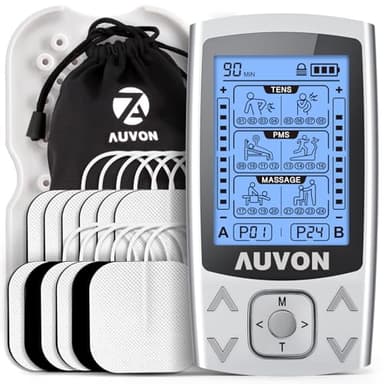
AUVON Dual Channel TENS Unit
Two independent channels so you can treat both sides of a problem at once, at a price where trying TENS costs less than one session of anything else.
What it gets right
- Two independent channels with separate intensity control
- Rechargeable rather than eating 9 V batteries
- Cheap enough to find out whether TENS does anything for you
What it does not
- Pad adhesive life is the real running cost, not the unit
- Interface is fiddly with cold hands
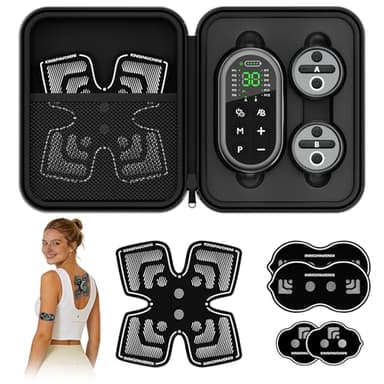
KingPavonini Wireless TENS + EMS Muscle Stimulator
TENS and EMS from two pods you stick on and wear, with no lead wires anywhere — which is the whole reason to pay this much, because it is the only version of the device you can use under a shirt and still move around in. The 48-mode count is marketing; the dual-zone independent control underneath it is not.
What it gets right
- Wireless pods rather than lead wires, so it works under clothing and while moving
- Two pods run independently — separate mode and intensity each, so a shoulder and a leg can run different settings at once
- Published 20 hours per pod on the 1040 mAh cell, charged over USB-C rather than off a disposable battery
- Ships with three pad sizes including a 4.3 in butterfly pad, which is the one that actually covers a lower back
What it does not
- Forty-eight modes is a mode count, not a specification — the same marketing this site flags on every cheap unit
- Several times the price of a wired dual-channel unit that treats a back just as well
- Two pods and a remote are three things to keep charged and not lose
- Listed only in December 2025 and rated 4.1 across 69 reviews, so there is very little ownership history behind it
Price as of September 17, 2026. #ad How we’re funded
TENS 7000 Digital TENS Unit
The unit clinics hand out, with manual control over pulse width and rate rather than a menu of preset programs — which is what you want once you know what setting helps.
What it gets right
- Manual pulse-width and rate control instead of fixed presets
- The long-standing clinic default, so accessories are everywhere
What it does not
- Runs on a 9 V battery
- Manual control is only an advantage if you know what you are adjusting
Price as of September 17, 2026. #ad How we’re funded
Belifu Dual Channel TENS EMS Unit
Twenty-four modes at the lowest price in the category, and the mode count is marketing — but the hardware underneath is a competent dual-channel stimulator.
What it gets right
- Cheapest dual-channel unit here
- Rechargeable
- Pads and leads included
What it does not
- Mode count is noise, not a feature
- Thin documentation of what each mode does
Common questions
Does a TENS unit help knee pain?
It can reduce how much an aching knee hurts while it is running and for a while after, and it does nothing to the cause. The Cochrane review of electrostimulation for knee osteoarthritis pooled eighteen small trials and could not confirm that it relieves pain; it called the evidence inconclusive and the trials of questionable quality, while finding no excess of adverse events. Read that as: safe, modest, and worth a cheap trial to see if you are someone it helps.
Where do you put TENS pads for knee pain?
Around the joint, never on the kneecap and never in the hollow behind the knee. With a dual-channel unit, place one channel’s two pads above and below the knee on the inside and the other channel’s pair above and below on the outside, so the current runs vertically past the joint on both sides. For pain clearly on one side, one channel bracketing that side is enough. Keep pads at least an inch apart on clean, dry, hair-free skin.
Can you use a TENS unit on a knee with arthritis?
Yes, with the usual exclusions — no pacemaker or implanted defibrillator, not in pregnancy, not over broken skin or a hot, swollen joint, and not on a leg with reduced sensation. The evidence that it relieves arthritic knee pain is weak: the Cochrane review was inconclusive. It is safe to try, cheap to try, and some people find it genuinely useful for getting through a day. It will not change the joint.
Sources
- 1.Transcutaneous electrostimulation for osteoarthritis of the knee - Cochrane Database of Systematic Reviews (PubMed 19821296) — 18 trials, 813 patients; could not confirm pain relief; inconclusive; no excess adverse-event dropouts