Massage Guns
The Best Massage Gun for Neck and Shoulders
A gun is a decent tool for the big muscles on top of your shoulders, and a dangerous one on the neck itself. Here is what to use on tight traps and shoulders, the line you never cross near the throat and spine, and the one to skip.
By Stephen V.Published Updated
Disclosure:Grip & Gait earns a commission when you buy through links on this page, at no extra cost to you. It never changes what we recommend or the order we rank things in — here is exactly how we’re funded.
Quick picks
Ranked on published manufacturer specs and what they mean for the job, not on testing we have not done. Tap a row for the full reasoning. How we score.
| # | Product | Best for | Score | Price |
|---|---|---|---|---|
| 1 |  Bob and Brad C2 Massage Gun Light and controllable at a low setting for the big shoulder muscles, and it publishes its numbers. | The upper traps | 8.5 | |
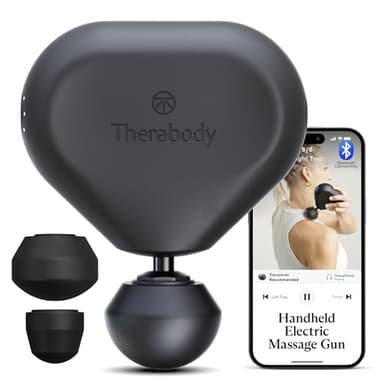
| 2 |  Therabody Theragun Mini (3rd Gen) Small and easy to steer around the shoulder. Keep it off the neck itself. | Control near the neck | 7.3 | $219.99 · View on Amazon Price as of October 21, 2026. #ad How we’re funded |
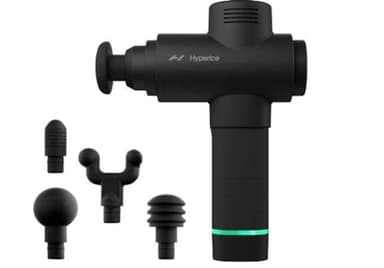
| 3 |  Hyperice Hypervolt 2 The lightest, quietest premium gun. Pleasant for evening use on the shoulders. | Quietest premium | 7.4 | $229.00 · View on Amazon Price as of October 21, 2026. #ad How we’re funded |
| 4 |  RENPHO Active Massage Gun Quiet for the money and FSA eligible. A fine first gun for shoulder tension. | Best budget | 7.1 | |
| ✕ |  Therabody Theragun Pro Heavy and aggressive. The wrong end of the range for a sensitive area. Skip this | The one to skip | 6.2 |
What a massage gun does for neck and shoulder tension
Desk work, phones and stress all pile tension into the same place: the big ropey muscles on top of the shoulders and across the base of the neck. That tension is real and a massage gun is a reasonable tool for it — but only on the muscle, and only on the parts that are safe to touch. This is the most delicate region on the body to point a percussion device at, so it is worth understanding what the tool can honestly do before you buy one.
The evidence is modest and short-lived, and we would rather you know that than expect a cure. A systematic review of percussive therapy found an effect on perceived pain and on short-term muscle performance, and a randomized controlled trial found percussion gave immediate, temporary relief in soreness each time it was applied without speeding the underlying recovery. So a gun can genuinely ease tight, aching traps for a while and make the area feel looser. It does not undo the hours of posture that built the tension, and it does not treat a neck problem — it treats the muscle around it, temporarily.
How we ranked these for necks and shoulders
A sensitive area rewards gentleness and control, so the criteria are almost the opposite of a deep-tissue roundup. In order:
- Control at a low setting. Near the neck you want the least aggressive tool that still does something. A gun with a usable low speed and a steady, easy-to-steer head is worth more here than raw power, which is a liability this close to the spine and throat.
- Weight and handling. You are reaching up and over your own shoulder, often with the opposite hand. A light gun you can steer precisely beats a heavy one you fight to hold in place.
- Quiet operation. Shoulder tension is an evening, in-front-of-the-TV problem for a lot of people. A gun quiet enough to use in a shared room is a gun you will actually reach for.
- Transparency and value.Bob and Brad publish the amplitude and stall-force figures the premium brands leave off — Hyperice, for instance, publishes weight, speeds and battery for the Hypervolt 2 but no amplitude at all, while the Bob and Brad C2 lists the lot. For a job that does not need much depth, a light well-specified budget gun is usually the right call.
The safety line you never cross
Read this section before anything else on the page. The neck holds the windpipe, the large blood vessels that feed the brain, and the top of the spinal cord, and a percussion device has no business near any of them.
Never use a massage gun on the front or the sides of your neck. The front holds the throat and windpipe; the sides carry the carotid arteries. Percussion over those structures is genuinely dangerous, not merely uncomfortable, and there is no technique that makes it safe. Never percuss the spineeither — the bony line up the back of the neck and down the middle of the back is off limits, at every setting.
What is left is plenty and it is where the tension actually lives: the upper traps, the thick muscle on top of each shoulder between the neck and the point of the shoulder, and the broad shoulder and upper-back muscle below and behind it. Work those, and only those, on a low setting, with slow passes, keeping well out to the side and away from the midline and the throat. If in doubt, stay further from the neck than you think you need to. Our page on neck and shoulder tension walks through exactly where the safe muscle is and how to reach it.
How to actually treat your traps
Almost all the useful work on this region happens on the upper traps and the shoulder, and the method is gentle and slow. Sit down, drop the shoulder you are working, and take the gun up and over with the opposite hand so the head rests on the thick muscle on top of the shoulder, out towards the point of it and well away from the neck. Run it slowly along the muscle from the base of the neck out towards the shoulder, pausing a few seconds where it is tender, then move on. Let the machine do the work; there is no need to press it in.
Two small things make it more effective. First, keep the shoulder relaxed rather than shrugged — a muscle you are actively tensing will not give anything up. Second, add a little slow movement: gently tip your head away from the side you are treating, or roll the shoulder, while the head is on the muscle, and the trap tends to release more readily. Work each side for a minute or two, no longer, and finish before it starts to feel bruised rather than looser.
The broad muscle across the top of the back, below and between the shoulder blades, is fair game too, and easy to reach by taking the head over the shoulder or leaning back against a ball on a wall. Keep off the shoulder blade’s bony edge and the spine, and keep well clear of the neck at every moment. On head choice, a larger, softer attachment spreads the force and is the right default for the traps and shoulders; keep any small, pointed head for a knot in thick muscle, and never bring a pointed head near the neck or spine. Softer and broader is almost always the better choice on this region.
What about the “knots” in your shoulders?
Almost everyone with shoulder tension describes a knot — a tight, tender lump in the muscle that seems to be the source of everything. A gun can take the edge off one, and the relief is the same temporary effect the research supports rather than the lump being dissolved. The honest framing is that percussion, pressure and movement can all quiet a tender spot for a while; none of them permanently removes it, and the tension usually returns until the thing driving it — posture, load, stress — changes. We go into what a knot actually is, and which tools help, in muscle knots. For a stubborn point, a firm ball against a wall often gives more useful, more controllable pressure than a gun does.
“Deep vein thrombosis, osteomyelitis; bone fracture or myositis ossificans; bleeding disorders; peripheral vascular insufficiency or disease; medications that thin the blood or alter sensations; pacemaker, ICD.”
Posture built the tension; a gun does not undo it
It is worth being blunt about cause and effect. The tightness that settles into the traps and the base of the neck is, for most people, the body’s response to hours held in one shape — head forward over a screen, shoulders rounded, phone down in the lap. A gun can ease the resulting ache, and the research supports that temporary relief honestly. What it cannot do is change the position that keeps rebuilding the tension. If the tightness is back by the same time tomorrow, the gun is doing its job and the posture is doing its job too, in opposite directions. The durable fixes are unglamorous: getting the screen to eye level, standing and moving on a timer, and building some strength through the upper back so it is not left to the traps to hold everything up. Use the gun for relief, not as a substitute for the boring changes that actually move the needle.
The cheaper tools worth keeping alongside
A gun is not the only good answer for shoulders, and for a specific stubborn knot it is often not the best one. A firm ball trapped between your shoulder and a wall gives you pressure you control to the millimeter — lean in for more, step away for less — and it reaches under the edge of the shoulder blade in a way a gun physically cannot. It costs a fraction of any gun, needs no charging, and lives in a drawer. For a lot of people the ideal shoulder kit is a light gun for general tightness across the traps and a ball for the one point that never quite lets go; our page on muscle knots goes through which tool suits which kind of tender spot. Warmth helps as well: a few minutes of heat on tight shoulders before you use the gun can make the muscle more willing to let go, which is the same order of operations a heated gun head is trying to shortcut.
Reading the picks below
The scores reward the things that matter for a sensitive area — light weight, a usable low speed, quiet operation and control — rather than raw power. That is why a light budget gun sits at the top and the heavy clinic unit is the one to skip: near the neck, gentleness and steerability are the whole point, and power is a liability. The quiet premium pick earns its place for evening use, and the pocket mini for the control that comes with a small head. Match the pick to how and when you will actually use it, and check the full specs and live prices in the cards below before deciding.
Which gun for necks and shoulders, in one line each
- For the upper traps, most people:the light, controllable Bob and Brad. Easy to steer at a low setting over the shoulder, and it publishes the numbers the premium brands hide — see the best budget massage guns for the wider case.
- For the most control near the neck:the pocketable mini. Small and precise, so it is easy to keep out to the side and away from the midline — just keep it off the neck itself.
- For quiet evening use:the Hypervolt 2, the lightest and quietest premium gun, pleasant on tired shoulders in a shared room — more options in the quietest massage guns.
- On a budget: the FSA-eligible Renpho, quiet for the money and a fine first gun for shoulder tension.
The heavy, aggressive clinic gun is the wrong end of the range for a sensitive area, which is why it is our skip here. It is also worth resisting the urge to use it constantly: because relief on the traps is real but short-lived, it is tempting to keep going back for more, and an area that feels bruised rather than looser has had too much. A short, gentle session once or twice a day is the most this region wants. Whatever you choose, technique is the safety net: low setting, slow passes, out to the side, never on the neck or spine. If you are new to it, read how to use a massage gun properly, and if the tension reaches down between the shoulder blades, upper back pain covers that region.
A gun cannot reach a cuff tendon, which runs under bone, so if the pain is on the outside of the upper arm rather than across the top of the shoulders, rotator cuff pain explains where percussion does and does not belong on a shoulder.
Every pick, in full
Specs below are the manufacturer’s own published figures, each linked to the page it came from. Where a maker does not publish a number, the table says so and names the page we checked — that absence is information too.
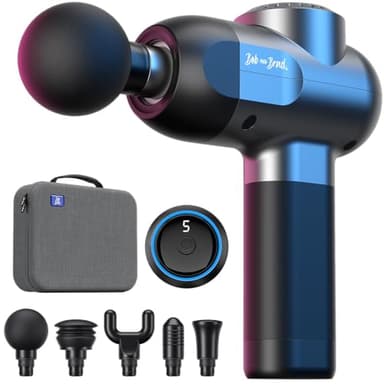
Bob and Brad C2 Massage Gun
The only gun in this roundup whose maker publishes all four numbers that decide whether it reaches the muscle — amplitude, stall force, speed range and noise — and the stall-force figure is higher than the premium units that hide theirs.
What it gets right
- Publishes amplitude, stall force, speed range and noise — the two market leaders publish none of the first three
- Published stall force of over 44 lb is higher than the figure Therabody publishes for the Prime
- 1.5 lb is light enough to hold overhead against your own shoulder without your arm giving out first
- FSA/HSA eligible, which quietly makes it cheaper again for a lot of buyers
What it does not
- 10 mm amplitude is genuinely shorter than a 16 mm premium stroke — that difference is real for glutes and thick back muscle
- No app, no pressure-feedback screen, no ecosystem
- Five fixed speeds rather than a continuous range
Price as of October 21, 2026. #ad How we’re funded
Therabody Theragun Mini (3rd Gen)
A genuinely pocketable gun that survives being thrown in a bag — the trade is that a short body has to give up stroke somewhere, and Therabody does not say where.
What it gets right
- Small enough to actually carry, which is the only spec that matters for a travel gun
- Simple three-speed operation
What it does not
- No published amplitude or stall force
- Priced like a full-size premium gun
- Short handle means you cannot reach your own mid-back with it
| Amplitude | Not published page we checked |
|---|---|
| Stall force | Not published page we checked |
| Speed range | 1,750–2,400 PPM source |
| Speed settings | 3 source |
| Weight | 0.9 lb source |
| Noise | Not published page we checked |
| Battery | 2.5 h source |
| Attachments | 3 source |
| Warranty | 1-year limited source |
| Dimensions | 116 × 135 × 96 mm source |
Price as of October 21, 2026. #ad How we’re funded
Hyperice Hypervolt 2
The quietest and lightest of the premium guns, with a genuinely comfortable handle — but Hyperice publishes weight, speeds, battery and motor wattage for it and no amplitude figure at all, so there is no way to compare its depth against anything.
What it gets right
- 1.8 lb is the lightest premium gun here, and weight is what decides whether you can reach your own upper back
- Three speeds is fewer than the spec sheets like, and in practice is one more than most people use
- Five attachments included
What it does not
- No published amplitude, anywhere on the product page — the single most important depth spec
- Three speeds with no continuous range
- Costs several times what a fully-specified budget gun costs
| Amplitude | Not published page we checked |
|---|---|
| Speed range | Not published page we checked |
| Speed settings | 3 source |
| Weight | 1.8 lb source |
| Noise | Not published page we checked |
| Battery | 3 h source |
| Attachments | 5 source |
| Dimensions | 7.5 × 2.5 × 9.5 in source |
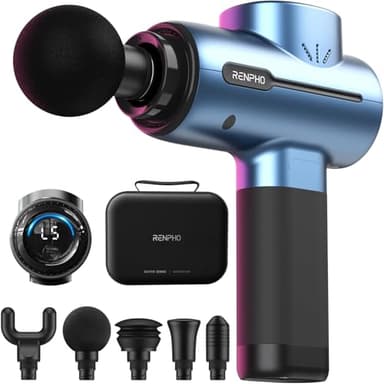
RENPHO Active Massage Gun
A competent mid-budget gun with FSA eligibility, sitting in the awkward space between the cheap gun that does the job and the specified one that does it better.
What it gets right
- FSA eligible, which changes the real price for a lot of buyers
- Quiet for the money
- Comfortable handle angle
What it does not
- Amplitude and stall force not published
- Costs close to the fully-specified C2 without matching its published numbers
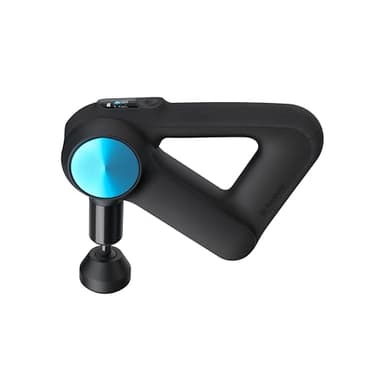
Therabody Theragun Pro
Built for a practitioner who runs it for hours a day across many bodies. For one person's own calves and shoulders it is the most expensive way to do a job a $70 gun does — which is why it is our skip.
What it gets right
- Rotating arm genuinely helps reach your own back
- Built for continuous professional use in a way the consumer models are not
What it does not
- The price gap over a fully-specified budget gun buys durability you will not consume at home
- Heavy in the hand for self-treatment
- Same unpublished-amplitude problem as the rest of the range
Common questions
Can I use a massage gun on my neck?
Not on the neck itself. Never use a gun on the front or sides of the neck — those carry the throat, windpipe and the carotid arteries — and never on the spine. The safe and useful targets are the upper traps, the thick muscle on top of each shoulder, and the broad shoulder muscle below it, worked on a low setting with slow passes well out to the side. If in doubt, stay further from the neck than you think you need to.
Does a massage gun get rid of knots in my shoulders?
It eases them rather than removes them. Research shows percussion gives immediate, temporary relief in soreness and can lower perceived pain, so a gun can quiet a tender spot for a while. It does not dissolve a knot permanently, and the tension tends to come back until whatever drives it — posture, load, stress — changes. For a stubborn point, a firm ball against a wall often gives more controllable pressure than a gun.
What is the best massage gun for shoulder tension?
A light, controllable, quiet one — not the most powerful. Shoulder tension is a low-setting job, so what matters is a usable low speed, a weight you can steer up and over your own shoulder, and quiet enough operation to use in the evening. A well-specified budget gun does this as well as a premium one for a fraction of the price. The heavy, aggressive clinic guns are the wrong tool for a sensitive area.
Sources
- 1.The Effect of Percussive Therapy on Musculoskeletal Performance and Experiences of Pain: A Systematic Literature Review (PubMed 37020441) — effect on perceived pain and short-term performance
- 2.Percussion massage therapy and recovery from delayed onset muscle soreness — randomized controlled trial (PMC11979224) — temporary soreness relief, no faster recovery
- 3.Bob and Brad — C2 massage gun product page — publishes amplitude, stall force, PPM, dB
- 4.Hyperice — Hypervolt 2 product page — no amplitude published on the product page
- 5.Therabody — Product Safety & Precautions — contraindications, quoted above