Massage Guns
The Best Massage Gun for Weightlifters
Lifters ask more of a massage gun than anyone else: the muscle is thicker, the soreness is heavier, and half the targets are on your own back. Here is what actually reaches a glute or a lat, what the between-sets research found, and the one gun to skip.
By Stephen V.Published
Disclosure:Grip & Gait earns a commission when you buy through links on this page, at no extra cost to you. It never changes what we recommend or the order we rank things in — here is exactly how we’re funded.
Quick picks
Ranked on published manufacturer specs and what they mean for the job, not on testing we have not done. Tap a row for the full reasoning. How we score.
| # | Product | Best for | Score | Price |
|---|---|---|---|---|
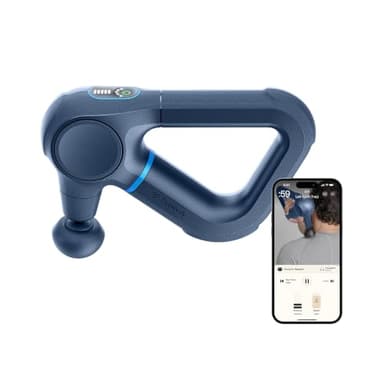
| 1 |  Therabody Theragun Prime (6th Gen) The long stroke Therabody quotes is the one spec that earns its money on dense muscle. Pressure feedback stops you leaning on it. | Glutes, quads, thick muscle | 8.3 | $329.99 · View on Amazon Price as of September 17, 2026. #ad How we’re funded |
| 2 | 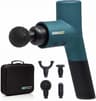 Ekrin Athletics B37v2 Massage Gun The angled handle is the difference between treating your own mid-back and asking a training partner. Lifetime warranty. | Reaching your own lats and back | 8.2 | $224.99 · View on Amazon Price as of September 17, 2026. #ad How we’re funded |
| 3 |  Bob and Brad C2 Massage Gun Publishes 44 lb of stall force and 10 mm of stroke. Light enough for overhead work on your own traps. FSA eligible. | Best value, published stall force | 8.1 | |
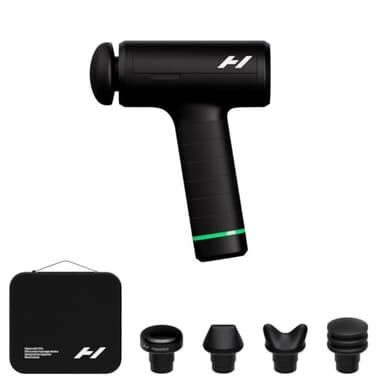
| 4 |  Hyperice Hypervolt 3 Pro 51 dB published and six speeds. Heavy at 2.5 lb, but the heated head before a session is a sensible order of operations. | Quiet power, heated head | 7.8 | $349.00 · View on Amazon Price as of September 17, 2026. #ad How we’re funded |
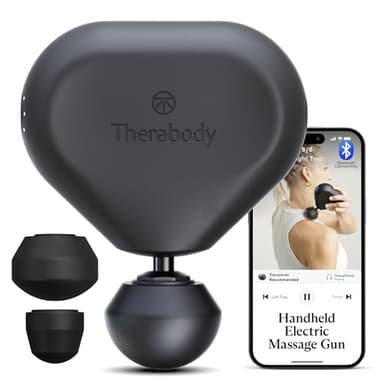
| ✕ |  Therabody Theragun Mini (3rd Gen) A gym-bag gun, not a gym gun. Short handle cannot reach your own back and a short body cannot deliver a long stroke into a glute. Skip this | The one to skip for lifting | 6.0 | $219.99 · View on Amazon Price as of September 17, 2026. #ad How we’re funded |
What a lifter actually needs from a gun
Most massage gun roundups are written for someone with tight calves and a sore neck. Lifting is a different problem. The muscle you want to reach is the thickest on the body — glutes, quads, hamstrings, lats and the spinal erectors — and the soreness after a heavy leg day is deeper and lasts longer than anything a runner gets from a tempo session. Half of the targets are also behind you. A gun that is fine for a calf can be useless on a glute and physically unable to reach a lat.
That reorders the specs. For this buyer, amplitude (how far the head travels on each stroke) and stall force (how hard you can press before the motor stops) stop being nice-to-haves and become the whole purchase. A short stroke that collapses the moment you lean into it does not reach a glute at all; it vibrates the skin over it. The third spec is one no product page lists: reach, which is decided by the handle geometry and the weight, and which determines whether you can treat your own back without help.
How we ranked these for lifters
- Stroke and stall force, as published.Therabody quotes a 16 mm stroke for the Prime in its wider material, which is genuinely long — but its current US product page does not publish amplitude, stall force, percussions per minute or noise. The Bob and Brad C2 publishes all four: 10 mm, over 44 lb, 2,000–3,200 PPM and under 60 dB. We rank on what the maker is prepared to put in writing, and we say when a number is missing.
- Reach. Lats, rear delts and the erectors either side of the spine are the muscles a lifter most wants to hit and least can reach. An angled handle changes that more than any extra millimeter of stroke.
- Weight for overhead work. Traps and rear delts mean holding the gun above your shoulder with the opposite hand. A 2.5 lb gun is fine on a quad and tiring up there.
- Value against what you will actually use. A lifter uses two attachments and two speeds. Ten heads and an app are listing features, not training features.
What the research says about guns and lifting
There is more direct evidence here than for most uses, and it cuts both ways. A randomized controlled trial in physically active young men induced soreness with squats and compared static stretching against 25 and 40 minutes of percussive massage. At 48 hours the longer percussion group had greater jump height and knee range of motion than the stretching group, and the authors concluded percussion was more effective than static stretching for DOMS recovery. That is a real result for a lifter, with the caveat that the sessions were long and the sample was thirty people.
A separate study on eccentric-exercise muscle damage found one minute of percussion at 24, 48 and 72 hours restored range of motion faster than rest but did not change isometric strength or muscle activation, and did not speed the underlying recovery from soreness until 72 hours — it consistently gave immediate, temporary relief each time it was applied. Read together: a gun makes a sore, stiff muscle move better and feel better for a while. It does not repair anything faster, and it does not make you stronger.
On use between sets, a study of a percussive device used during resistance exercise looked at the physiological responses to running the gun between sets. Our reading of the broader literature, including a study of massage gun and foam roller use during a warm-up in trained athletes, is that short pre-lift use does not meaningfully improve performance and does not hurt it either. Use it before a session for stiffness, not for strength, and keep pre-lift passes under thirty seconds per muscle so you do not switch the muscle off before a heavy set. The full protocol is in massage gun before or after a workout.
Muscle by muscle: where a gun earns its place
Glutes and hamstrings. This is where stroke length matters. Sit on a bench, shift your weight off the side you are treating, and run the gun slowly across the glute with a large round head on a mid speed. A short-stroke gun feels like a buzz here; a long-stroke gun feels like pressure. For a piriformis-type deep ache, a lacrosse ball on the floor still beats every gun on this page, which we cover in glute and piriformis pain.
Quads. Broad and easy. Any gun works; a foam roller covers more area per minute for a fraction of the money. Where the gun wins is the vastus medialis above the inside of the knee, which a roller rolls past. Keep off the kneecap and the tendon below it.
Lats and the mid-back.The reach problem. With a straight-handled gun you can get the top of the lat under the armpit with the opposite hand and not much else. The angled handle on the Ekrin gets you further down and around; a straight full-size gun does not. For the erectors either side of the spine, never percuss the spine itself — a peanut ball against a wall straddles it and does the job more safely.
Traps and rear delts.Overhead, opposite hand, low speed. Weight decides this one: the 1.5 lb C2 is comfortable held above the shoulder for a minute; the 2.5 lb Hypervolt 3 Pro is not. Stay on the muscle on top of the shoulder and well away from the neck — the line you never cross is in the neck and shoulders roundup.
Lower back. Percussion into a back that is guarding after heavy pulls tends to make it guard harder. Heat first; a gun on the glutes and hamstrings that feed the problem second; nothing on the spine. Our back pain roundup goes into that order of operations.
“Deep vein thrombosis, osteomyelitis; bone fracture or myositis ossificans; bleeding disorders; peripheral vascular insufficiency or disease; medications that thin the blood or alter sensations; pacemaker, ICD.”
The head and the speed, for thick muscle
Use the large round head for almost everything. It spreads the force across the muscle rather than driving it into one point, and on a glute or a quad that is exactly what you want. The flat head is the alternative for the same jobs if the round one feels too soft. Save the bullet head for a single knot in a thick muscle, and keep it off anything bony. Speed is the least important control: a mid setting with the head moving continuously does more than the top setting held in one place, which is how people bruise a quad the day before a squat session. Thirty seconds to two minutes per muscle group, no longer — the timing rules are in how to use a massage gun.
Which gun for a lifter, in one line each
- Thick muscle, and you want the longest stroke: the Theragun Prime. The pressure-feedback display also stops the most common lifter error, which is leaning on it as if more force were more result.
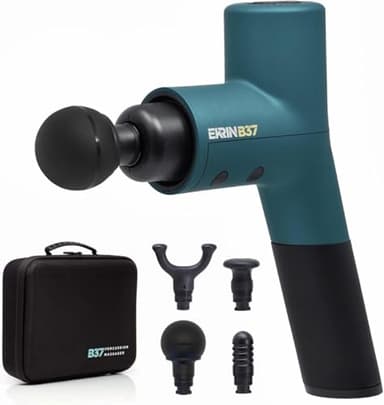
- You train alone and your back is the target: the Ekrin B37v2. The 15-degree handle is the only genuine ergonomic idea in the category, and the lifetime warranty is unusual at any price.
- Best value, and you want to see the numbers: the Bob and Brad C2. It gives up stroke to the Prime and admits it in writing, which is more than the premium brands do.
- Shared house, evening use, money not an issue: the Hypervolt 3 Pro. A published 51 dB, six speeds and a heated head. Heavy for overhead work.
The Theragun Mini is the skip, not because it is a bad gun but because it is the wrong one: a short body cannot deliver a long stroke into a glute, and a short handle cannot reach a lat. It is the right answer for a gym bag and the wrong answer for a gym. If you are choosing between the premium brands more generally, Hypervolt vs Theragun and Ekrin B37v2 vs Theragun Prime are the two head-to-heads a lifter should read. And if you are honest about how sore you are after leg day, the cheapest thing that helps is still a firm ball and a wall — see DOMS and muscle soreness.
Every pick, in full
Specs below are the manufacturer’s own published figures, each linked to the page it came from. Where a maker does not publish a number, the table says so and names the page we checked — that absence is information too.
Price as of September 17, 2026. #ad How we’re funded
Therabody Theragun Prime (6th Gen)
The long-stroke option, and the build quality is not in question — but Therabody's current US product page publishes dimensions, weight, battery and warranty and does not publish amplitude, stall force, PPM or noise, so the numbers most buyers are shopping on are not on the page they are shopping from.
What it gets right
- The 16 mm stroke Therabody quotes is genuinely long, and stroke length is what determines depth
- Real-time pressure feedback stops the most common user error — leaning on it far too hard
- Rated by Therabody to survive drops from 10 feet, which matters more than it sounds for a thing you use on a hard floor
What it does not
- Amplitude, stall force, PPM and dB are absent from the current US product page — we checked
- Two attachments in the box, against five on guns costing a fifth as much
- 120 minutes of battery is quoted at the LOWEST speed setting, which is not the setting you will use
- One-year limited warranty on a device at this price
| Amplitude | Not published page we checked |
|---|---|
| Stall force | Not published page we checked |
| Speed range | Not published page we checked |
| Speed settings | 5 source |
| Weight | 2 lb source |
| Noise | Not published page we checked |
| Battery | 2 h source |
| Attachments | 2 source |
| Warranty | 1-year limited source |
| Dimensions | 238 × 153 × 61 mm source |
Price as of September 17, 2026. #ad How we’re funded
Ekrin Athletics B37v2 Massage Gun
The 15-degree angled handle is the one genuine ergonomic idea in this category — it is the difference between reaching your own mid-back and asking someone else to.
What it gets right
- Angled handle materially extends self-treatment reach
- Lifetime warranty is unusual at any price in this category
- Quieter than most mid-priced guns
What it does not
- Costs several times a fully-specified budget gun
- Heavier than the lightest premium handhelds
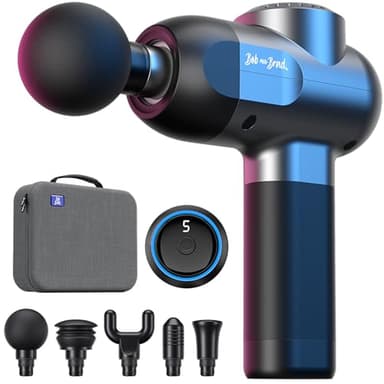
Bob and Brad C2 Massage Gun
The only gun in this roundup whose maker publishes all four numbers that decide whether it reaches the muscle — amplitude, stall force, speed range and noise — and the stall-force figure is higher than the premium units that hide theirs.
What it gets right
- Publishes amplitude, stall force, speed range and noise — the two market leaders publish none of the first three
- Published stall force of over 44 lb is higher than the figure Therabody publishes for the Prime
- 1.5 lb is light enough to hold overhead against your own shoulder without your arm giving out first
- FSA/HSA eligible, which quietly makes it cheaper again for a lot of buyers
What it does not
- 10 mm amplitude is genuinely shorter than a 16 mm premium stroke — that difference is real for glutes and thick back muscle
- No app, no pressure-feedback screen, no ecosystem
- Five fixed speeds rather than a continuous range
Price as of September 17, 2026. #ad How we’re funded
Hyperice Hypervolt 3 Pro
The one premium gun that publishes both a speed range and a noise figure — 1,500–2,500 RPM at 51 dB — which is quiet for the power, though amplitude is still missing.
What it gets right
- 51 dB published is genuinely quiet; you can hold a conversation over it
- Published 1,500–2,500 RPM range, which almost nothing else at this price states
- Heated head attachment included, and heat before percussion is a sensible order of operations
What it does not
- Amplitude still not published
- 2.5 lb is heavy for overhead work on your own shoulder
- The most expensive handheld here by a wide margin
Price as of September 17, 2026. #ad How we’re funded
Therabody Theragun Mini (3rd Gen)
A genuinely pocketable gun that survives being thrown in a bag — the trade is that a short body has to give up stroke somewhere, and Therabody does not say where.
What it gets right
- Small enough to actually carry, which is the only spec that matters for a travel gun
- Simple three-speed operation
What it does not
- No published amplitude or stall force
- Priced like a full-size premium gun
- Short handle means you cannot reach your own mid-back with it
| Amplitude | Not published page we checked |
|---|---|
| Stall force | Not published page we checked |
| Speed range | 1,750–2,400 PPM source |
| Speed settings | 3 source |
| Weight | 0.9 lb source |
| Noise | Not published page we checked |
| Battery | 2.5 h source |
| Attachments | 3 source |
| Warranty | 1-year limited source |
| Dimensions | 116 × 135 × 96 mm source |
Common questions
Is a massage gun worth it for weightlifting?
For soreness and stiffness, yes, within limits. A randomized trial that induced soreness with squats found percussive massage more effective than static stretching for recovery of jump height and range of motion at 48 hours. A separate study found percussion restored range of motion faster after eccentric damage but did not change strength or speed the underlying repair. So a gun helps you move and feel better between sessions; it does not make you stronger or recover faster in a way that shows up on the bar.
Should you use a massage gun before or after lifting?
Both, differently. Before a session, a short pass of under thirty seconds per muscle reduces stiffness without switching the muscle off; a warm-up study in trained athletes found no meaningful performance change either way. After a session, longer passes of one to two minutes per muscle group are where the recovery-of-motion evidence sits. Never use it over a fresh strain, and keep it off the spine and the front of the neck.
Which massage gun reaches your own back?
One with an angled handle. The Ekrin B37v2’s 15-degree handle materially extends how far down your own mid-back you can reach with the opposite hand, and it is the one genuine ergonomic idea in the category. For the muscle either side of the spine, a peanut ball against a wall is safer and cheaper than any gun.
Sources
- 1.Percussion massage therapy and recovery from delayed onset muscle soreness — randomized controlled trial (PMC11979224) — squat-induced DOMS; percussion vs static stretching
- 2.Effects of Percussive Massage Treatments on Symptoms Associated with Eccentric Exercise-Induced Muscle Damage (PMC10915620) — ROM restored faster; strength and activation unchanged
- 3.Massage It Out: Physiological Responses to a Percussive Therapy Device Used Intra-Resistance Exercise (PMC12225236) — percussive device used between resistance sets
- 4.Does Massage Gun or Foam Roller Use During a Warm-Up Improve Performance in Trained Athletes? (PMC12473898) — pre-session use and performance in trained athletes
- 5.Therabody — Theragun Prime product page — no amplitude or stall force on the US product page
- 6.Bob and Brad — C2 massage gun product page — publishes amplitude, stall force, PPM, dB
- 7.Therabody — Product Safety & Precautions — contraindications, quoted above