Feet & Gait
Scrapers and Gua Sha Tools
Instrument-assisted soft tissue work is genuinely used by clinicians and genuinely under-evidenced compared with the claims made for it. Here is what a stainless edge does mechanically, and how to use one without leaving marks you did not want.
By Stephen V.Published Updated
Disclosure:Grip & Gait earns a commission when you buy through links on this page, at no extra cost to you. It never changes what we recommend or the order we rank things in — here is exactly how we’re funded.
Quick picks
Ranked on published manufacturer specs and what they mean for the job, not on testing we have not done. Tap a row for the full reasoning. How we score.
| # | Product | Best for | Score | Price |
|---|---|---|---|---|
| 1 |  Rena Chris Gua Sha & Muscle Scraper Tool Stainless holds a consistent edge profile where stone chips. Several radii for different structures. | Multiple edge radii, stainless | 8.0 | $14.99 · View on Amazon Price as of October 21, 2026. #ad How we’re funded |
| 2 |  THERABAND Foot Roller For a plantar fascia specifically, a contoured roller is easier to control and much harder to overdo. | The foot, without an edge | 8.0 | $19.57 · View on Amazon Price as of October 21, 2026. #ad How we’re funded |
| 3 |  Kieba Massage Lacrosse Balls If what you want is deep pressure rather than shearing along tissue, this is cheaper and better evidenced. | Pressure instead of shear | 8.6 | $7.99 · View on Amazon Price as of October 21, 2026. #ad How we’re funded |
| 4 |  Bob and Brad C2 Massage Gun Percussion has a real if modest evidence base and published specs. Scraping has neither. | The documented alternative | 8.4 |
What a scraper actually does
A gua sha or muscle-scraping tool applies shearing pressure along tissue, rather than pressing into it. You hold an edge at an angle against skin — with an emollient so it glides rather than drags — and draw it along the direction of the muscle or fascia.
That is a third distinct mechanism from the two others on this site. Percussion drives force inward. A ball or roller presses inward with body weight. A scraper moves force along the surface. Whether that difference produces different outcomes is exactly the question the evidence does not clearly answer.
What the evidence supports, honestly
We are going to be direct about this rather than gesture at “studies show.”
Instrument-assisted soft tissue mobilization is used by physical therapists and chiropractors under various proprietary names, and it has been studied. The research base is smaller and more heterogeneous than the percussion literature we cite elsewhere on this site, studies are often small, and blinding is genuinely difficult because the intervention frequently leaves visible marks on the skin. That is a real methodological problem rather than a rhetorical point.
Compare that to what we can cite for percussion: a systematic review supporting acute and explosive strength gains, a controlled study finding reduced tissue stiffness and improved range of motion, and a randomized trial on soreness. Percussion’s effects are modest, but they are documented.
So: scraping tools are cheap, they are used professionally, and plenty of people find them useful. We are not going to tell you they break down scar tissue or release fascia, because we cannot support that. See our scar tissue and fascia page for why those specific claims do not survive scrutiny.
Stainless versus stone
Traditional gua sha tools are jade or bian stone and are largely sold now for facial use. For body work, stainless steel is the better tool, for a mechanical reason: the edge profile is the entire product, and stone chips. A chipped edge on a stone tool is both less effective and more likely to damage skin.
Stainless also holds a consistent radius, wipes clean between uses, and does not care about being dropped. Weight helps too — a heavier tool needs less hand pressure to do the same work, which means less fatigue and better control.
What to look for: multiple edge radii on one tool or in one set (different structures want different curves), a comfortable grip, and 304-grade stainless or better.
Technique, because this is the part that goes wrong
- Always use an emollient. Oil, balm, or lotion. A dry tool on dry skin drags rather than glides, and that is how you take skin off rather than working tissue. This is not optional.
- Angle around 30–45 degrees. Steeper digs in, flatter just slides.
- Light pressure, more strokes. The most common error by a wide margin is leaning on it. Pressure that feels reasonable at the time produces impressive bruising twelve hours later.
- Along the muscle, not across it — except deliberately across a fascial edge, briefly.
- Stop at redness. Mild pinkness is fine. If distinct red spotting appears, you are past useful and into bruising.
- Thirty to sixty seconds per area, then move on. Come back another day rather than staying longer.
Where scraping is genuinely well-suited
- Along a plantar fascia. Long, superficial, and hard to reach with anything broad. Though a contoured roller or spiked ball is easier to control and much harder to overdo.
- Forearm extensors. Thin muscle over bone where percussion is unpleasant and body weight cannot be applied. This is the strongest structural case for a scraper.
- Along the shin, either side of the bone. Same reasoning — and stay off the tibia itself.
- Achilles and its surrounding tissue. Gently. This area is unforgiving.
Where it is the wrong tool
- Large muscle groups. Quads and hamstrings want a roller. Scraping a quad takes forever for less effect.
- Deep structures. A scraper is a superficial tool by design. Glutes want a ball.
- Anywhere you cannot see. Your own back. Pressure control depends on watching the skin, and you cannot.
The other manual therapy people weigh against a scraper is cupping, which pulls tissue up rather than pushing it along and has the same gap between claim and evidence: massage gun vs cupping covers what a suction set does and does not do.
If you have read this far and still want one, the buying question is which edge shapes you need rather than which brand you trust — the effect-size review found the different tools performed alike. The best muscle scraping tools ranks four real scrapers on that basis, with the 46-trial update that argues against the technique quoted in full.
Our recommendation
A stainless scraper set costs less than a takeaway and is worth trying if forearm, shin or foot tissue is your problem — those are the structures where its geometry genuinely suits and where the alternatives are least good.
Do not buy it expecting more than the evidence supports, do not buy it before you own a ball and a roller, and use considerably less pressure than feels right. The most common outcome of a first session is a week of bruises and a tool in a drawer.
Every pick, in full
Specs below are the manufacturer’s own published figures, each linked to the page it came from. Where a maker does not publish a number, the table says so and names the page we checked — that absence is information too.
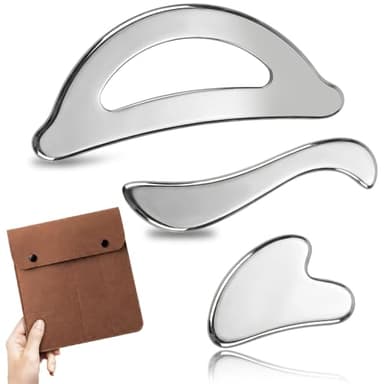
Price as of October 21, 2026. #ad How we’re funded
Rena Chris Gua Sha & Muscle Scraper Tool
Stainless rather than the jade sold for facial use — the edge profile is the whole product, and a stone tool will not hold one against a plantar fascia.
What it gets right
- Stainless holds a consistent edge profile; stone chips
- Multiple edge radii for different structures
- Wipes clean
What it does not
- Very easy to bruise yourself with — this needs emollient and a light hand
- The evidence base for scraping is thin and we say so on the page
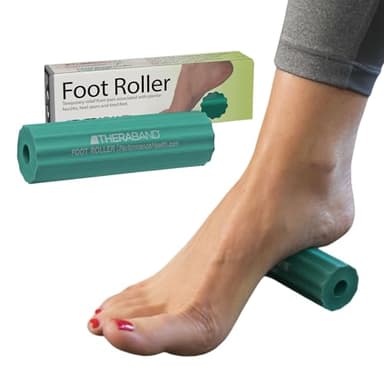
Price as of October 21, 2026. #ad How we’re funded
THERABAND Foot Roller
Shaped for the arch specifically rather than being a general-purpose ball, and it can be chilled — which covers both jobs a first-thing-in-the-morning heel needs.
What it gets right
- Contoured to the arch instead of a plain sphere
- Freezes, so you get cold and pressure in one pass
- Costs less than a takeaway lunch
What it does not
- Fixed shape suits some arches better than others
- Not usable anywhere but the foot
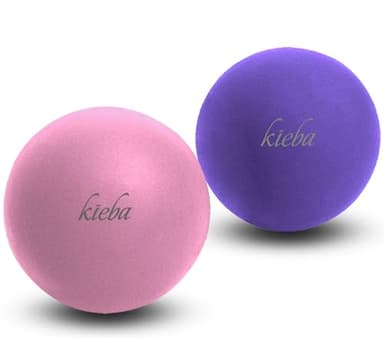
Price as of October 21, 2026. #ad How we’re funded
Kieba Massage Lacrosse Balls
The highest work-per-dollar tool on this entire site. A hard rubber sphere concentrates all your body weight into one square inch, which is more pressure than any handheld gun can generate.
What it gets right
- Concentrates body weight into a single point — more local pressure than any percussion device
- Nothing to charge, nothing to break, fits in a coat pocket
- Reaches under the shoulder blade against a wall, which a roller physically cannot
What it does not
- Unforgiving — very easy to overdo on a first session
- Wrong tool for broad surfaces like quads or lats
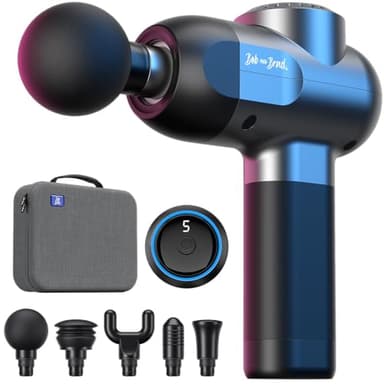
Bob and Brad C2 Massage Gun
The only gun in this roundup whose maker publishes all four numbers that decide whether it reaches the muscle — amplitude, stall force, speed range and noise — and the stall-force figure is higher than the premium units that hide theirs.
What it gets right
- Publishes amplitude, stall force, speed range and noise — the two market leaders publish none of the first three
- Published stall force of over 44 lb is higher than the figure Therabody publishes for the Prime
- 1.5 lb is light enough to hold overhead against your own shoulder without your arm giving out first
- FSA/HSA eligible, which quietly makes it cheaper again for a lot of buyers
What it does not
- 10 mm amplitude is genuinely shorter than a 16 mm premium stroke — that difference is real for glutes and thick back muscle
- No app, no pressure-feedback screen, no ecosystem
- Five fixed speeds rather than a continuous range
Common questions
Does gua sha or muscle scraping actually work?
It is used professionally and plenty of people find it useful, but the research base is smaller and more heterogeneous than the percussion literature, studies are often small, and blinding is genuinely hard because the intervention leaves visible marks. We are not going to tell you it breaks down scar tissue or releases fascia, because we cannot support that.
Is stainless steel or stone better for gua sha?
Stainless for body work. The edge profile is the entire product and stone chips — a chipped edge is both less effective and more likely to damage skin. Stainless holds a consistent radius, wipes clean and survives being dropped. Weight helps too: a heavier tool needs less hand pressure for the same work.
How hard should you press with a muscle scraper?
Far less than feels right. The most common error by a wide margin is leaning on it — pressure that seems reasonable during the session produces impressive bruising twelve hours later. Use an emollient so the tool glides, hold it at roughly 30–45 degrees, use light pressure with more strokes, and stop at mild pinkness rather than red spotting.
Can I use a scraper for plantar fasciitis?
Along the fascia, yes, and the geometry suits it. But a contoured arch roller or spiked ball is easier to control and much harder to overdo, and the strongest published evidence for plantar fasciitis is for the plantar fascia-specific stretch rather than any device. See our plantar fasciitis page.
Is it normal to bruise from gua sha?
Marks are common and are what shearing pressure does to superficial vessels. Persistent bruising beyond a few days means you used far too much pressure. Be substantially more cautious on anticoagulant medication, and do not scrape over broken skin, varicose veins, fresh injury or an area with reduced sensation.
Sources
- 1.The Effect of Percussive Therapy on Musculoskeletal Performance and Experiences of Pain: A Systematic Literature Review (PubMed 37020441) — the comparison evidence base for percussion
- 2.Acute Effects of Theragun Percussive Therapy on Viscoelastic Tissue Dynamics and Hamstring Range of Motion (PMC10499144)
- 3.Percussion massage therapy and recovery from delayed onset muscle soreness — randomized controlled trial (PMC11979224)
- 4.Therabody — Product Safety & Precautions — blood-thinning medication named among precautions