Rollers & Balls
TriggerPoint GRID vs Amazon Basics Foam Roller
Both press your body weight into a muscle across a broad area — the entire mechanism — so the real question is narrow: does the branded roller's texture and longer-lasting core justify several times the price of a plain dense cylinder? For most beginners, not yet.
By Stephen V.Published
Disclosure:Grip & Gait earns a commission when you buy through links on this page, at no extra cost to you. It never changes what we recommend or the order we rank things in — here is exactly how we’re funded.
Quick picks
Ranked on published manufacturer specs and what they mean for the job, not on testing we have not done. Tap a row for the full reasoning. How we score.
| # | Product | Best for | Score | Price |
|---|---|---|---|---|
| 1 |  Amazon Basics High-Density Foam Roller (18 in) Sustained pressure across a broad area is the mechanism, and a plain cylinder delivers it for a fraction of the price. | Value; does the actual work | 8.4 | $15.29 · View on Amazon Price as of October 21, 2026. #ad How we’re funded |
| 2 |  TriggerPoint GRID Foam Roller (13 in) A multi-density surface and a hollow rigid core that will not compress into a soft log after a year. | Texture and a core that lasts | 8.3 | |
| ✕ |  321 STRONG Foam Roller Textured like the branded roller at close to plain-cylinder money. If you cannot decide, this splits the difference (and is the one to skip only if you want a clear winner). Skip this | The middle ground | 8.0 | $25.99 · View on Amazon Price as of October 21, 2026. #ad How we’re funded |
The short answer
Both of these do the same thing, and it is worth being blunt about that up front: a foam roller works by pressing your body weight into a muscle across a broad contact area, and a plain dense cylinder delivers that mechanism for a fraction of the branded price. So the honest question in this comparison is narrow. It is not whether the branded roller works — both work — but whether its texture and its longer-lasting core are worth several times the money for the person actually buying one.
For most people starting out, the plain cylinder is the correct purchase and the branded roller is the upgrade you grow into. For a specific kind of user — someone who rolls often, wants to pick out a single band like the outer thigh, and does not want to replace a softening roller in a couple of years — the branded one earns its premium. Here is how to tell which one you are.
What they share
Underneath the surface treatment, these are the same tool. Both are rigid enough to press honest pressure into a muscle, both cover a broad muscle like a quad in a few slow passes, and both are subject to the same rule that matters more than any branding: a roller has to stay firm under your weight, because the moment it compresses, your body mass is going into deforming foam instead of into muscle. Neither of these fails that test, which is why the decision comes down to refinements rather than whether the thing works at all.
It is worth naming what a bad roller looks like, because it is what both of these avoid. The rollers that genuinely fail are the soft, cheap, no-name cylinders that feel firm in the shop and compress the moment a real person lies on them, and the flimsy hollow tubes whose seams give way. Neither of the two here is that roller. The plain cylinder is high-density enough to stay honest under load, and the branded one is built around a rigid core that does not yield at all. So this is a comparison between two tools that both clear the bar, which is exactly why the decision is about refinement and money rather than about avoiding a dud.
Where the branded roller genuinely differs
- The surface.A multi-density textured surface concentrates load into raised strips with gaps between them, instead of spreading it flat. That lets you find and work a specific band — an outer thigh, a strip of calf — with more intensity than a smooth cylinder, without having to hold your breath through full-width pressure.
- The core. A hollow rigid core holds its shape more or less indefinitely. This is the durability argument, and it is real: solid foam softens slowly over years of heavy use and quietly stops working as well without ever obviously failing, while the rigid core does not.
- The feel. The combination reads as a more deliberate, more controllable tool, which for someone who rolls regularly is worth something on its own.
The catch is the price, which is several times the plain cylinder, and a hollow core is noticeably noisier on a hard floor. Neither is a dealbreaker; both are things a first-time buyer should know before paying up.
Where the plain cylinder wins
- It does the actual work.Sustained pressure across a broad area is the mechanism, and a smooth dense cylinder delivers it in full. Nothing about a beginner’s results depends on texture.
- Price.It costs a fraction of the branded roller, which frees the difference for a pair of balls that reach the spots any cylinder skims — a far better use of the money for most people.
- Length. The plain cylinder here is the longer one, and length is the underrated spec in this whole category.
The plain cylinder’s honest drawbacks are the flip side: a flat surface spreads pressure rather than concentrating it, so a stubborn band can feel vague, and solid foam will soften over years in a way the rigid core does not.
Length, specifically
Length gets almost no attention and decides more than texture does. A longer cylinder is long enough to lie along your spine, which unlocks gentle thoracic extension over the roller — a mobility drill a roller can do and a ball cannot — and it gives you room to work a whole muscle without constantly repositioning. A shorter roller fits in a gym bag, which is its own kind of usefulness, but it cannot lie along the spine. If mid-back mobility is part of why you are buying, length outranks the surface pattern, and here the plain cylinder is the longer tool.
The durability question, in plain terms
Durability is the branded roller’s strongest genuine argument, so it is worth being precise about it rather than waving at it. A solid-foam cylinder does not break; it fades. Over years of regular use the foam gradually loses density, and because the change is slow and invisible you keep using a roller that presses a little less honestly each month without ever noticing the day it stopped being firm. A rigid hollow core sidesteps that entirely — it holds its exact shape for as long as you own it. Whether that is worth paying for comes down to a simple question: are you buying a tool for this year, or a tool you would like to still trust in five? For a beginner unsure they will stick with it, the fade is a problem for a future that may not arrive. For a committed roller, buying once is cheaper than buying twice.
Who should pay up
Pay for the branded roller if you already know you will roll often, if you specifically want to pick out a single band with concentrated strips of pressure rather than blanket the whole muscle, or if you want to buy once and not think about a softening core for a very long time. Those are real reasons, and the premium buys them honestly.
Do not pay up if this is your first roller and you are not yet sure how much you will use it. Start with the plain cylinder, put the saved money toward a ball, and upgrade later if you find yourself reaching for the roller several times a week. The branded roller is a better object; it is not a better mechanism, and a beginner is buying the mechanism.
The middle ground, and why it is our skip here
There is a third roller that splits the difference: a textured triple-density surface at close to plain-cylinder money. On its own it is a genuinely sensible buy, and if you want texture without the branded price it is arguably the smartest purchase of the three. It is our skip in this particular head-to-head only because this page exists to give you a clear winner between two ends of the market, and the middle option muddies that — its knobs are also more aggressive than the branded roller’s, which not everyone tolerates on a sensitive band. If you would rather not choose between cheap-and-plain and pricey-and-textured, though, the middle roller is exactly the compromise, and there is no shame in taking it.
What the research supports
Neither surface changes what rolling can do, so it is worth keeping expectations honest. Rolling improves short-term range of motion and feels good, and a study of foam roller or massage gun use during a warm-up looked at exactly that use in trained athletes. A direct comparison of foam rolling and percussive massage found both helped recover the muscle properties disrupted by soreness while neither reduced pain much more than rest did. A textured core does not change any of that; it changes how the work feels, not what it accomplishes.
The honest recommendation
Buy the plain cylinder first. It does the work, it is the longer of the two, and it costs a fraction of the branded roller — and the money you save buys a ball that reaches what any cylinder cannot. Step up to the branded roller when texture and a core that outlasts everything genuinely matter to how often you roll. And if you cannot decide, the middle-ground textured roller is a legitimate compromise rather than a mistake. New to all of this? Start with the best foam roller for beginners; for what a ball adds, read foam roller vs massage ball and the best massage balls; and for the technique itself, how to foam roll.
Every pick, in full
Specs below are the manufacturer’s own published figures, each linked to the page it came from. Where a maker does not publish a number, the table says so and names the page we checked — that absence is information too.
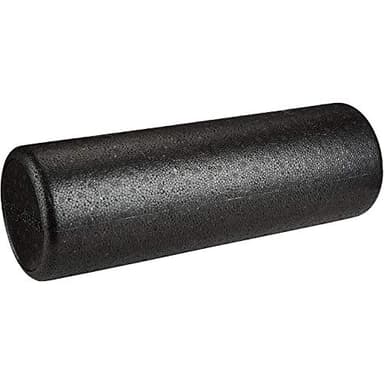
Price as of October 21, 2026. #ad How we’re funded
Amazon Basics High-Density Foam Roller (18 in)
A dense foam cylinder does the same mechanical job as a textured roller for a fraction of the money, and for a first roller that is the correct purchase.
What it gets right
- Does the actual mechanical work — sustained pressure across a broad contact area
- Nothing to break; no core, no seams, no electronics
- 18 in is long enough to lie along your spine, which the 13 in rollers are not
What it does not
- Flat surface spreads pressure rather than concentrating it
- Solid EVA softens over a few years of heavy use
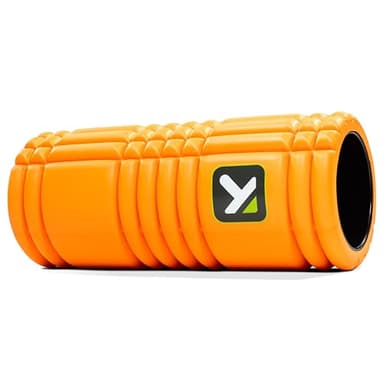
TriggerPoint GRID Foam Roller (13 in)
The multi-density surface is the reason to buy this over a plain foam cylinder: the raised sections concentrate pressure in strips instead of spreading it flat, which is what makes it usable on an IT band without needing to hold your breath.
What it gets right
- Hollow rigid core does not compress into a soft log the way plain EVA foam does after a year
- Multi-density surface gives you three pressure intensities on one roller
- 13 in length fits in a gym bag; the 26 in version does not
What it does not
- Costs roughly three times a plain high-density cylinder that also works
- The hollow core makes it noisier on a hard floor
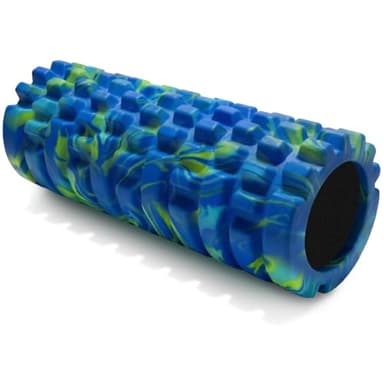
Price as of October 21, 2026. #ad How we’re funded
321 STRONG Foam Roller
Textured like the premium rollers at close to plain-cylinder money — the sensible middle purchase if the flat cylinder feels too blunt and the branded one feels too dear.
What it gets right
- Triple-density surface at roughly a third of the branded price
- Rigid core holds shape
What it does not
- Knobs are more aggressive than the GRID's, which some people cannot tolerate on the IT band
Common questions
Is the TriggerPoint GRID worth it over a cheap foam roller?
For a first roller, usually not. A plain dense cylinder does the same mechanical work — broad, sustained pressure into a muscle — for a fraction of the price. What the branded roller adds is a textured surface that concentrates pressure into strips and a rigid hollow core that will not soften over the years. Those are genuine upgrades for someone who rolls often, not reasons a beginner needs to pay several times more on day one.
Does foam roller texture actually matter?
It changes how the work feels, not whether it works. A smooth cylinder and a textured roller both press your body weight into muscle; the texture concentrates that load into raised strips with gaps between them, which some people find lets them pick out a specific band like the outer thigh with more intensity. If flat pressure feels too blunt to you, texture is worth paying for. If it does not, you are paying for a preference, not a result.
What length foam roller should I buy?
A full-length cylinder if you have room, because length matters more than most buyers realize. A longer roller is long enough to lie along your spine, which lets you do gentle mid-back extension over it — a mobility drill a shorter roller cannot support. A short roller fits in a gym bag and is fine for limbs, but it cannot do the spine-length work. Between these two, the plain cylinder is the longer tool.