Compare
Massage Gun vs Stretching
One is free and one costs money, which makes people suspicious of the comparison. It is a fair one: the trials that have put percussion against static stretching found real differences, and which wins depends on whether you are about to train or have just finished. Here is what they found, the order that works, and where a gun genuinely cannot replace a stretch.
By Stephen V.Published
Disclosure:Grip & Gait earns a commission when you buy through links on this page, at no extra cost to you. It never changes what we recommend or the order we rank things in — here is exactly how we’re funded.
The short version
Before training, a short pass with a gun does what a long static stretch used to do without the cost to strength. After training, the one head-to-head trial found percussion beat static stretching for soreness recovery. For lasting flexibility, stretching wins and a gun does not replace it. That is three different answers because it is three different questions, and most of the argument online comes from people answering one while asking another.
| Use case | Winner | Why |
|---|---|---|
| Warm-up before a session | Gun, briefly | Short percussion reduces stiffness without the strength deficit long static holds produce. Dynamic stretching does the same for free. |
| Soreness in the two days after training | Gun | The direct RCT found percussion beat static stretching for jump height and range of motion at 48 hours. |
| Getting genuinely more flexible over months | Stretching | Range of motion gains that last come from regular stretching. A gun's effect on range is real and wears off within the hour. |
| A muscle in spasm, or a nerve-tension problem | Neither, then a clinician | Percussion on a guarding muscle makes it guard harder; stretching a nerve makes it worse. Both are wrong tools here. |
| You will only do one, and only if it takes two minutes | Gun | The tool you use beats the tool you do not. A gun is the one most people actually reach for. |
What they each actually do
A static stretchholds a muscle at length for a period and, done regularly over weeks, changes how far a joint moves. The immediate effect is mostly neural — you tolerate the stretch better — and the longer-term effect is real. The catch is that a long hold immediately before training costs something: a systematic review of acute stretching effects found static stretching reduced immediate performance by around 3.7% on average, with a dose-response — holds of 60 seconds or more per muscle produced larger deficits than holds under 60 seconds — and found no clear effect on injury. Dynamic stretching, by contrast, produced small-to-moderate improvements. Range-of-motion gains from any form of stretching typically lasted under 30 minutes.
A massage gun drives a head into muscle at speed. The immediate effect is on tissue: a study on percussive therapy and hamstring range of motion measured changes in tissue dynamics and range after a session, and a systematic review of percussive therapy found effects on perceived pain and short-term muscle performance. Like stretching, the range-of-motion effect is temporary. Unlike a long static hold, a short pass does not appear to switch the muscle off before you load it.
The one trial that put them head to head
A randomized controlled trial in thirty physically active young men induced soreness with squats and then gave one group static stretching and two groups percussive massage, for 25 or 40 minutes. At 48 hours, the longer percussion group had greater jump height and greater knee range of motion than the stretching group, and lower muscle activation for the same task. The authors concluded percussion was more effective than static stretching for recovery from delayed-onset soreness, and that 40 minutes beat 25.
Two honest caveats. The percussion sessions were long — far longer than the two minutes per muscle we recommend in how to use a massage gun— so this is evidence that a lot of percussion beat stretching, not that a quick pass does. And thirty people is a small trial. It is still the most direct comparison we know of, and it points the same way as a study of percussion after eccentric damage, which found faster restoration of range of motion but no change in strength and no faster underlying recovery until 72 hours: the gun makes a sore muscle move and feel better sooner, and it does not repair anything faster.
Gun or stretch first?
Gun first, stretch second, if you are doing both. Percussion raises tissue temperature and reduces the sense of stiffness, which makes the stretch that follows more tolerable and lets you get to length without fighting the muscle. Stretching first and then percussing a muscle you have just lengthened adds nothing. Before training the whole sequence should be short: thirty seconds of gun per muscle, then dynamic movement rather than long holds, then the session. After training the order is the same and the durations are longer: a minute or two of gun per muscle, then static holds if flexibility is a goal, because this is the one time a long hold has no performance cost to pay.
Where a gun cannot replace stretching
- Lasting flexibility. If the goal is to touch your toes in three months, a gun is not the tool. A meta-analysis comparing static stretch training with foam rolling training found both improved range of motion over the long term, with stretching clearly ahead over shorter programs of four weeks or less. There is no equivalent body of training studies for massage guns, and the acute effect of one wears off within the hour.
- Length under load. A stretch teaches the nervous system to allow a joint to go further. A gun changes how the tissue feels. Those are different adaptations and the second does not produce the first.
- Anything the gun cannot safely reach. The front of the hip, the deep neck, the inner thigh near the groin, anything over a nerve or a vessel. A hip flexor stretch is the first treatment for a tight hip flexor; a gun on the front of the hip is a bad idea. See how to loosen tight hip flexors.
Where stretching cannot replace a gun
- Immediate soreness relief. Every percussion trial finds the same thing: it feels better straight away, temporarily. Stretching a sore muscle usually does not.
- A muscle you cannot get a stretch on.Some muscles do not lengthen well against gravity on your own — the lateral quad, the muscle under the shoulder blade, the outer calf. A gun, or better a ball, gets pressure onto them directly.
- Pre-session, when you are short on time. Thirty seconds of percussion per muscle achieves the stiffness reduction that three minutes of stretching used to, without the strength deficit.
“Deep vein thrombosis, osteomyelitis; bone fracture or myositis ossificans; bleeding disorders; peripheral vascular insufficiency or disease; medications that thin the blood or alter sensations; pacemaker, ICD.”
What we would actually buy
Stretching costs nothing and needs nothing, which is the honest place to start. The two tools below are for the half of this comparison that does need equipment, plus the one cheap thing that makes the stretching half easier.
The gun
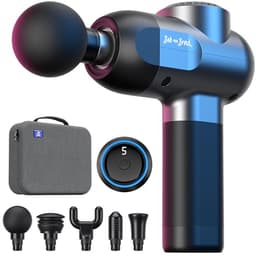
Bob and Brad C2 Massage Gun
Light enough for a thirty-second pre-session pass on every major muscle without your arm tiring, and it publishes the amplitude and stall force the premium brands leave off the page.
For the stretching half
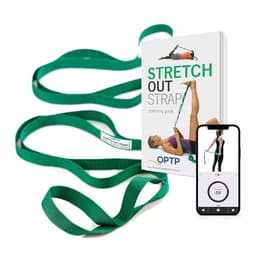
OPTP Original Stretch Out Strap
A looped strap lets you hold a hamstring or calf at length lying down, relaxed, for the long post-session holds where flexibility is actually built. The difference between a stretch you hold and one you fight.
The middle option
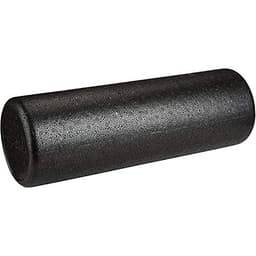
Amazon Basics High-Density Foam Roller (18 in)
Rolling sits between the two: the meta-analysis found it builds range of motion over weeks like stretching does, and it gives the immediate tissue effect a gun does, for the price of neither.
Price as of September 17, 2026. #ad How we’re funded
The honest summary
A gun is the better tool immediately before training and in the sore days after it, on the evidence we have. Stretching is the better tool for becoming more flexible, and nothing a gun does replaces that. Most people who own a gun should still stretch, and most people who stretch would get more from adding thirty seconds of percussion before they start than from holding anything longer. If you are weighing a gun against the other cheap alternative, massage gun vs foam roller is the companion to this page, and foam rolling vs stretching covers the same before-or-after question for the roller. If a gun is still the question, are massage guns worth it is where we answer it without a product to sell in the first paragraph.
Common questions
Is a massage gun better than stretching?
For soreness after training, the one direct trial says yes: forty minutes of percussion beat static stretching for jump height and range of motion at 48 hours. For a warm-up, a short pass with a gun avoids the strength deficit a systematic review found from static holds of a minute or more. For lasting flexibility, stretching is better and a gun does not replace it; its effect on range of motion wears off within the hour.
Should you use a massage gun before or after stretching?
Before. Percussion warms the tissue and reduces the sense of stiffness, so the stretch that follows is more tolerable and gets to length without a fight. Keep the pre-training version short — thirty seconds per muscle, then dynamic movement rather than long holds. After training, a minute or two of gun per muscle followed by static holds is the sequence, because that is the one time a long hold has no performance cost.
Can a massage gun replace stretching?
No. A gun changes how tissue feels and moves for an hour or so; stretching, done regularly over weeks, changes how far a joint goes. A meta-analysis comparing stretch training with foam rolling training found both built range of motion over time, and there is no equivalent training evidence for massage guns. Use the gun for the immediate effect and keep stretching for the lasting one.
Sources
- 1.Percussion massage therapy and recovery from delayed onset muscle soreness — randomized controlled trial (PMC11979224) — the direct head-to-head: percussion vs static stretching after squat-induced DOMS
- 2.Acute effects of muscle stretching on physical performance, range of motion, and injury incidence in healthy active individuals: a systematic review - Applied Physiology, Nutrition, and Metabolism 2016 (PubMed 26642915) — static stretching -3.7% immediate performance, dose-dependent; dynamic +1.3%; ROM gains under 30 min
- 3.Static Stretch Training versus Foam Rolling Training Effects on Range of Motion: A Systematic Review and Meta-Analysis - Sports Medicine 2024 (PMC11393112) — both build ROM over weeks; stretching ahead over programs of four weeks or less
- 4.Acute Effects of Theragun Percussive Therapy on Viscoelastic Tissue Dynamics and Hamstring Range of Motion (PMC10499144) — percussion and hamstring range of motion
- 5.Effects of Percussive Massage Treatments on Symptoms Associated with Eccentric Exercise-Induced Muscle Damage (PMC10915620) — ROM restored faster; strength unchanged; no faster recovery until 72 h
- 6.The Effect of Percussive Therapy on Musculoskeletal Performance and Experiences of Pain: A Systematic Literature Review (PubMed 37020441) — effects on pain and short-term performance
- 7.Therabody — Product Safety & Precautions — contraindications, quoted above