Recovery Tech
The Best Compression Boots for Runners
A runner's legs are mostly calf and shin, and that is the one thing most boot buyers never check before ordering. Here is the pair we would put a marathon block behind, the fit measurement that decides whether they work at all, and the honest size of what the research says you are buying.
By Stephen V.Published
Disclosure:Grip & Gait earns a commission when you buy through links on this page, at no extra cost to you. It never changes what we recommend or the order we rank things in — here is exactly how we’re funded.
Quick picks
Ranked on published manufacturer specs and what they mean for the job, not on testing we have not done. Tap a row for the full reasoning. How we score.
| # | Product | Best for | Score | Price |
|---|---|---|---|---|
| 1 |  FIT KING Air Compression Recovery Boots Genuinely sequential, sized rather than one-size, and cheap enough that a runner can own a pair without it being a decision. The default recommendation for anyone training. | Best overall for mileage | 8.6 | |
| 2 |  QUINEAR Leg Recovery Compression System Covers from the foot to the thigh, which matters because a runner's complaints cluster below the knee. If your shins and arches are the problem, this reaches them. | Calves, shins and feet | 8.2 | $359.99 · View on Amazon Price as of October 5, 2026. #ad How we’re funded |
| 3 | 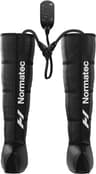 Hyperice Normatec 3 Recovery System The one case where the premium is defensible: 60-plus miles a week for years, daily use, and you want the pump and the support that comes with it. Not a performance upgrade. | High mileage, bought once | 7.9 | $899.00 · View on Amazon Price as of October 5, 2026. #ad How we’re funded |
| ✕ |  Musugy Sequential Leg Compression Massager Fine as a first taste of the category, underpowered as a training-block tool. Short cycles and a narrow sleeve are exactly wrong for a developed calf. Skip this | The one to skip for running | 6.5 |
The measurement that decides this purchase
Get a tape measure and measure the widest part of your calf, then the length from the floor to just below your knee. Those two numbers decide whether a pair of recovery boots does anything for you, and they are the two numbers almost nobody checks before buying.
The reason is specific to runners. Years of mileage builds the gastrocnemius and soleus, so a runner’s leg is not the shape the generic “one size fits most” sleeve was cut for. If a sleeve is tight around the calf before the pump starts, the chambers cannot inflate and deflate in the sequence that makes the device work — you get a constant squeeze rather than a traveling wave, which is a different and less useful thing. If the sleeve is too short, the top chamber lands mid-calf and the part of the leg that most needs it never gets compressed at all. Both failure modes feel like “these do nothing for me” and both are fit problems, not product problems.
That is why sized sleeves rank above refinement on this page, and why the cheapest unit in the category is our skip for a running audience specifically: the narrow sleeve is the one spec a trained calf will not forgive.
How we ranked these for runners
- Sleeve length and circumference, as sized. Published size ranges beat published pressure numbers. A boot you can zip around a developed calf and that reaches your knee is doing more than a better pump you cannot close.
- Genuinely sequential inflation. The chambers must fill in order from the foot upward and release in order. Several cheap systems inflate everything at once and call it sequential in the listing; the honest tell is a published cycle description, which is in the main compression boots roundup.
- Cycle time per session. Twenty to thirty minutes is the realistic window a runner will actually use after a long run. A unit whose longest program is ten minutes gets marked down, because you will end up restarting it three times.
- Foot chamber.A runner’s arch takes a beating that a cyclist’s never does. Coverage that starts at the foot rather than the ankle is worth real money here and almost nothing to most other athletes.
- What it is honestly for. Ranked as a comfort and feel-better device with modest recovery evidence, not as a performance tool. See below, because this is where the category oversells itself.
What the research supports, including the part that does not help our case
Intermittent pneumatic compression — which is what every boot on this page is — has a real literature, and it is mixed.
On the positive side, a 2025 systematic review with meta-analysis examined photobiomodulation, intermittent pneumatic compression and neuromuscular electrical stimulation for muscle recovery and found measurable effects for the modalities it pooled. That is the strongest general support the category has.
On the other side, a randomized placebo-controlled trial in international-level youth soccer players applied intermittent pneumatic compression after a match and found it did not improve neuromuscular, biochemical or perceptual recovery compared with placebo. Not “a small effect” — no improvement on any of the three outcome families, including the perceptual one, which is the outcome boots are most often credited with.
We cite both because the second one is the result a shop would leave out. Taken together, the defensible claim for a runner is: boots are a pleasant, passive, low-risk twenty minutes with your legs up that many runners find makes the next morning feel better, and the measured effects on recovery markers are inconsistent and sometimes absent. That is worth the price of the FIT KING. It is not worth the price of a premium system unless the premium is buying you something concrete, which for a high-mileage runner it sometimes is: durability, a quieter pump you will run nightly, and a longer support window.
What does have good evidence for a runner is less exciting. A systematic review of lower-extremity running injuries identifies training load — distance, and increases in it — as the determinant that keeps appearing. No recovery device substitutes for the week you built sensibly.
Where boots fit in a training week
After the long run and after a hard session.Those are the two slots. Twenty to thirty minutes, legs elevated, within a few hours of finishing. Not before — a passive squeeze does nothing useful as a warm-up and the timing question is covered in when to use compression boots.
Not instead of the thing that hurts.Boots are indiscriminate: they compress the whole limb. If one specific structure is the problem — an Achilles, a shin, an IT band — a targeted tool does more. The routing is in recovery tools by runner problem, and for the below-the-knee cluster specifically, foam rolling shins and calves.
Not on a fresh injury. A calf strain that happened today does not want a pump cycling pressure through it. That is a wait-and-see or a see-someone situation.
Which pair for which runner, in one line each
- You run four to six days a week and want one pair: the FIT KING. Sized sleeves, a real sequential cycle, programs long enough to be useful, and a price that makes it a normal purchase rather than a special occasion.
- Your problems are shins, calves and arches: the QUINEAR. Foot-to-thigh coverage is the specific reason, and for a runner that is where the complaints live.
- You are running sixty-plus miles a week and will use them nightly for years: the Normatec 3. Buy it for the pump, the build and the support window. Do not buy it expecting an effect the cheaper unit does not produce, because the mechanism is the same.
- Skip the cheapest system if you are training. The Musugy is a fair introduction to the category and the wrong tool for a developed calf under a mileage block. If budget is the constraint, read the best budget compression boots rather than spending twice.
Boots versus the alternatives, for a runner
If you are choosing between categories rather than models, the honest ranking for a runner is: a foam roller first because it is ten dollars and targeted, a massage gun second because it reaches what a roller rolls past, and boots third as the passive option you use while doing something else. Massage gun vs compression boots lays out the mechanisms side by side, and are compression boots worth it is the page to read before spending anything at all. If a model comparison is what you came for, Normatec 3 vs FIT KINGis the head-to-head between our first and third picks. And for the gun side of a runner’s kit, the best massage gun for runners ranks the same shortlist against a different job.
Every pick, in full
Specs below are the manufacturer’s own published figures, each linked to the page it came from. Where a maker does not publish a number, the table says so and names the page we checked — that absence is information too.
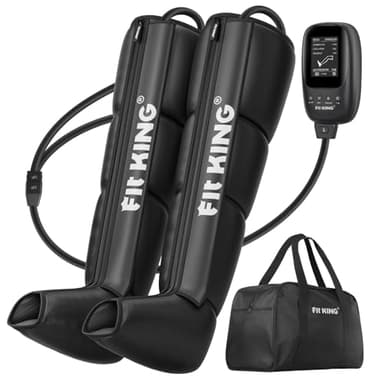
FIT KING Air Compression Recovery Boots
Sequential chamber inflation — the mechanism that actually distinguishes recovery boots from a leg-shaped pressure cuff — at a third of what the category leader charges.
What it gets right
- Genuinely sequential: chambers fire ankle-upward rather than all at once
- Sized options rather than one-size-fits-nobody
- A fraction of the premium system price
What it does not
- Louder pump than the premium units
- Bulky to store and not remotely portable
- Sizing runs specific — measure before buying
Price as of October 5, 2026. #ad How we’re funded
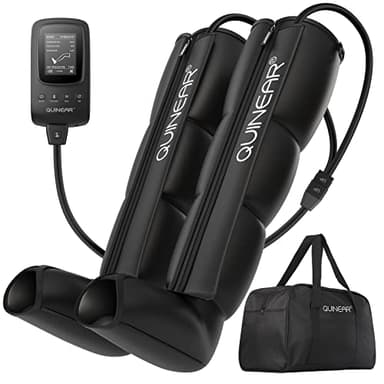
QUINEAR Leg Recovery Compression System
Covers foot, calf and thigh in one sleeve, which matters because the foot is where most budget systems stop and where a lot of the swelling sits.
What it gets right
- Includes the foot, which many systems omit
- Multiple pressure levels and modes
What it does not
- Pump noise
- Not portable
Price as of October 5, 2026. #ad How we’re funded
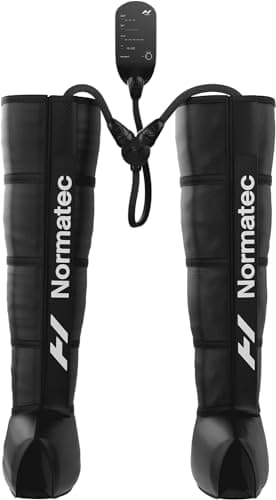
Hyperice Normatec 3 Recovery System
The reference system in the category, and also the one whose price gap over a sequential competitor buys refinement rather than a different mechanism — which is why it is our skip for a home buyer.
What it gets right
- The most refined pressure control and the quietest pump in the category
- The system most likely to still be supported in five years
What it does not
- Several times the price of boots that inflate sequentially the same way
- The added refinement does not change the mechanism
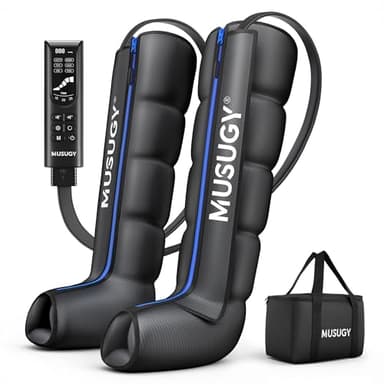
Musugy Sequential Leg Compression Massager
The cheapest genuinely sequential system here — the entry point at which compression boots stop being an aspiration and start being a thing you own.
What it gets right
- Sequential inflation at the lowest price in the category
- Full-leg coverage
What it does not
- Basic controls
- Build quality reflects the price
Common questions
Are compression boots worth it for runners?
For comfort and the feeling of fresher legs the next morning, often yes at the mid-market price. For measured recovery, the evidence is mixed: a 2025 systematic review with meta-analysis found effects for intermittent pneumatic compression on muscle recovery, while a randomized placebo-controlled trial in international-level youth soccer players found no improvement in neuromuscular, biochemical or perceptual recovery after a match. Buy them as a passive comfort device, not as a performance purchase.
What size compression boots do runners need?
Measure the widest part of your calf and the floor-to-below-knee length before ordering, and buy a sized sleeve rather than one-size if your calf is at all developed. A sleeve that is tight before the pump starts cannot inflate and deflate in sequence, so you get a constant squeeze instead of a traveling wave, and a sleeve that is too short leaves the upper calf untreated. Both feel like the boots not working.
When should a runner use compression boots?
After the long run and after hard sessions, within a few hours of finishing, for twenty to thirty minutes with your legs elevated. Not as a warm-up, because a passive squeeze does nothing to prepare a muscle for work. Not on a fresh calf strain or any suspected tear. And not as a substitute for building the training week sensibly, which is the determinant that keeps appearing in the running-injury literature.
Do I need the expensive boots or will cheap ones do?
The mechanism is the same at both ends of the market, so for most runners the mid-market sized pair is the right answer and the premium system is not buying a different effect. The premium becomes defensible in one specific case: very high mileage, nightly use over years, and a preference for a quieter pump and a longer support window. The cheapest systems are the ones to avoid if you are training seriously, because narrow sleeves and short cycles are the wrong two compromises for a runner.
Sources
- 1.Effects of photobiomodulation, intermittent pneumatic compression and neuromuscular electrical stimulation on muscle recovery: systematic review with meta-analysis - Journal of Bodywork and Movement Therapies 2025 (PubMed 40954632) — systematic review with meta-analysis covering intermittent pneumatic compression for muscle recovery
- 2.Intermittent pneumatic compression does not improve post-match neuromuscular, biochemical or perceptual recovery in international-level youth soccer players: a randomized placebo-controlled trial - BMC Sports Science, Medicine and Rehabilitation 2026 (PMC12983609) — placebo-controlled trial: no neuromuscular, biochemical or perceptual recovery benefit after a match
- 3.Incidence and determinants of lower extremity running injuries in long distance runners: a systematic review - British Journal of Sports Medicine (PMC2465455) — training distance and increases in load as recurring determinants of running injury
- 4.camelcamelcamel — FIT KING compression boots price history — price history for the top pick
- 5.camelcamelcamel — Normatec 3 price history — price history for the premium pick