Guides
IT Band Trigger Points
The band itself contains no muscle fibers, which means it cannot contain a trigger point. The tender spots people are hunting for sit in three muscles that pull on it, and once you know where those are, the ball goes somewhere much more useful than the outside of your thigh.
By Stephen V.Published
Disclosure:Grip & Gait earns a commission when you buy through links on this page, at no extra cost to you. It never changes what we recommend or the order we rank things in — here is exactly how we’re funded.
The short version
There is no trigger point in the iliotibial band, because the band is connective tissue with no muscle in it. The three places worth pressing are the tensor fasciae latae at the front of the hip, the gluteus medius at the side and back of the hip, and the vastus lateralis on the outer thigh. Those are muscles, they do tension the band, and they are where a ball earns its money.
Why the band cannot have one
A trigger point, as the term is normally used, is a tender spot within a taut band of muscle fibers. The IT band has none. It is a broad, dense sheet of fascia running down the outside of the thigh from the hip to just below the knee, and its job is to transmit force, not to contract.
That anatomy is also why the treatment advice around it changed. A clinical update in the Journal of Athletic Training describes the long-standing “friction syndrome” model — the band sawing back and forth across the outside of the knee — as having been built on a limited or incorrect understanding of the relevant anatomy, and one that led to a plethora of frustrating and ineffective interventions. The updated model in that paper is compression of the tissue underneath the band rather than friction across it.
The rolling research points the same way. In a repeated-measures study comparing foam rolling over the IT band with foam rolling over the gluteal muscles, the authors concluded that a single bout of rolling over a myofascial group appears to increase passive range of motion in healthy young adults, whereas rolling over the IT band itself — primarily fascial tissue — does not. And a randomized controlled trial using shear wave ultrasound elastography found no significant change in IT band stiffness from a single episode of either foam rolling or stretching.
The three spots, and how to find each one
1. Tensor fasciae latae — front-outside of the hip
Find the bony point at the front of your hip, then move about two finger-widths down and slightly toward the outside. The TFL is a small muscle there, roughly the size of a deck of cards. It is the muscle that pulls directly on the top of the IT band, and in most people who complain of lateral thigh pain it is the single most tender of the three.
How to press it: lie face down with a ball under that spot, propped on your forearms so you control how much weight goes in. Small circles rather than long strokes; there is not enough room for a long stroke. Thirty to sixty seconds is plenty.
2. Gluteus medius — side and back of the hip
Put a hand on the side of your hip with your fingers spread between the top of the pelvis and the bony point at the side. That fan of muscle under your hand is gluteus medius. It also feeds into the band, and it is the muscle group the ITB syndrome literature keeps coming back to.
How to press it: ball against a wall, standing, leaning into it. The wall version lets you regulate pressure by how far your feet are from the baseboard, which is far easier to control than lying on the floor. Then work down and back toward the outer edge of the buttock.
3. Vastus lateralis — the outer thigh, in front of the band
This is the one people think they are rolling when they roll the IT band. Lie on your side with the roller under the outer thigh, then rotate your body about 30 degrees toward the floor. You come off the dense band and onto the outer quad, which is thick, contractile muscle and responds like muscle does.
How to press it: roller rather than ball, because the area is large. Slow passes from just above the knee to the top of the thigh, and expect the lower third to be the tender part.
| Spot | Tool | Position |
|---|---|---|
| Tensor fasciae latae | Ball | Face down, propped on forearms, ball two finger-widths below and outside the front hip bone. Small circles, 30-60 seconds. |
| Gluteus medius | Ball on a wall | Standing, ball between the wall and the side of the hip. Regulate pressure by how far your feet are from the wall. |
| Vastus lateralis | Roller | Side-lying, then rotate about 30 degrees toward the floor so you land on outer quad rather than on the band. |
| The IT band itself | Nothing | Dense fascia with no muscle in it. Rolling it did not change measured band stiffness in a controlled trial, and it hurts. |
What we would actually buy
Start here
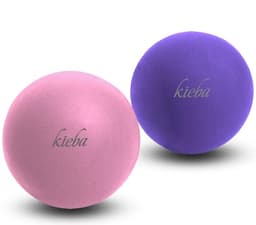
Kieba Massage Lacrosse Balls
Two firm balls are all the TFL and glute medius work needs, and a wall does the rest. This is the cheapest item on the site that solves a real problem outright.
Price as of October 21, 2026. #ad How we’re funded
For the outer quad
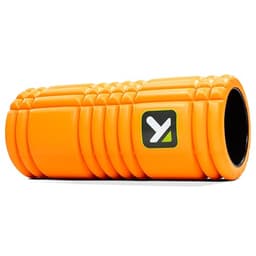
TriggerPoint GRID Foam Roller (13 in)
The vastus lateralis is a big area and wants a roller, not a ball. The multi-density surface lets you find an intensity you can hold a position at without bracing.
If the floor is the barrier
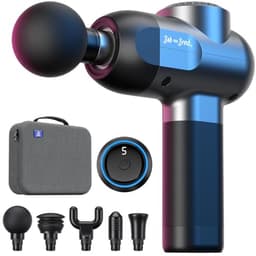
Bob and Brad C2 Massage Gun
The TFL is awkward to reach on the floor and easy to reach standing with a gun. The cheapest unit here that publishes real specs rather than a made-up power figure.
The thing that changed outcomes in the review
A 2024 systematic review of conservative treatment for iliotibial band syndrome in runners pulled together thirteen studies covering 201 participants. Hip abductor strengthening emerged as the common strategy across them, with pain reduction ranging from 27% to 100% and functional improvement from 10% to 57% over interventions lasting two to eight weeks. The authors note large heterogeneity between studies, which is why they could not pool the results into a meta-analysis — so treat those ranges as a spread of study findings rather than as a promise.
Gluteus medius is a hip abductor. That is the connection worth taking away: the muscle you press with a ball for thirty seconds is the same one worth strengthening for the following two months, and the strengthening is the part with the evidence behind it. Side-lying leg raises, banded walks and single-leg work are the usual starting points, and a physical therapist will give you a version that fits what your knee is actually doing.
How to actually run a session
- TFL first, 30–60 seconds. Face down on a ball, forearms taking as much weight as you need them to.
- Glute medius second, 60 seconds. Ball on the wall, working from the top of the pelvis down and back.
- Outer quad third, two slow passes. Roller, rotated 30 degrees off the band.
- Then the strengthening. Which is the part that changes the next run.
Total: about four minutes. If a session is taking fifteen, you are grinding rather than treating, and grinding the lateral thigh is the specific thing the measured research found does not change the tissue.
Related reading on this site
The tool-class routing for this problem — including where a massage gun fits and where it does not — is on the IT band symptom page. If the pain is really coming from the glutes rather than the band, see glutes and piriformis. And if you are working through a set of running niggles rather than one, recovery tools by runner problem maps each one to the cheapest thing that addresses it.
Common questions
Where are the trigger points for the IT band?
Not in the band. The IT band is dense fascia with no muscle fibers in it, so it cannot hold a trigger point. The tender spots are in three muscles that tension it: tensor fasciae latae at the front-outside of the hip, gluteus medius at the side and back of the hip, and vastus lateralis on the outer thigh in front of the band.
How do you release an IT band trigger point with a ball?
For the TFL, lie face down with the ball two finger-widths below and outside the front hip bone, propped on your forearms so you control the load, and make small circles for 30–60 seconds. For gluteus medius, stand with the ball between the wall and the side of your hip and set the pressure by how far your feet are from the wall. Both are more useful than anything you do to the band itself.
Why does foam rolling the IT band hurt so much and help so little?
Because you are compressing dense connective tissue against the femur rather than working a muscle. A study comparing rolling the IT band with rolling the gluteal muscles concluded that rolling a myofascial group increases passive range of motion while rolling the band itself does not, and a separate randomized trial using shear wave elastography found no significant change in band stiffness after a single episode of rolling or stretching.
Should I use a massage gun on my IT band?
On the band itself it has the same problem a roller does — dense fascia over bone. On the TFL and the outer quad a gun is genuinely convenient, particularly if getting on the floor is the reason you skip sessions. Use a ball or flat head, keep it off the bony point at the side of the hip, and stay well above the outside of the knee.
What actually fixes IT band pain in runners?
A 2024 systematic review of conservative treatment in runners found hip abductor strengthening to be the common strategy across thirteen studies, with reported pain reduction of 27% to 100% and functional improvement of 10% to 57% over two to eight weeks. The review notes large heterogeneity between studies. Soft-tissue work makes the hip more comfortable; the strengthening is what the evidence sits behind.
How long should I spend on each spot?
Thirty to sixty seconds on the TFL, about a minute on gluteus medius, two slow passes on the outer quad. Four minutes total. Long grinding sessions on the lateral thigh are the specific thing the measured research found does not change the tissue, and they leave you bruised enough to skip tomorrow.
Sources
- 1.Current Clinical Concepts: Synthesizing the Available Evidence for Improved Clinical Outcomes in Iliotibial Band Impingement Syndrome - Journal of Athletic Training (PMC8359713) — describes the friction-syndrome model as built on a limited or incorrect understanding of the anatomy
- 2.The Effects of an Acute Bout of Foam Rolling on Hip Range of Motion on Different Tissues - International Journal of Sports Physical Therapy (PMC6088119) — rolling a myofascial group increased passive range of motion; rolling the IT band itself did not
- 3.The Immediate Effects of Foam Rolling and Stretching on Iliotibial Band Stiffness: A Randomized Controlled Trial - International Journal of Sports Physical Therapy (PMC8169023) — shear wave elastography found no significant change in IT band stiffness after a single episode of rolling or stretching
- 4.Effects of conservative treatment strategies for iliotibial band syndrome on pain and function in runners: a systematic review - Frontiers in Sports and Active Living (PubMed 39247485) — 13 studies, 201 participants; hip abductor strengthening the common strategy, pain reduction 27-100% over 2-8 weeks
- 5.Reliability of physical examination for diagnosis of myofascial trigger points: a systematic review of the literature - The Clinical Journal of Pain (PubMed 19158550) — physical examination cannot currently be recommended as a reliable test for diagnosing trigger points