Guides
Recovery Tools for Golfers
Golf hurts people in two places: the lower back, from repeating a violent rotation several hundred times a week, and the lead elbow and forearm, from striking the ground. A roller and a ball cover the first. The second needs a tool that loads the tendon rather than massaging it - and that is the one most golfers have never heard of.
By Stephen V.Published
Disclosure:Grip & Gait earns a commission when you buy through links on this page, at no extra cost to you. It never changes what we recommend or the order we rank things in — here is exactly how we’re funded.
What the swing actually loads
A golf swing is a rapid rotation and side-bend of the lumbar spine, repeated. Add a range session to a round and an amateur can do three hundred of them in a week, which is a lot of repetition of one movement in one direction — and the asymmetry is the point: almost nobody practices the mirror-image swing.
Two consequences follow, and they are the whole of this page.
The lumbar spine takes the rotational load. A 2026 T2* mapping study imaged ten high-level amateur golfers against ten matched non-golfers and found no statistically significant difference in overall disc values — but it did find distinctive patterns of intervertebral disc change in the golfers and a higher frequency of elevated Pfirrmann grades. The authors are candid that it is a pilot: their own power analysis suggests 140 to 180 participants per group would be needed for an adequately powered comparison of the lowest lumbar segment. So the correct reading is “a signal worth taking seriously, not a finding”. What is not in dispute is that golfers report low back pain often.
The lead arm takes the strike.The club hits the ground, and the deceleration goes up the lead forearm into the elbow. That is medial elbow tendinopathy — golfer’s elbow — and it is a tendon problem, which matters because tendons respond to graded load, not to massage. This is the single most common place golfers spend money on the wrong tool.
The warm-up, which has a trial behind it
If you buy one thing from this page, buy none of them and do this instead. A double-blind randomized controlled trial gave forty-five high-school golfers either a golfer’s low back pain exercise prevention program or a sham routine, performed before playing, for twelve weeks. The number of people reporting low back pain did not differ significantly between groups. The number of low back pain incidents did, dramatically: 16 in the exercise group against 100 in the sham group.
That is an adolescent sample and a twelve-week window, so do not over-extrapolate it to a sixty-year-old with twenty years of back history. But the direction is clear and the intervention is free: a structured pre-round routine that takes the spine, hips and thoracic spine through their range beats turning up and swinging.
One caveat on how you warm up. A systematic review of the acute effects of muscle stretching on performance and range of motion is the reason we say “dynamic” rather than “hold a hamstring stretch for a minute” before a round. Long static holds are for afterwards.
What a roller does and does not do for a golfer
Rolling has a reasonable evidence base for the two things golfers want from it, and no evidence base for the thing they hope for.
A systematic review and meta-analysis of foam rolling and range of motion supports its use for improving range of motion, and a meta-analysis on post-exercise soreness supports a preventive effect on soreness. A 2024 meta-analysis comparing static stretch training with foam rolling found them broadly comparable for range of motion gains, which is the honest framing: a roller is a convenient way to do mobility work, not a magic alternative to it.
What rolling does not do is change the mechanics of your swing or the load on your discs. If your back hurts because your hips do not rotate and your thoracic spine is stiff, the roller is a tool for working on that — over weeks, not in one session before a round.
What to look for in a golfer’s kit
A long, dense roller, not a textured one. The targets are the lats, the thoracic spine in extension, the glutes and the quads. An 18-inch dense roller spans the back and does not collapse under an adult. Texture is a preference, not a feature; the argument is in foam roller density.
A hard ball, for the glutes and under the shoulder blade. Body weight on a small hard point reaches what a roller rolls past, and those two areas are where a rotational athlete gets stuck.
A light gun, if you want one. The useful jobs are the forearms after a range session and the lats. Weight matters more than power because you will be using it one-handed on your own arm. Nothing on the spine.
A resistance bar for the elbow. The one item here that treats rather than soothes. Medial elbow tendinopathy responds to slow, loaded wrist flexion and extension, and a flexible resistance bar is the standard way to apply it at home.
Lats, thoracic spine, quads
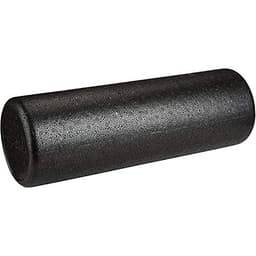
Amazon Basics High-Density Foam Roller (18 in)
Eighteen inches of dense foam spans the back for thoracic extension and covers the lats and quads. The first purchase, and the one that will still be in the garage in ten years.
Price as of October 5, 2026. #ad How we’re funded
Glutes and under the shoulder blade
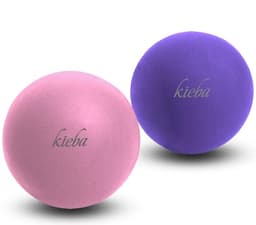
Kieba Massage Lacrosse Balls
Body weight on a hard ball reaches the glute and the muscle under the scapula that a roller skims. A pair costs less than a sleeve of balls you will lose in a round.
Price as of October 5, 2026. #ad How we’re funded
The lead elbow, properly
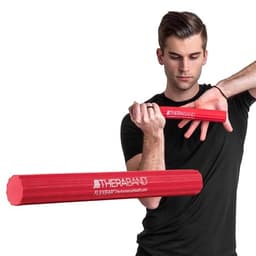
TheraBand FlexBar, Red (light resistance)
The only tool here that loads a tendon rather than rubbing it. Slow, controlled wrist twists are what medial elbow tendinopathy responds to - start with the light resistance, not the stiff one.
Price as of October 5, 2026. #ad How we’re funded
Forearms and lats after a range session
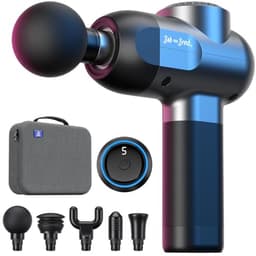
Bob and Brad C2 Massage Gun
Light at 1.5 lb, which is what lets you use it one-handed on your own forearm, and it publishes 10 mm of stroke and over 44 lb of stall force. Never on the spine.
The routine, by when
Before a round.Dynamic only: hip rotations, trunk rotations with a club across the shoulders, side bends, arm swings, and a few half-speed swings building to full. Thirty seconds of roller or gun per muscle at most if you want it — keep it short, because short is the dose the warm-up literature supports. No long static holds and nothing new on the first tee.
After a round. Roller on the lats, quads and glutes, ball on the glute and under the shoulder blade, then the longer stretches. Two or three minutes per area is plenty; the soreness-prevention evidence sits in that range, not in twenty-minute sessions.
Three times a week, away from the course. The elbow bar, and thoracic extension over the roller. This is the part that changes anything, and it is the part everyone skips.
“Deep vein thrombosis, osteomyelitis; bone fracture or myositis ossificans; bleeding disorders; peripheral vascular insufficiency or disease; medications that thin the blood or alter sensations; pacemaker, ICD.”
Where to go next
For the elbow in detail, including why the bar beats the gun, golfer’s elbow is the page, and tennis elbow covers the outside-of-the-elbow version that golfers also get. For the back, lower back pain and upper back pain set out the order of operations, and tight hip flexors is the one most golfers should read first because rotation starts there. If your grip or forearms are the limiting factor, hand and grip strength covers the tools that build it. For the gun side of the kit, the best massage gun for glutes and hips is the relevant roundup for a rotational athlete, and recovery tools for soccer players is the same exercise for a very different sport if you play both.
Common questions
What recovery tools do golfers actually need?
Four things, and two of them are cheap: a long dense foam roller for the lats, thoracic spine and quads; a pair of hard balls for the glutes and under the shoulder blade; a flexible resistance bar for the lead elbow, which is the only item that treats rather than soothes; and optionally a light massage gun for the forearms after a range session. The warm-up matters more than any of them.
Does a warm-up prevent golf back pain?
A double-blind randomized controlled trial in forty-five high-school golfers compared a golfer’s low back pain exercise prevention program with a sham routine before play over twelve weeks. The number of people reporting pain did not differ significantly, but the number of pain incidents did: 16 against 100. It is an adolescent sample over a short window, so read it as a strong direction rather than a guarantee — and note the intervention is free.
Should you use a massage gun on golfer's elbow?
Not on the painful tendon itself. Medial elbow tendinopathy is a load-tolerance problem and what it responds to is slow, graded loading — controlled wrist flexion and extension against a flexible resistance bar, done for weeks. A gun on the forearm muscles above the elbow can feel good and does not treat the tendon, and a gun on the tender spot at the inside of the elbow is the most common wrong purchase in this sport.
Is golf bad for your lower back?
Golfers report low back pain often, and the swing is a repeated rapid rotation and side-bend of the lumbar spine performed almost entirely in one direction. On imaging, a 2026 pilot study of ten elite amateur golfers found no statistically significant overall difference in disc values against matched non-golfers, but did find distinctive degeneration patterns and more elevated Pfirrmann grades — and the authors estimate well over a hundred participants per group would be needed to test it properly. Treat it as a reason to warm up and work on hip and thoracic rotation, not a reason to stop playing.
Sources
- 1.Warm-Up Program for Adolescent Golfers Reduces Low Back Pain: A Double-Blind, Randomized Controlled Trial - Translational Sports Medicine 2025 (PMC12358233) — 16 low back pain incidents vs 100 in the sham group over 12 weeks; adolescent sample
- 2.Early intervertebral degeneration patterns among elite amateur golfers: A T2* mapping study - Brain & Spine 2026 (PMC13332466) — pilot, 10 v 10; no significant overall T2* difference, distinctive patterns and higher Pfirrmann grades
- 3.Foam Rolling Training Effects on Range of Motion: A Systematic Review and Meta-Analysis - Sports Medicine 2022 (PMC9474417) — foam rolling training effects on range of motion
- 4.Preventive effect of foam rolling on muscle soreness after exercise: a systematic review and meta-analysis - Journal of Bodywork and Movement Therapies 2024 (PubMed 39593540) — preventive effect of rolling on post-exercise soreness
- 5.Static Stretch Training versus Foam Rolling Training Effects on Range of Motion: A Systematic Review and Meta-Analysis - Sports Medicine 2024 (PMC11393112) — static stretch training and foam rolling broadly comparable for range of motion
- 6.Acute effects of muscle stretching on physical performance, range of motion, and injury incidence in healthy active individuals: a systematic review - Applied Physiology, Nutrition, and Metabolism 2016 (PubMed 26642915) — acute effects of stretching on performance - why the pre-round work is dynamic
- 7.Therabody — Product Safety & Precautions — contraindications, quoted above