Guides
Recovery Tools for Tennis Players
The injury review is specific enough to shop from: lower-limb problems are roughly half of all tennis injuries, the lower back is next, and shoulder overuse follows. The cheapest intervention in the whole literature is not a device at all - personalising grip size halved lateral elbow pain. Here is what to own for everything that comes after.
By Stephen V.Published Updated
Disclosure:Grip & Gait earns a commission when you buy through links on this page, at no extra cost to you. It never changes what we recommend or the order we rank things in — here is exactly how we’re funded.
The short version
If you play a lot of tennis, the three things worth owning are a light resistance FlexBar for the elbow, a pair of massage balls for the shoulder and hip, and a gun that publishes its numbersfor the legs. The FlexBar is first for a reason: lateral elbow pain is the injury tennis is named after, and the review below found that personalising grip size halved it — which means before you buy anything, go and check the grip on your racket.
Where tennis players actually get hurt
The 2025 systematic review of risk factors and prevention in adolescent and adult high-performance tennis players pulled together 37 observational studies — 16 in adolescents, 18 in adults, three mixed — appraised them with NIH tools and graded the certainty with GRADE. The numbers are worth quoting because they contradict how most players train.
- Lower-limb trauma predominated, at 48 to 56% of injuries. Not the shoulder. Not the elbow. Legs.
- Lumbar problems came next at 12 to 39%, followed by shoulder overuse syndromes.
- Incidence ranged from 2.1 to 3.5 injuries per 1,000 hours in juniors and 1.25 to 56.6 per 1,000 hours in adults — that enormous adult range tells you how differently these studies counted, and is a good reason to read any single number with suspicion.
- Seasonal prevalence was 46 to 54% in juniors and 30 to 54% in professionals. Over a season, roughly half of players get hurt.
The strongest extrinsic predictor across both age groups was an abrupt increase in the acute-to-chronic workload ratio — at or above 1.3 in juniors and 1.5 in adults. In plain terms: the week where you suddenly play much more than you have been playing is the week you get injured. Intrinsic contributors were reduced internal rotation at the shoulder, scapular dyskinesis, and poor core stability.
The three prevention strategies that carried numbers
The review grouped prevention into three clusters, and each came with a figure attached. These are worth more than anything on this page that plugs in.
- External load control.Four-week “ramp-up” strategies reduced injury incidence by up to 21%. Free, and the hardest to actually do in a season.
- Kinetic-chain conditioning. Core stability plus eccentric rotator-cuff training decreased overuse injury by 26% and preserved shoulder mobility. Also free, and the reason the shoulder work on this page is loading rather than massage.
- Technique and equipment adjustment. Grip-size personalisation halvedlateral epicondylalgia — tennis elbow — and serve-timing modification reduced shoulder torque. A racket grip is cheaper than any device we sell.
Nothing in that list is a recovery tool. That is the honest frame for everything below: tools manage symptoms, support loading work and make the week after a tournament tolerable. They do not do what a sensible training ramp and a properly sized grip do.
What to treat, by body part
| The problem | What to use | Why |
|---|---|---|
| Lateral elbow pain (tennis elbow) | Loading, with a FlexBar | Progressive loading is the first-line answer, and the review's cheapest win was grip-size personalisation halving this exact problem. Check the racket before the tendon. |
| Shoulder overuse, loss of internal rotation | Eccentric cuff work; balls for the pec and rear shoulder | Core plus eccentric cuff training cut overuse by 26%. A ball against a wall reaches the structures that have tightened around it; percussion does not reach the cuff. |
| Lower back after a serving session | Foam roller for the thoracic spine and hips | Lumbar injury is 12-39% of tennis injuries, and serving loads it. Mobility above and below the lumbar spine is the usable half at home. |
| Legs: calves, quads, hamstrings | Gun or roller | Lower-limb trauma is roughly half of all tennis injuries. Court sport means repeated acceleration and deceleration, and this is where a gun earns its keep. |
| Feet after a long match on hard court | Foot roller or ball | The plantar surface takes every stop and split-step. A couple of minutes rolling it is the cheapest recovery habit in the sport. |
| An ankle that rolled | Clinician first | Acute trauma is not a recovery-tool problem. Get it assessed, then come back for the rehab half. |
What to look for in the tools themselves
- Light resistance for the elbow, not heavy. Loading a painful tendon starts below where you think it should. The red FlexBar is the light one, and it is the one to buy first; going too hard too early is the most common self-inflicted setback in tennis elbow.
- Balls, not a gun, for the shoulder. You can pin a ball between a wall and the back of your shoulder one-handed. A gun cannot reach the cuff tendons, which run under bone.
- A gun light enough for your own hamstring and calf. Weight matters more than power for self-treatment. Published amplitude and stall force matter more than brand.
- A roller dense enough for quads, not so dense it is unusable. Medium density covers both the thoracic spine and the legs, which is the whole kit for most players.
- Nothing that claims to prevent injury. The things that reduced injury in the review were a workload ramp, a conditioning program and a racket grip.
What we would actually buy
Three items, in the order the injury data justifies them: the elbow tool, the shoulder tool, and the legs tool.
For the elbow
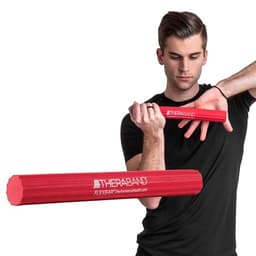
TheraBand FlexBar, Red (light resistance)
Light resistance, which is where loading an irritable elbow tendon has to start. The cheapest item here and the one aimed at the injury tennis is named after - after you have checked your grip size.
Price as of October 21, 2026. #ad How we’re funded
For the shoulder and hip
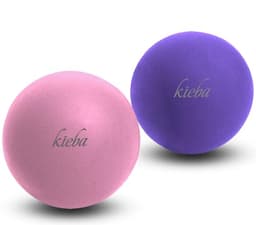
Kieba Massage Lacrosse Balls
A pair of firm balls does the rear shoulder, the pec and the glute, one-handed, against a wall. The structures that tighten around an overused serving shoulder are reachable this way and not with percussion.
Price as of October 21, 2026. #ad How we’re funded
For the legs
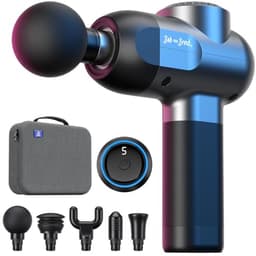
Bob and Brad C2 Massage Gun
Publishes both amplitude and stall force at a budget price, which almost no premium gun does. Calves, quads and hamstrings after a long match is exactly the job percussion is good at.
A week that respects the workload finding
The single most actionable number in the review is the workload one, so build the week around it. If you played four hours last week, six this week is a bigger jump than it feels like. Add court time gradually over four weeks rather than in one keen fortnight — that is the strategy that reduced incidence by up to 21%.
Around that: eccentric cuff work and core stability twice a week, because together they cut overuse injury by 26% in the review and nothing you can buy comes close to that. Five minutes of rolling for calves and quads after matches. A ball on the rear shoulder and pec on the days after heavy serving. And the elbow loading, if your elbow has ever complained, done little and often rather than in angry bursts.
Where to go next
By body part: tennis elbow has the full loading routine, rotator cuff pain covers the serving shoulder, lower back pain the lumbar half, and calf and shin pain the court-sport legs. For the kit itself, the starter recovery kit is the cheapest sensible set, and the massage ball roundup covers the shoulder tools in detail. Players from other sports: see golfers, soccer players and basketball players, climbers and swimmers, whose shoulder problem is the same structure arriving by a completely different route.
Common questions
What are the most common tennis injuries?
Lower-limb injuries, by a wide margin. The 2025 systematic review of 37 studies in high-performance tennis found lower-limb trauma accounted for 48 to 56% of injuries, lumbar problems 12 to 39%, and shoulder overuse syndromes after that. Seasonal prevalence was 46 to 54% in juniors and 30 to 54% in professionals, so roughly half of players pick up an injury over a season. Tennis elbow is the famous one, not the most common one.
What actually prevents tennis injuries?
Three things, each with a number attached in the 2025 review. Four-week workload ramp-up strategies reduced injury incidence by up to 21%. Core stability combined with eccentric rotator-cuff training decreased overuse injury by 26% and preserved shoulder mobility. And grip-size personalisation halved lateral epicondylalgia, while serve-timing modification reduced shoulder torque. None of those is a device — they are a training plan, a conditioning program and a racket adjustment.
Does a massage gun help tennis elbow?
Only indirectly. A gun can loosen the forearm muscles around an irritated tendon, which is sometimes comfortable, and it does not treat the tendon. What changes a tendon is progressive loading — a light FlexBar is the cheapest way to do it at home — and the single biggest intervention in the review was equipment: grip-size personalisation halved lateral elbow pain. Do not run a gun directly over the painful bony point on the outside of the elbow.
How should a tennis player recover after a long match?
Legs first, because that is where the injuries are. Five minutes of rolling for calves and quads, a couple of minutes on the plantar surface of each foot, and a ball on the rear shoulder and pec if you served heavily. Then the boring half that the data actually supports: do not spike your court hours the following week, and keep the core and cuff conditioning going twice a week.
Sources
- 1.Risk Factors and Prevention of Musculoskeletal Injuries in Adolescent and Adult High-Performance Tennis Players: A Systematic Review - Sports (Basel) 2025 (PMC12568103) — 37 studies; lower limb 48-56%, lumbar 12-39%; ramp-up -21%, core plus eccentric cuff -26%, grip sizing halved lateral elbow pain
- 2.Exercise interventions for rotator cuff-related shoulder pain in middle-aged and older adults: a systematic review and meta-analysis - BMC Musculoskeletal Disorders 2026 (PMC13471655) — the exercise evidence behind the shoulder half
- 3.Preventive effect of foam rolling on muscle soreness after exercise: a systematic review and meta-analysis - Journal of Bodywork and Movement Therapies 2024 (PubMed 39593540) — what rolling does for soreness, which is the claim we make for the legs
- 4.camelcamelcamel — Bob and Brad C2 price history — price history for the gun pick