Massage Guns
Theragun Mini vs Bob and Brad Q2 Mini
Two guns you can actually carry, judged on the only spec that matters for a travel tool — whether you take it with you. The Q2 is the honest pick and the Mini is the nicer object, but the harder question is whether you should buy a mini at all.
By Stephen V.Published
Disclosure:Grip & Gait earns a commission when you buy through links on this page, at no extra cost to you. It never changes what we recommend or the order we rank things in — here is exactly how we’re funded.
Quick picks
Ranked on published manufacturer specs and what they mean for the job, not on testing we have not done. Tap a row for the full reasoning. How we score.
| # | Product | Best for | Score | Price |
|---|---|---|---|---|
| 1 |  Bob and Brad Q2 Mini Massage Gun Pocketable, FSA eligible, from the brand whose full-size gun publishes complete specs, at a fraction of the premium mini. | The honest travel pick | 7.6 | |
| 2 |  Therabody Theragun Mini (3rd Gen) A nicer object that survives a bag, priced like a full-size premium gun for a shorter stroke. | Premium build and brand | 7.1 | $219.99 · View on Amazon Price as of October 21, 2026. #ad How we’re funded |
| ✕ |  Bob and Brad C2 Massage Gun A full-size gun reaches more of your body. Buy a mini only if portability is the actual requirement. Skip this | If you do not truly need mini | 8.6 |
The short answer
If you genuinely need a gun that lives in a bag, buy the Bob and Brad Q2 Mini. It is pocketable, it is FSA and HSA eligible, and it comes from the one brand in this category with a habit of publishing its numbers — all at a fraction of what the premium mini costs. The Theragun Mini is the nicer object: better built, more likely to shrug off being thrown in a bag, and backed by a brand that will still exist in a few years. But it is priced like a full-size premium gun for a shorter stroke, which is a strange thing to pay for. And the real question, the one both product pages would rather you skipped, is whether you should buy a mini at all.
The one spec that matters for a travel gun
A mini is judged on exactly one thing: whether you actually take it with you. Every other specification is downstream of that. A gun that is a little more powerful but too bulky to pack gets left at home, where it does nothing; a gun small enough to live in your bag gets used on the road, where a full-size one never would. Both of these clear that bar — each is small enough to carry and light enough to hold against your own muscle without your arm giving out. So the decision comes down to the things that separate two tools that both pass the only test that counts: price, build, transparency, and honesty about what a small body can and cannot do.
The physics nobody selling a mini wants to lead with
Here is the constraint that governs this entire category, and it is not a flaw in any particular product: a short body cannot deliver a long stroke. Stroke length — how far the head travels on each pass — is what determines how deep a percussion gun reaches, and that travel has to happen inside the housing. Shrink the housing to make the gun pocketable and you have less room for the stroke to occur in, so it gets shorter. This is geometry, not corner-cutting. Every mini on the market, premium or budget, trades reach for portability, and no amount of brand or price buys back the millimeters the small body gave up.
That is why a mini is a second gun, not a first one. It is the tool you carry to keep a niggle quiet on a trip, not the tool you rely on for a dense glute or a thick lower back at home. Hold that thought — it is the whole reason the third pick on this page exists.
Where the Q2 wins: honesty and price
The Q2’s case is straightforward. It is genuinely pocketable, it costs a fraction of what the Theragun Mini does, and it is FSA and HSA eligible, which lowers its real price again for a lot of buyers. Its most underrated feature, though, is the badge on it. Bob and Brad is the one brand here whose full-size gun publishes amplitude, stall force, speed range and noise on the page you buy from, when the premium brands publish none of the first three — we checked Therabody’s current US page. You are buying from a company with a track record of telling you what its hardware does, which is worth something even on a small model where the specs are necessarily modest. If you are set on Therabody and weighing the Mini against its full-size sibling instead, Theragun Prime vs Mini lays out what each publishes.
Where the Theragun Mini wins: it is a nicer thing to own
The Theragun Mini is the better-made object. It feels more solid, it is more likely to survive years of being dropped into a gym bag and rattled around, and it carries the permanence of a brand that will still be selling attachments long after most of this category has disappeared. Those are real advantages and some buyers value them enough to pay for. What is hard to defend is the price: the Mini costs about what a full-size premium gun costs, and for that money you get a shorter stroke and a smaller body. You are paying a premium to get less reach, in exchange for build quality and a badge. Whether that trade is worth it depends entirely on how much you value the object over what it does.
The pick that undercuts both: buy full-size instead
For most people asking this question, the honest answer is to buy neither mini and get a full-size gun. The Bob and Brad C2is a full-size unit that reaches more of your body, delivers a longer stroke than any mini can, publishes all four depth-relevant specs, and is FSA and HSA eligible — and it costs less than the Theragun Mini. Its published stall force, the number that decides whether the stroke survives contact, is higher than the figure the premium field quotes, and it is still light enough to hold overhead against your own shoulder. For a home gun there is no contest.
The one thing the C2 cannot do is disappear into a jacket pocket. That is the entire case for a mini, and it is a real case — but only if portability is the actual requirement rather than a nice-to-have you talked yourself into. Be honest about how often you will really travel with it. If the true answer is “rarely,” buy the full-size gun and put a lacrosse ballin your bag for the road instead. If the true answer is “constantly,” the Q2 is your gun and the Mini is your gun-if-money-is-no-object. Our travel massage gun guide walks through the same logic in more detail.
What a mini is genuinely good at
None of this means a mini is a bad tool — used for the job it is built for, either of these earns its keep. On the road, a mini keeps a travel-stiff calf, a knotted shoulder or a tight forearm quiet, and those are exactly the accessible muscles a short stroke handles well. Before a run or a lift away from home, a quick pass with a mini does the same warm-up job the research supports without you having to pack anything full-size. Kept in a desk drawer, it breaks up the stiffness of a day spent at a keyboard. In every one of those cases the mini is winning on the one spec that matters — it is there, in your bag, when the full-size gun is at home.
For travel specifically, two practical details matter more than any performance number. The first is charging: a mini you can top up from the same cable as your phone is one less adapter to pack, so a common charging standard is worth more on the road than an extra speed setting. The second is bulk, including the case — a gun that only fits with a rigid case the size of a lunchbox is not really a pocket gun. Both of these clear those bars comfortably, which is why the decision between them comes back to price, build and honesty rather than portability, since each is portable enough.
What either mini will and will not do
Whichever you carry, keep your expectations calibrated to what percussion actually does. A systematic review supports percussion producing short-term gains in acute and explosive strength when used before activity, which is a sensible thing to want from a gun you carry to the gym. But the randomized trial on soreness found it delivered immediate, temporary relief without actually speeding recovery. A mini, with its necessarily shorter stroke, reaches an even more modest version of that same ceiling. It is excellent for keeping a calf or a shoulder loose on a trip and poor for serious work on dense muscle — which is exactly what a travel tool should be, provided you do not expect it to replace the gun at home.
Our verdict
Buy the Bob and Brad Q2 Mini if you need a travel gun: it is pocketable, FSA eligible, honestly priced, and from the brand that publishes its numbers. Buy the Theragun Mini only if build quality and brand permanence are worth paying full-size premium money for a shorter stroke. And for almost everyone else, buy neither — a full-size gun like the C2 reaches more of your body for less than the premium mini, and a mini earns its place only when portability is the real requirement. Sort out which of those you are before you spend, and read our Bob and Brad vs Theragun and cheap vs expensive breakdowns if you are still deciding.
Every pick, in full
Specs below are the manufacturer’s own published figures, each linked to the page it came from. Where a maker does not publish a number, the table says so and names the page we checked — that absence is information too.
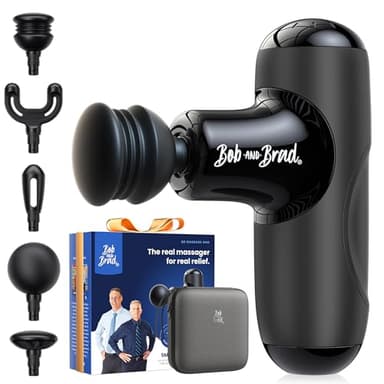
Bob and Brad Q2 Mini Massage Gun
Pocket-sized from the one brand in this category with a habit of publishing its numbers — the honest travel option at a third of what the premium minis cost.
What it gets right
- Genuinely pocketable
- From a brand whose full-size model publishes complete specs
- FSA/HSA eligible
What it does not
- A short body cannot deliver a long stroke — physics, not a flaw
- Not the tool for glutes or thick back muscle
Price as of October 21, 2026. #ad How we’re funded
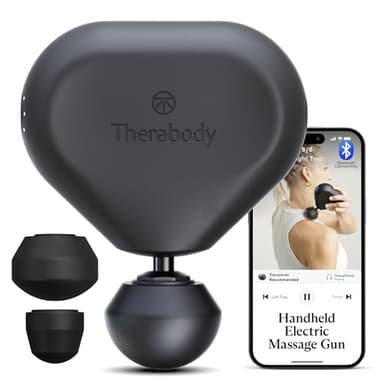
Therabody Theragun Mini (3rd Gen)
A genuinely pocketable gun that survives being thrown in a bag — the trade is that a short body has to give up stroke somewhere, and Therabody does not say where.
What it gets right
- Small enough to actually carry, which is the only spec that matters for a travel gun
- Simple three-speed operation
What it does not
- No published amplitude or stall force
- Priced like a full-size premium gun
- Short handle means you cannot reach your own mid-back with it
| Amplitude | Not published page we checked |
|---|---|
| Stall force | Not published page we checked |
| Speed range | 1,750–2,400 PPM source |
| Speed settings | 3 source |
| Weight | 0.9 lb source |
| Noise | Not published page we checked |
| Battery | 2.5 h source |
| Attachments | 3 source |
| Warranty | 1-year limited source |
| Dimensions | 116 × 135 × 96 mm source |
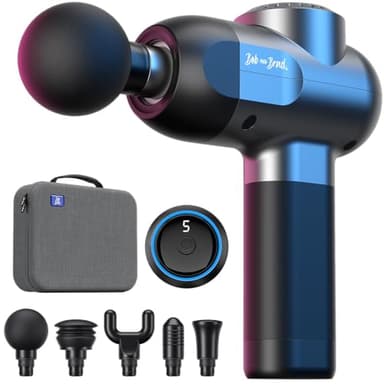
Bob and Brad C2 Massage Gun
The only gun in this roundup whose maker publishes all four numbers that decide whether it reaches the muscle — amplitude, stall force, speed range and noise — and the stall-force figure is higher than the premium units that hide theirs.
What it gets right
- Publishes amplitude, stall force, speed range and noise — the two market leaders publish none of the first three
- Published stall force of over 44 lb is higher than the figure Therabody publishes for the Prime
- 1.5 lb is light enough to hold overhead against your own shoulder without your arm giving out first
- FSA/HSA eligible, which quietly makes it cheaper again for a lot of buyers
What it does not
- 10 mm amplitude is genuinely shorter than a 16 mm premium stroke — that difference is real for glutes and thick back muscle
- No app, no pressure-feedback screen, no ecosystem
- Five fixed speeds rather than a continuous range
Common questions
Is the Bob and Brad Q2 Mini as good as the Theragun Mini?
For a travel tool, it is the smarter buy. The Q2 is pocketable, FSA and HSA eligible, costs a fraction of the Theragun Mini, and comes from the brand whose full-size gun publishes its full specs. The Theragun Mini is the better-made object and carries stronger brand permanence, but it is priced like a full-size premium gun for a shorter stroke. Unless build quality is worth that premium to you, the Q2 wins.
Do mini massage guns work as well as full-size ones?
Not for deep work, and it is physics rather than a flaw. A short body cannot fit a long stroke inside it, and stroke length is what determines how deep a gun reaches. Minis trade reach for portability, so they are good for keeping accessible muscles loose on the road and poor for dense glutes or a thick lower back. Treat a mini as a second gun for travel, not as a replacement for a full-size one at home.
Should I buy a mini massage gun or a full-size one?
If it is your only gun, buy full-size. A full-size unit reaches more of your body, delivers a longer stroke into thick muscle, and often costs less than a premium mini — the Bob and Brad C2 does all three and undercuts the Theragun Mini. Buy a mini only when portability is a real, specific requirement, such as frequent travel or a daily gym bag, and ideally as a second gun alongside a full-size one at home.
Sources
- 1.Bob and Brad — C2 massage gun product page — full-size C2 publishes amplitude, stall force, speed range and noise; FSA/HSA eligible
- 2.Therabody — Theragun Prime product page — amplitude and stall force not published on the current US product page
- 3.The Effect of Percussive Therapy on Musculoskeletal Performance and Experiences of Pain: A Systematic Literature Review (PubMed 37020441)
- 4.Percussion massage therapy and recovery from delayed onset muscle soreness — randomized controlled trial (PMC11979224)