Recovery Tech
The Best TENS Units for Neck and Shoulder Pain
This is the one region where the wireless unit is the right answer, because a trap you can treat while you keep working is a trap you will actually treat. It is also the one region with a hard anatomical no-go zone. Here is the unit we would buy, where the pads go, and where they must never go.
By Stephen V.Published
Disclosure:Grip & Gait earns a commission when you buy through links on this page, at no extra cost to you. It never changes what we recommend or the order we rank things in — here is exactly how we’re funded.
Quick picks
Ranked on published manufacturer specs and what they mean for the job, not on testing we have not done. Tap a row for the full reasoning. How we score.
| # | Product | Best for | Score | Price |
|---|---|---|---|---|
| 1 |  KingPavonini Wireless TENS + EMS Muscle Stimulator The one body region where wireless is worth the premium: pods sit on the trapezius under a shirt and you carry on with your day rather than sitting still for 30 minutes. | Best overall for traps | 8.4 | |
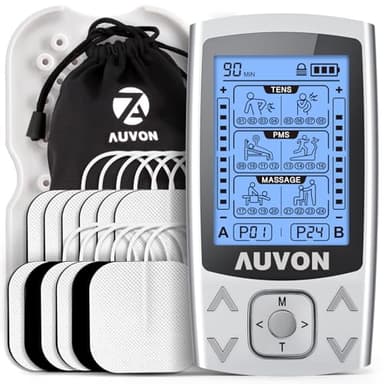
| 2 |  AUVON Dual Channel TENS Unit Dual channel, so one pair on each shoulder, with small intensity steps at the bottom of the range - which matters a lot more on a neck than on a lower back. | Best value for the same job | 8.2 | $35.99 · View on Amazon Price as of October 5, 2026. #ad How we’re funded |
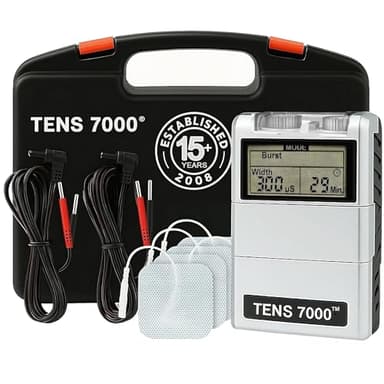
| 3 |  TENS 7000 Digital TENS Unit Adjustable pulse width and rate if you want to tune the sensation rather than cycle through programs. Wired, which is the trade for the control. | Manual control of the pulse | 7.9 | $38.88 · View on Amazon Price as of October 5, 2026. #ad How we’re funded |
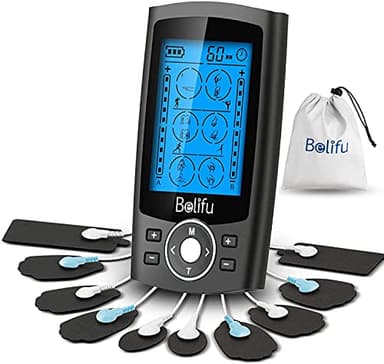
| ✕ |  Belifu Dual Channel TENS EMS Unit Bought for its pad count, which is the wrong virtue for a region that needs two or four pads placed accurately. The long unnamed mode list gets in the way. Skip this | The one to skip here | 6.8 | $32.99 · View on Amazon Price as of October 5, 2026. #ad How we’re funded |
The no-go zone comes first on this page
Everywhere else on the body, TENS placement is a matter of effectiveness. On a neck it is a matter of safety, so this is the first section rather than the last.
Never place a TENS electrode on the front or sides of your neck. The carotid sinus sits there, and stimulating it can affect blood pressure and heart rhythm. Never place one over the throat or the voice box. Never place pads so that current passes through your head. Never use a TENS unit at all if you have a pacemaker, an implanted defibrillator or any other implanted electrical device.
What that leaves you is the back and the top: the trapezius sloping from the base of the skull out to the point of the shoulder, the muscle between the shoulder blades, and the back of the neck either side of the spine — never on the bony midline itself. That is plenty of room for the problem most people have, which is a stiff, loaded, screen-and-phone neck rather than anything in front.
Why wireless wins specifically here
On every other page on this site we rank the wireless unit last, and on two of them we mark it as the one to skip. Here it goes first, and the reason is behavioral rather than technical.
Neck and shoulder pain is chronic, low-grade and tied to posture and hours at a desk. The useful dose is not one heroic session; it is twenty minutes, several times across a working day, repeated over weeks. A wired unit means sitting still with leads running out of your collar, which nobody does three times a day at work. Pods that stick to the top of each shoulder under a shirt and run from a remote are the difference between a device you use and a device in a drawer — and compliance is the only variable that reliably separates people who get something out of TENS from people who do not.
The trade is real: fixed programs instead of adjustable pulse width, pod-shaped pads instead of squares you can cut and position, and a higher price. For a sciatic referral down a leg those trades are disqualifying, which is why the sciatica page ranks it last. For a trapezius they barely matter, because the target is a broad sheet of muscle sitting right under the skin, and you are not trying to aim anything at a nerve root.
How we ranked these for necks and shoulders
- Will you wear it at your desk? Weighted first, deliberately. A unit that fits under a shirt gets used at the frequency the problem needs.
- Pad shape against a sloping muscle. The trapezius curves. A pad that lifts at one edge stops conducting evenly and starts stinging at the corner that is still stuck.
- Small steps at the bottom of the intensity range.A neck tolerates far less current than a lumbar spine and the jump between “nothing” and “too much” on a coarse unit lands exactly in the useful zone.
- Two independent channels. Both shoulders at once, at different intensities, because almost nobody is symmetrical here.
- Nothing that encourages a bad placement. We marked down any unit whose packaging or app illustrates pads near the front of the neck.
What the evidence currently is, stated plainly
Honest answer: thinner than you would expect for a treatment this old. The best indication of where the field stands is that Cochrane has an open 2026 protocol for a systematic review of TENS for chronic neck pain — a protocol, not a finished review. Its stated objective is to evaluate the benefits and harms of TENS, alone or as an adjunct, against sham TENS, placebo, no treatment or other clinical interventions in adults with chronic neck pain. In other words, the definitive synthesis for this exact question is still being assembled, and anyone quoting you a number for it today is quoting something other than a Cochrane review.
For calibration, Cochrane’s review of transcutaneous electrostimulation for knee osteoarthritis gives you a sense of the effect sizes this modality tends to produce in a joint with far more trial data, and a 2025 meta-analysis of TENS for neuropathic pain found only a small, not clinically significant reduction against placebo overall. Nothing in that picture says TENS is useless; it says the honest expectation is modest symptom relief while the unit is running, at low cost and low risk.
Which, for a desk-bound neck, is a reasonable thing to buy. Just buy it alongside the unglamorous things — a screen at eye height, breaks, and the shoulder work in our neck and shoulder page— rather than instead of them.
Where the pads go
Both traps. One pad on the top of each shoulder, roughly midway between the base of the neck and the point of the shoulder, with the second of each pair a few inches lower on the back so current crosses the muscle. This is the default and it covers most of what people come here for.
Either side of the back of the neck. Two pads at the base of the skull level, placed on muscle either side of the spine, never on the midline and never wrapping toward the front. Lower intensity than the traps.
Between the shoulder blades. Bracket the sore area with the pads above and below or either side of it. This is the placement for the stiffness that comes from hours of forward reach, and it is also the easiest one to get a partner to help with.
Twenty to thirty minutes, up to two or three times a day, at a strong but comfortable tingle with no visible muscle twitch. Move pads slightly between sessions so the adhesive is not pulling the same skin every time. The general method, including why you bracket rather than aim at the center, is in how to use a TENS unit.
Which unit for which person, in one line each
- You want to treat your traps during the working day: the KingPavonini wireless. Pods under a shirt, a remote in your pocket, and the dose frequency the problem actually needs.
- You want the same job done for a third of the money: the AUVON. Dual channel, fine low-end control, and the preset modes are usable without a manual. The value pick on this page by a wide margin.
- You want to tune the sensation yourself: the TENS 7000. Manual pulse width and rate; accept the wires as the price of the dials.
- Skip the big pad bundle.The Belifu is a good unit bought for the wrong reason here — a neck needs two or four pads placed accurately, not twelve.
Where TENS is the wrong tool for a neck
If the complaint is one hard knot rather than a diffuse ache, pressure beats current — a ball against a wall or a gun used carefully on the top of the shoulder. The boundaries for percussion on a neck are strict and they are set out in the best massage gun for neck and shoulders, which also explains why nothing goes on the front of the neck there either. If the pain refers down an arm with pins and needles, that is a nerve pattern and the first stop is neck and shoulder pain rather than a device. For the category comparison, heating pad vs TENS is the honest one for this region, and massage gun vs TENS covers the pressure-versus-current question. If you want the general ranking rather than this region, the main TENS roundup is the page.
Every pick, in full
Specs below are the manufacturer’s own published figures, each linked to the page it came from. Where a maker does not publish a number, the table says so and names the page we checked — that absence is information too.
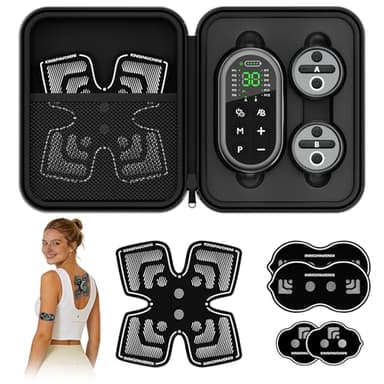
KingPavonini Wireless TENS + EMS Muscle Stimulator
TENS and EMS from two pods you stick on and wear, with no lead wires anywhere — which is the whole reason to pay this much, because it is the only version of the device you can use under a shirt and still move around in. The 48-mode count is marketing; the dual-zone independent control underneath it is not.
What it gets right
- Wireless pods rather than lead wires, so it works under clothing and while moving
- Two pods run independently — separate mode and intensity each, so a shoulder and a leg can run different settings at once
- Published 20 hours per pod on the 1040 mAh cell, charged over USB-C rather than off a disposable battery
- Ships with three pad sizes including a 4.3 in butterfly pad, which is the one that actually covers a lower back
What it does not
- Forty-eight modes is a mode count, not a specification — the same marketing this site flags on every cheap unit
- Several times the price of a wired dual-channel unit that treats a back just as well
- Two pods and a remote are three things to keep charged and not lose
- Listed only in December 2025 and rated 4.1 across 69 reviews, so there is very little ownership history behind it
Price as of October 5, 2026. #ad How we’re funded
AUVON Dual Channel TENS Unit
Two independent channels so you can treat both sides of a problem at once, at a price where trying TENS costs less than one session of anything else.
What it gets right
- Two independent channels with separate intensity control
- Rechargeable rather than eating 9 V batteries
- Cheap enough to find out whether TENS does anything for you
What it does not
- Pad adhesive life is the real running cost, not the unit
- Interface is fiddly with cold hands
Price as of October 5, 2026. #ad How we’re funded
TENS 7000 Digital TENS Unit
The unit clinics hand out, with manual control over pulse width and rate rather than a menu of preset programs — which is what you want once you know what setting helps.
What it gets right
- Manual pulse-width and rate control instead of fixed presets
- The long-standing clinic default, so accessories are everywhere
What it does not
- Runs on a 9 V battery
- Manual control is only an advantage if you know what you are adjusting
Price as of October 5, 2026. #ad How we’re funded
Belifu Dual Channel TENS EMS Unit
Twenty-four modes at the lowest price in the category, and the mode count is marketing — but the hardware underneath is a competent dual-channel stimulator.
What it gets right
- Cheapest dual-channel unit here
- Rechargeable
- Pads and leads included
What it does not
- Mode count is noise, not a feature
- Thin documentation of what each mode does
Common questions
Can you use a TENS unit on your neck?
On the back and top of the neck and shoulders, yes. Never on the front or sides of the neck: the carotid sinus is there and stimulating it can affect blood pressure and heart rhythm. Never over the throat, and never in a way that sends current across your head. Keep pads off the bony midline of the spine, use a lower intensity than you would on a lower back, and do not use TENS at all with a pacemaker or implanted defibrillator.
What is the best TENS unit for neck and shoulder pain?
The KingPavonini wireless unit, because this is the one region where wearability beats control: pods sit on the trapezius under a shirt, so you get the several-times-a-day dose the problem needs instead of one session you sit still for. If you want the same job for much less money, the AUVON dual channel is the value pick, and the TENS 7000 is the choice if you want manual pulse width and rate and do not mind wires.
Does TENS work for chronic neck pain?
The definitive answer does not exist yet. Cochrane has an open 2026 protocol for a systematic review of TENS for chronic neck pain, which means the synthesis is still being assembled. Related evidence suggests modest effects for this modality: a 2025 meta-analysis of TENS for neuropathic pain found only a small, not clinically significant reduction against placebo. Expect symptom relief while it runs, at low cost and low risk, and pair it with posture and shoulder work rather than relying on it.
How often can you use a TENS unit on your shoulders?
Twenty to thirty minutes per session, up to two or three times a day, at a strong but comfortable tingle with no visible muscle twitch. Shift the pads a centimeter or two between sessions so the adhesive is not pulling the same patch of skin repeatedly. If you find yourself steadily turning the intensity up to get the same sensation, take a day off rather than climbing.
Sources
- 1.Transcutaneous electrical nerve stimulation (TENS) for chronic neck pain - Cochrane Database of Systematic Reviews 2026, PROTOCOL (PMC13501494) — open Cochrane PROTOCOL, 2026 - the review itself is not yet published
- 2.Transcutaneous electrostimulation for osteoarthritis of the knee - Cochrane Database of Systematic Reviews (PubMed 19821296) — completed Cochrane review in a joint with more trial data, for calibration
- 3.Neuropathic Pain Relief Through Transcutaneous Electrical Neuromuscular Stimulation: Insights From a Systematic Review and Meta-Analysis of Clinical Evidence - BioMed Research International 2025 (PMC12543013) — SMD -0.35 vs placebo, not clinically significant, across 25 pooled studies
- 4.camelcamelcamel — AUVON TENS price history — price history for the value pick
- 5.camelcamelcamel — TENS 7000 price history — price history for the manual-control pick