Massage Guns
Hypervolt vs Hypervolt Go
Hyperice sells a small handheld and a full-size one, and the intuitive assumption — that the bigger, pricier unit is the better-documented one — is backwards. The Go 3 publishes a speed range and a noise figure. The Hypervolt 2, which costs more, publishes neither. Here is what that actually means when you are choosing.
By Stephen V.Published
Disclosure:Grip & Gait earns a commission when you buy through links on this page, at no extra cost to you. It never changes what we recommend or the order we rank things in — here is exactly how we’re funded.
Quick picks
Ranked on published manufacturer specs and what they mean for the job, not on testing we have not done. Tap a row for the full reasoning. How we score.
| # | Product | Best for | Score | Price |
|---|---|---|---|---|
| 1 |  Hyperice Hypervolt Go 3 1.6 lb, five speeds, and the only Hyperice handheld under the premium tier that states both an RPM range and a dB figure. | Most people, and all travel | 8.2 | $149.00 · View on Amazon Price as of October 21, 2026. #ad How we’re funded |
| 2 |  Hyperice Hypervolt 2 More attachments, a bigger motor and pressure feedback. Costs more than the Go and publishes less about itself than the Go does. | Five attachments, full-size body | 8.0 | $229.00 · View on Amazon Price as of October 21, 2026. #ad How we’re funded |
| 3 |  Hyperice Hypervolt 3 Pro 51 dB, a 1,500-2,500 RPM range and a heated head. The most expensive handheld Hyperice sells, and the heaviest. | The most documented Hyperice | 8.1 | $349.00 · View on Amazon Price as of October 21, 2026. #ad How we’re funded |
The short answer
Buy the Hypervolt Go 3 unless you have a specific reason not to. It is the lightest unit Hyperice makes, it publishes more about itself than the full-size Hypervolt 2 does, and it is the cheapest of the three. Buy the Hypervolt 2 if you want five attachments and a larger motor in a full-size body and you are comfortable buying a device whose maker publishes no speed range and no noise figure for it. Buy the Hypervolt 3 Pro only if a heated head and a stated 51 dB are worth roughly double the Go to you.
None of the three publishes the number that decides depth. That is the honest frame for this whole comparison and we come back to it below.
The criteria, before the picks
This site ranks percussion devices on published specifications, not on how a device feels in a video. So the questions that decide this comparison, in the order they matter:
- Weight. The single most practical spec on a handheld. Weight is what decides whether you can hold the thing against your own upper back or shoulder for more than about a minute, which is the position most people actually need it in.
- What the maker will state in writing. A published decibel figure or speed range is checkable. “Whisper quiet” is not. Between two devices we cannot test, the one whose maker commits to numbers is the one we can say more about.
- Attachments and reach. How many heads are in the box, and whether the body is shaped to get behind your own shoulder blade.
- Battery and portability. Stated runtime, and whether it goes in the bag you were already carrying.
- Price against all of the above. Last, deliberately. Cheap is only a virtue once the tool does the job.
What Hyperice actually publishes for each
We read all three current product pages on 5 September 2026 and recorded what is on them. The full sourced tables sit under each pick below; the short version is this.
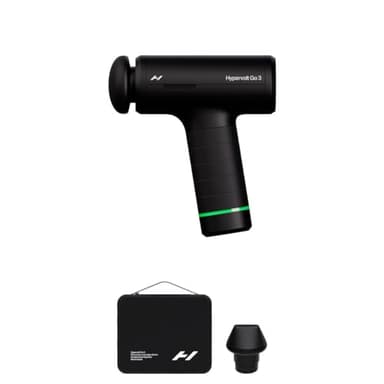
- Hypervolt Go 3.1.6 lb. Five speeds across a stated 1,500–2,500 RPM. A stated 55 dB. Up to four hours of battery. Two attachments, flat and wedge.
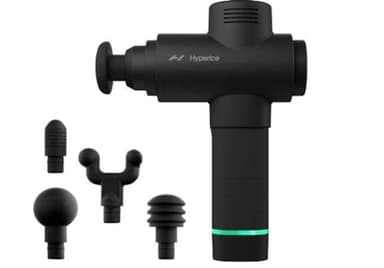
- Hypervolt 2. 1.8 lb. Three speeds, with no stated RPM range at all. No decibel figure. Three hours of battery. Five attachments, a 60 W brushless motor, Bluetooth and pressure-sensor feedback.
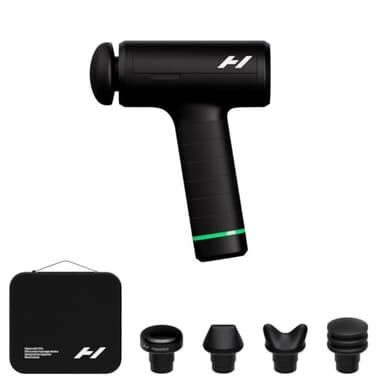
- Hypervolt 3 Pro.2.5 lb. Six speeds across a stated 1,500–2,500 RPM. A stated 51 dB. Four hours of battery. Five attachments including a heated head.
Read that list again in price order and it inverts. The cheapest unit states its speed range and its noise level. The middle unit states neither. Only at the top of the range does the documentation come back. If you were assuming that paying more buys you a better-specified device, Hyperice’s own pages say otherwise in the middle of its own lineup.
That matters more than it sounds, because “three speeds” on the Hypervolt 2 tells you almost nothing without a range. Three speeds could span 1,500 to 2,500 RPM or 1,800 to 2,200; the page does not say, so the number is a count of buttons rather than a description of what the device does. The Go 3 gives you five steps and tells you where they start and stop.
The spec none of them publishes
Amplitude — how far the head travels on each stroke — is the one figure that determines how deep a percussion device physically reaches. Hyperice does not publish it for the Go 3, for the Hypervolt 2, or for the Hypervolt 3 Pro. Neither does it publish stall force, which is how hard you can lean on the head before the motor gives up. Searching all three product pages for either term returns nothing.
So the thing you cannot do with this comparison is rank these three by depth, and anyone who does is estimating. What you can do is choose on weight, noise, attachments, battery and price, which are all published and all checkable. We lay out who publishes what across the whole category in the deep-tissue roundup, and the argument about what a premium price actually buys is in cheap vs expensive massage guns.
The Hypervolt Go 2 question
Search for a Hypervolt Go and you will find two of them for sale: the Go 2 and the Go 3. Both are genuinely in stock, and the Go 2 is the cheaper of the two.
Here is the part worth knowing before you save the difference. Hyperice’s own Go 2 product page no longer exists — the URL redirects to the Go 3. We checked it on 5 September 2026 and the redirect is what happens. The practical consequence is that the Go 2 is the outgoing generation, and its published specifications are no longer on the manufacturer’s site at all. We will not quote figures for it, because the document we would have to cite has been taken down.
That is not a warning against buying one. Retailers clear outgoing stock and a discounted Go 2 may be a perfectly sensible purchase. It is a reason to know which one you are looking at: if a listing is cheaper than it should be, check whether it says Go 2 or Go 3, and understand that with the Go 2 you are buying a unit whose maker has stopped documenting it.
Which one, by use case
- You travel with it, or you want one gun for everything: the Go 3. At 1.6 lb it is the lightest of the three, Hyperice states that it is TSA friendly for carry-on, and it is the one you will actually pack. The travel case is made in full in the best massage guns for travel.
- You want the most attachments: the Hypervolt 2 or the 3 Pro, both with five heads against the Go’s two. Whether that matters depends on whether you will use them — see what each attachment is actually for.
- Evening use in a shared home: the 3 Pro at a stated 51 dB, or the Go 3 at a stated 55 dB. Not the Hypervolt 2, not because it is loud but because Hyperice will not tell you how loud it is. More on that in the quietest massage guns.
- You want heat before percussion: the 3 Pro, the only one of the three that ships a heated head. Warming tissue before working it is a sensible order of operations.
- You are working thick muscle — glutes, thick lower back: honestly, none of these can be recommended on published evidence, because none publishes amplitude or stall force. Choose a gun whose maker states both, or use a tool that does not need a motor.
- You are on a strict budget: the Go 3 is the cheapest Hyperice, but it is not the cheapest capable gun. See the best budget massage guns before you assume a brand name is the right place to spend.
Where the Go is the wrong buy
Two attachments is the real limitation, not the size. Flat and wedge cover broad muscle and edges; there is no ball head for general work and no bullet for pinpoint trigger points in the box. If your plan involves a specific head for a specific job, the Go starts you short and you will be buying attachments separately.
The second limitation is reach. A short body is harder to angle behind your own shoulder blade than a longer one, which is the reason angled-handle designs exist at all. If reaching your own upper back is the main job, read what actually works on an upper back before you buy any handheld — for a good deal of that region, a ball against a wall does the job a gun struggles with, for a few dollars.
And the third is the one that applies to all three: if the problem is a joint, a nerve, or something that has been getting worse for weeks, no percussion device is the answer. Start at the symptom pages instead, which route a problem to a class of tool before naming any product.
How the two lines relate
Hyperice keeps a small handheld and a full-size handheld in the range at the same time, and the generations do not run in step: the current Go is a third-generation unit while the Hypervolt 2 sitting above it is not. That is why the smaller, cheaper device wins on weight, speed count, battery and published detail all at once. It is a newer design, not a better class of product, and it is worth knowing that is what you are seeing rather than reading it as the Go somehow out-engineering the full-size line.
If your question is really about which full-size Hyperice to buy rather than whether to buy a small one, that comparison is made in full in Hypervolt 2 vs Hypervolt 3 Pro. If it is about Hyperice against the other big name in the category, that is Hypervolt vs Theragun.
Every pick, in full
Specs below are the manufacturer’s own published figures, each linked to the page it came from. Where a maker does not publish a number, the table says so and names the page we checked — that absence is information too.
Price as of October 21, 2026. #ad How we’re funded
Hyperice Hypervolt Go 3
The smallest Hyperice, and the best-documented one under the premium tier — 5 speeds, a stated 1,500–2,500 RPM range and a stated 55 dB, all of which the pricier Hypervolt 2 leaves off its page. Two attachments and no pressure sensor is the trade.
What it gets right
- 1.6 lb is the lightest Hyperice handheld, which is what decides whether you can reach your own shoulder
- Publishes a speed range and a decibel figure, which the more expensive Hypervolt 2 does not
- Up to 4 hours of stated battery life, an hour more than the Hypervolt 2
What it does not
- Two attachments in the box (flat and wedge) against five on the full-size units
- No amplitude or stall force published, so its actual depth cannot be compared to anything
- Hyperice does not list Bluetooth or pressure-sensor feedback among its features, unlike the Hypervolt 2 and 3 Pro
Price as of October 21, 2026. #ad How we’re funded
Hyperice Hypervolt 2
The quietest and lightest of the premium guns, with a genuinely comfortable handle — but Hyperice publishes weight, speeds, battery and motor wattage for it and no amplitude figure at all, so there is no way to compare its depth against anything.
What it gets right
- 1.8 lb is the lightest premium gun here, and weight is what decides whether you can reach your own upper back
- Three speeds is fewer than the spec sheets like, and in practice is one more than most people use
- Five attachments included
What it does not
- No published amplitude, anywhere on the product page — the single most important depth spec
- Three speeds with no continuous range
- Costs several times what a fully-specified budget gun costs
| Amplitude | Not published page we checked |
|---|---|
| Speed range | Not published page we checked |
| Speed settings | 3 source |
| Weight | 1.8 lb source |
| Noise | Not published page we checked |
| Battery | 3 h source |
| Attachments | 5 source |
| Dimensions | 7.5 × 2.5 × 9.5 in source |
Price as of October 21, 2026. #ad How we’re funded
Hyperice Hypervolt 3 Pro
The one premium gun that publishes both a speed range and a noise figure — 1,500–2,500 RPM at 51 dB — which is quiet for the power, though amplitude is still missing.
What it gets right
- 51 dB published is genuinely quiet; you can hold a conversation over it
- Published 1,500–2,500 RPM range, which almost nothing else at this price states
- Heated head attachment included, and heat before percussion is a sensible order of operations
What it does not
- Amplitude still not published
- 2.5 lb is heavy for overhead work on your own shoulder
- The most expensive handheld here by a wide margin
Common questions
Is the Hypervolt Go worth it over the full-size Hypervolt?
For most people, yes. The Hypervolt Go 3 is lighter at 1.6 lb against the Hypervolt 2’s 1.8 lb, gives five speeds against three, states a 1,500–2,500 RPM range and 55 dB where the Hypervolt 2 states neither, and costs less. The full-size unit’s advantages are five attachments against two, a larger motor and pressure-sensor feedback. If those three things are not what you are buying for, the Go is the better-documented and more portable device.
What is the difference between the Hypervolt Go 2 and the Go 3?
The Go 3 is the current generation and the Go 2 is the outgoing one. Hyperice’s own Go 2 product page now redirects to the Go 3, checked on 5 September 2026, which means the Go 2’s published specifications are no longer available from the manufacturer. We therefore do not quote figures for it. Both are still sold and the Go 2 is usually cheaper; just make sure you know which one a listing is offering.
Does the Hypervolt Go have enough power for deep tissue?
Nobody can answer that from published data, including us. Hyperice does not publish an amplitude figure or a stall force for the Go 3, the Hypervolt 2 or the Hypervolt 3 Pro, and those two numbers are what determine how deep a percussion device reaches and how hard you can lean on it. If deep work on thick muscle is the whole reason you are buying, choose a device whose maker states both figures rather than one that states neither.
Which Hypervolt is the lightest?
The Hypervolt Go 3 at 1.6 lb, ahead of the Hypervolt 2 at 1.8 lb and the Hypervolt 3 Pro at 2.5 lb. Weight is the spec that decides whether you can hold a device against your own upper back without your arm giving out first, so for self-treatment the lightest unit is usually the most usable one regardless of what else is on the spec sheet.
How many attachments does the Hypervolt Go come with?
Two — a flat head and a wedge head. The Hypervolt 2 and the Hypervolt 3 Pro each ship with five. Two heads cover broad muscle and edges, but there is no ball head and no bullet head in the box, so pinpoint work on a trigger point needs an attachment you buy separately. Heads are sold by shaft diameter and the sizes do not interchange between brands.
Sources
- 1.Hyperice — Hypervolt Go 3 product page — 1.6 lb, 5 speeds, 1,500-2,500 RPM, 55 dB, up to 4 h, 2 attachments; amplitude and stall force absent. Fetched 2026-09-05
- 2.Hyperice — Hypervolt 2 product page — 1.8 lb, 3 speeds, 3 h, 5 attachments, 60 W motor; no RPM range, no dB, no amplitude, no stall force. Fetched 2026-09-05
- 3.Hyperice — Hypervolt 3 Pro product page — 2.5 lb, 6 speeds, 1,500-2,500 RPM, 51 dB, 4 h, 5 attachments including a heated head; amplitude absent. Fetched 2026-09-05