Guides
How to Use a TENS Unit
A TENS unit is simple to use and easy to use slightly wrong: pads in the wrong place, turned up until the muscle jumps, or reached for when the pain should have been looked at first. Here is how to place it, how hard to run it, and when to leave it in the drawer.
By Stephen V.Published
Disclosure:Grip & Gait earns a commission when you buy through links on this page, at no extra cost to you. It never changes what we recommend or the order we rank things in — here is exactly how we’re funded.
Quick picks
Ranked on published manufacturer specs and what they mean for the job, not on testing we have not done. Tap a row for the full reasoning. How we score.
| # | Product | Best for | Score | Price |
|---|---|---|---|---|
| 1 |  TENS 7000 Digital TENS Unit Manual pulse-width and rate control, and the clinic default so pads are everywhere. | The unit this guide assumes | 8.2 | $38.88 · View on Amazon Price as of October 21, 2026. #ad How we’re funded |
| 2 |  AUVON Dual Channel TENS Unit Two channels and preset programs, rechargeable. | Easiest to start with | 8.0 | $35.99 · View on Amazon Price as of October 21, 2026. #ad How we’re funded |
| 3 |  Belifu Dual Channel TENS EMS Unit Competent dual-channel hardware at the lowest price. | Cheapest way in | 7.2 | $35.99 · View on Amazon Price as of October 21, 2026. #ad How we’re funded |
What TENS does, and what it does not
TENS stands for transcutaneous electrical nerve stimulation, which is a long name for a simple idea: it sends a mild electrical current through pads on your skin to change how much pain your nervous system notices. The usual explanation is the gate-control model — the current floods the nerves in an area with harmless sensation, and that traffic crowds out some of the pain signal trying to travel the same path to your brain. You feel a tingle, and while the tingle is running the pain feels smaller.
The important word is feels. TENS masks pain; it does not treat the thing causing it. Turn it off and the pain is exactly as far along as it was — nothing has been healed, released or repaired. That is not a criticism, it is the job description. Used for what it is — a way to make a painful stretch of the day more bearable without another dose of something — it is genuinely useful for a lot of people. Expected to fix a bad back or cure a nerve problem, it will disappoint every time. Responses also vary enormously: some people get real, repeatable relief from it and others feel the buzz and nothing else, and there is no way to know which you are until you try.
Where to put the pads
The guiding principle is to bracket the painful area rather than to cover it. Place a pad on each side of the sore spot so the current passes through the region between them, not a single pad squarely on the worst point. On a two-channel unit you can bracket a larger area, or treat two problems at once with a channel for each.
A handful of placement rules are not negotiable, and they exist for real reasons rather than caution for its own sake:
- Never directly over the spine. Bracket a sore back with a pad either side of the spine so the current runs through the muscle, not over the bony midline itself.
- Never on the front or the sides of the neck. The nerves that help control your heart rate and your airway run close to the surface there, and stimulating them is genuinely dangerous. Keep pads well away from the throat and the sides of the neck.
- Never across the chest.Do not run current from one side of the chest to the other or over the heart — passing current across the torso in that way is the placement to avoid.
- Never on broken, infected or numb skin. Damaged skin changes how the current spreads, and skin that cannot feel properly cannot warn you that something is wrong.
Beyond those, keep the pads spaced apart so the current has somewhere to travel rather than arcing between two pads almost touching, put them on clean dry skin with no lotion or oil, and press the whole surface down so no corner lifts.
How high to turn it up
Start low and bring the intensity up slowly until you feel a strong but comfortable tingle — a clear, buzzing sensation you would call firm rather than painful. That is the level you want, and turning it higher does not buy more relief.
The line you must not cross is muscle contraction. If the pad site starts twitching or the muscle jumps, you have turned it up too far for TENS and wandered into what a stimulator does in its EMS mode, which is a different job. For pain relief you want sensation in the nerves, not a muscle-jumping contraction, so back it off until the twitching stops and the tingle is strong but steady. It is also normal for the sensation to fade partway through as your nervous system gets used to it; nudging the intensity up a little to bring the tingle back is expected, not a sign anything is wrong. The difference between the two modes is covered in TENS vs EMS.
How long, and how often
Run a session for a moderate stretch — long enough to settle the pain, not so long you forget it is on — and repeat it through the day as often as you need. There is no virtue in leaving it running for hours on end; a few focused sessions spread across the day tend to serve you better than one marathon. Give the skin under the pads a rest between sessions, and shift the pads slightly if the same patch starts to get irritated. If you are treating an ongoing problem it is fine to make TENS a daily habit, but it should sit inside a plan that also addresses why the pain is there, not stand in for one.
Pads are the real running cost
The unit is a one-off; the pads are forever. Electrode pads lose their stick after a run of uses — sooner if your skin is oily or hairy, or if the pads get left out to dry — and replacing them is the actual cost of owning a TENS unit over time. Two habits stretch that out a long way. First, peel pads off from the edge rather than pulling them by the wire, press them straight back onto their plastic backing sheet, and seal that in a bag so the gel does not dry. Second, keep the contact skin clean and dry, because lotion and sweat kill adhesion faster than anything else.
One thing worth checking before you buy: whether the unit takes standard connector pads or a proprietary shape. A unit that uses ordinary pin-connector pads lets you buy replacements from anyone, cheaply, for as long as you own it, while a proprietary pad locks you to one supplier at their price. Over the life of the device that choice matters more than the price of the unit. The roundup goes into this on the best TENS units page, and for a sore back specifically there is best TENS for back pain.
The mistakes that stop it working
Most disappointment with a TENS unit comes down to a few avoidable habits rather than the unit being wrong for you.
- Turning it up too fast. Cranking straight to a high setting is uncomfortable and no more effective than climbing there slowly. Ease up until the tingle is firm and stop there.
- Chasing a contraction. If you keep raising the intensity until the muscle jumps, you have left pain relief behind and started doing something the tool does in a different mode. You want a strong tingle, not a twitch.
- Putting a pad on the sorest point. A single pad squarely on the worst spot does less than a pad on each side of it, because the current needs two points to travel between.
- Oily, damp or hairy skin. Lotion, sweat and hair all wreck the contact, so the current spreads unevenly and the pads die early. Clean and dry first, every time.
- Expecting it to last after you switch off. The relief is largely there while it is running. That is normal rather than a fault, and it is why short sessions repeated through the day beat one long one.
When not to reach for it at all
TENS is for managing a pain you already understand. If a pain is new, severe, spreading, or came with numbness, weakness or anything else that worries you, the answer is not to turn up the tingle — it is to get it looked at first. Masking an undiagnosed pain is exactly the wrong use of the tool, because the relief can talk you out of the appointment you actually need.
And if what you really have is general muscle stiffness with no nerve component, a heating pad is often the simpler tool— nothing to place precisely, no pads to replace, and it suits a broad ache better than a current does. TENS is a good addition to a pain-management toolkit and a poor substitute for working out what is wrong. If you are still weighing it against percussion for sore muscles, start with massage gun vs TENS.
Every pick, in full
Specs below are the manufacturer’s own published figures, each linked to the page it came from. Where a maker does not publish a number, the table says so and names the page we checked — that absence is information too.
Price as of October 21, 2026. #ad How we’re funded
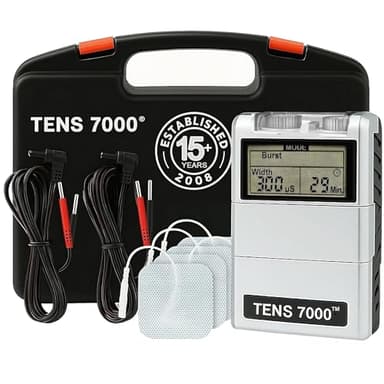
TENS 7000 Digital TENS Unit
The unit clinics hand out, with manual control over pulse width and rate rather than a menu of preset programs — which is what you want once you know what setting helps.
What it gets right
- Manual pulse-width and rate control instead of fixed presets
- The long-standing clinic default, so accessories are everywhere
What it does not
- Runs on a 9 V battery
- Manual control is only an advantage if you know what you are adjusting
Price as of October 21, 2026. #ad How we’re funded
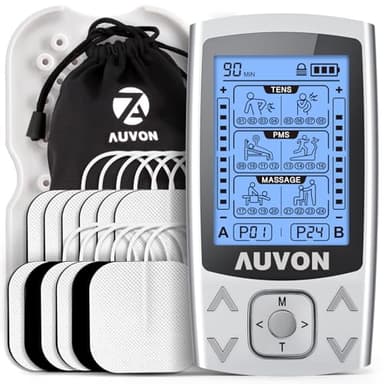
AUVON Dual Channel TENS Unit
Two independent channels so you can treat both sides of a problem at once, at a price where trying TENS costs less than one session of anything else.
What it gets right
- Two independent channels with separate intensity control
- Rechargeable rather than eating 9 V batteries
- Cheap enough to find out whether TENS does anything for you
What it does not
- Pad adhesive life is the real running cost, not the unit
- Interface is fiddly with cold hands
Price as of October 21, 2026. #ad How we’re funded
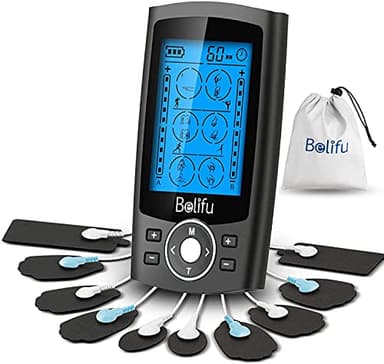
Belifu Dual Channel TENS EMS Unit
Twenty-four modes at the lowest price in the category, and the mode count is marketing — but the hardware underneath is a competent dual-channel stimulator.
What it gets right
- Cheapest dual-channel unit here
- Rechargeable
- Pads and leads included
What it does not
- Mode count is noise, not a feature
- Thin documentation of what each mode does
Common questions
Where do you place TENS pads?
Bracket the painful area rather than covering it: put a pad on each side of the sore spot so the current passes through the region between them, not a single pad on the worst point. Keep the pads spaced apart on clean, dry skin. Never place electrodes directly over the spine, on the front or sides of the neck, across the chest or over the heart, over the eyes, on the abdomen or lower back during pregnancy, or on broken or numb skin.
How strong should a TENS unit feel?
Turn the intensity up slowly until you feel a strong but comfortable tingle — a firm, buzzing sensation, not pain. Turning it higher does not buy more relief. The line you must not cross is muscle contraction: if the muscle twitches or jumps you have gone too far for TENS and into EMS territory, so back it off. It is normal for the tingle to fade as your body adjusts, so nudging it up a little mid-session is expected.
Who should not use a TENS unit?
Do not use TENS if you have a pacemaker, an implanted defibrillator or any other implanted electronic device. Take particular care in pregnancy and avoid the abdomen and lower back then. Anyone with epilepsy or a heart condition should ask a clinician first. Do not use it while driving or operating machinery, do not place it on the front or sides of the neck or across the chest, and never use it to push through a new or undiagnosed pain — get that looked at first. Your unit’s manual is the final word.