Symptoms
Weak Grip and Hand Strength
Grip strength is the most quoted number in consumer health and the least understood purchase. The large study everyone cites measured grip - it did not train it, and its own authors say whether improving strength changes anything is still untested. Here is what that means for what to buy.
By Stephen V.Published
Disclosure:Grip & Gait earns a commission when you buy through links on this page, at no extra cost to you. It never changes what we recommend or the order we rank things in — here is exactly how we’re funded.
Measuring grip is the part of this that holds up. Training it with a spring gripper is a narrow tool that works one of the four things your hand does. Buy a dynamometer if you want to know whether anything is working, a gripper if you want a cheap and progressive way to load the crush grip, and bands if you want the half of the hand that nothing else on this page trains. Carrying heavy things remains free and covers more of it than any of the three.
What grip strength actually predicts, and what it does not
The reason grip is everywhere is one very large study. The Prospective Urban Rural Epidemiology study measured grip with a Jamar dynamometer in 139,691 people across 17 countries and followed them for a median of four years. Grip strength was inversely associated with all-cause mortality, at a hazard ratio of 1.16 per 5 kg reduction in grip. The association held across country-income strata for almost every outcome examined.
That is a real and large finding, and it is worth reading what the authors concluded from it. Their interpretation is that measurement of grip strength is a simple, inexpensive risk-stratifying method — and that further research is needed to test whether improvement in strength reduces mortality and cardiovascular disease.
In other words: the validated part is the measuring. Whether making the number go up changes anything is, by the study’s own account, an open question. Grip is probably acting as a cheap proxy for whole-body strength and health rather than as a lever you pull. A page selling you a $23 spring on the strength of that study should say so, so this one does.
Four things your hand does, and what trains each
“Grip” is at least four separate abilities, and most people buy one tool and train one of them.
| What it is | Where you use it | What trains it |
|---|---|---|
| Crush grip | Closing the hand hard - a handshake, a spring gripper | An adjustable gripper. This is the one every gripper on the market trains, and the only one. |
| Support grip | Holding on - luggage, a pull-up bar, a shopping bag | Carries and hangs. Free, and the grip most real life actually asks for. |
| Pinch grip | Thumb against fingers - a jar lid, a key, a plate | Pinch clips and putty. Almost nothing else reaches it. |
| Extension | Opening the hand against resistance | Finger extension bands. Nothing else here trains it at all, and everything else trains its opposite. |
That last row is the one worth sitting with. A day at a keyboard, a day on tools and a set on a gripper all train closing. Nothing in an ordinary day trains opening. Whether balancing that prevents anything is not established — but it costs a few dollars and takes a minute, which is a different risk calculation from a $400 device.
Which class of tool fits
The three pieces of hardware built specifically for this job — a gripper, a dynamometer and extension bands — are the picks in the next section. This table is everything else that turns up in the same search, including the free thing that beats all of them and the device that has no business here.
| Tool class | Cost | Why it does or doesn’t work here | Verdict |
|---|---|---|---|
| Heavy carries and hangs | Cost: Budget | Free, trains the support grip that real life actually uses, and loads the whole arm and trunk at the same time. A loaded bag in each hand until your hands are the limit is a grip session.Where it fails: Needs something heavy to hold, and it does nothing for pinch or for opening the hand. | Start here |
| Hand exercise putty | Cost: Budget | Graded, gentle, and it reaches pinch and individual fingers, which a spring handle cannot. It is the medium for the hand exercise program with the best trial evidence on this site.Where it fails: Equipment for a program rather than relief. A hand therapist supplies the program; the putty alone does very little. | Start here |
| Massage ball (on the forearm) | Cost: Budget | For the aching, tight forearm that comes with gripping all day. Roll it on a desk under your own body weight - more pressure per dollar than anything powered.Where it fails: Addresses a different complaint. It does nothing whatsoever for strength. | Sometimes |
| Graded resistance bar | Cost: Budget | If the pain has localized to the outside or inside of the elbow, progressive loading with a resistance bar is the best-supported intervention we cover.Where it fails: An elbow-tendon tool, not a hand-strength tool, and the protocol matters more than the bar. | Sometimes |
| Night wrist splint | Cost: Budget | For carpal tunnel symptoms rather than weakness. Cheap, with no plausible long-term harm, which is why it is often worth trying while you wait for an assessment.Where it fails: Not a strength tool at all, and the Cochrane review found insufficient evidence to conclude that splinting benefits carpal tunnel syndrome. | Sometimes |
| Massage gun | Cost: Mid-range | Genuinely useful on the forearm muscles that get tight from gripping, which is a neighboring complaint rather than this one.Where it fails: It does not build strength, and a hand is mostly small bones and nerves close to the surface. Wrong tool for this page entirely. | Not for this |
What we would actually buy
If you want to train it
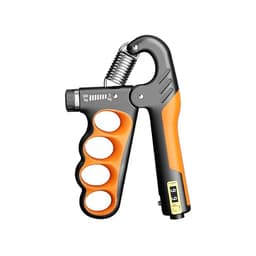
Hiyoga Adjustable Grip Strength Trainer
Adjustable resistance and a rep counter, for less than a takeaway. Adjustable is the feature that matters - a fixed spring is either impossible in week one or pointless by week ten.
If you want to know it is working
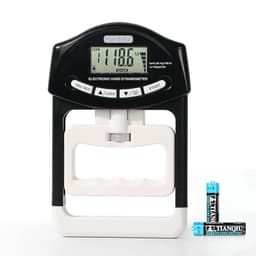
Handeful Digital Grip Strength Tester (198 lb)
Measurement is the validated half of the grip-strength story. Retest on the same hand, same posture, same time of day, eight weeks apart, and you have an answer instead of an impression.
Price as of September 15, 2026. #ad How we’re funded
For the half nothing else trains
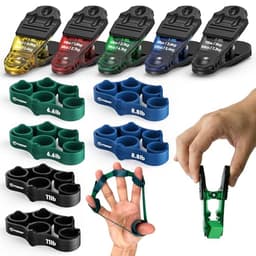
FitBeast Finger Exerciser Set (extension bands and pinch clips)
Extension bands and pinch clips cover opening the hand and the thumb-to-finger pinch, neither of which a gripper touches. A few dollars for the two movements every other tool here skips.
What each of those is bad at
Every pick on this page has a real limitation and none of them is hidden in a spec sheet.
- The gripper trains the crush grip and nothing else. It cannot load the support grip a carry uses, it cannot reach pinch, and it trains the exact direction your day already overtrains. Its advertised pound range is a relative setting, not a measured force.
- The dynamometer does not train anything, and it is not a calibrated clinical Jamar, so your reading is not directly comparable with a published cohort figure. Readings also move with elbow angle, wrist position and time of day, so only your own trend measured identically means anything.
- The extension bands are rubber and will perish; check them for cracking before each use and expect to replace them. Their resistance grades are relative to each other and to nothing else, and the case for training extension is mechanical reasoning rather than trial evidence.
- All three together still amount to less whole-body stimulus than carrying two heavy bags up a flight of stairs.
What the evidence says actually builds grip
A systematic review and Bayesian network meta-analysis of 13 randomized trials covering 711 older adults with sarcopenia looked at the dose of resistance training that improves handgrip strength. The effective ranges it reported were a frequency of two to five sessions a week, an intensity of 30% to 75%, and a period of four to twenty-four weeks.
Two honest notes on that. It studied resistance training— loaded exercise — not spring grippers, so it is evidence about the training rather than about the product. And it studied older adults with sarcopenia, a population selected for low muscle mass, so the size of the effect will not transfer straight to a healthy 30-year-old who wants to hold on to a hangboard.
What it does establish is the shape of a program: a few times a week, moderate loads, measured in months. That shape is the same whether the load comes from a gripper, a pair of heavy bags or a barbell, and it is the reason the rep counter on a gripper earns its place — consistency over weeks is the whole mechanism.
If your hand hurts rather than feels weak
Pain and weakness get bought for with the same search and they are different problems.
Numbness, tingling, and carpal tunnel symptoms
Numbness or tingling in the thumb, index and middle finger, worse at night, is the classic carpal tunnel pattern, and it is a nerve compression rather than a strength deficit. The Cochrane review of splinting for carpal tunnel syndrome concluded there is insufficient evidence to determine whether splinting benefits people with the condition, while noting low-certainty evidence that people may have a greater chance of overall improvement with night-time splints than with no treatment, and that as a cheap intervention with no plausible long-term harm, small effects could justify trying it.
That is a careful conclusion and it is worth repeating carefully. What it does not support is training through it with a gripper. Squeezing loads the same tunnel the symptoms are coming from.
Aching, stiff, arthritic hands
For arthritic hands the intervention with the best trial support on this site is a tailored hand exercise program, not a device — the SARAH trial is covered in full on the arthritis page, along with why we link compression gloves with a caveat rather than a recommendation.
Aching forearms from gripping all day
If the complaint is a tight, aching forearm from typing, trade work or climbing rather than weakness, the muscle is the target and a ball on a desk beats every powered device. That is the wrist and forearm page. If the pain localizes to the outside or inside of the elbow, it is tennis elbow or golfer’s elbow, where graded loading with a resistance bar is the best-supported answer.
A routine, if you want one
- Measure once, properly. Elbow at your side and bent to about 90 degrees, wrist neutral, three squeezes per hand, record the best. Write it down with the date.
- Carries, twice a week. Something heavy in each hand, walk until your grip is genuinely the limit, put it down. This is the part most like the evidence.
- Gripper, three days a week. Sets where the last two reps are hard, not sets of forty. Raise the setting when they stop being hard.
- Extension bands, same days. One or two sets. It takes a minute and it is the only opening work you will do.
- Retest at eight weeks, exactly the same way. Same hand, same posture, same time of day.
- Stop at pain in a finger joint or the wrist. Soreness in the forearm belly is training; sharp or joint-line pain is not.
What the makers say about the hand
Percussion devices come up constantly in hand searches, so it is worth quoting the published precautions that apply regardless of which attachment is fitted:
“Deep vein thrombosis, osteomyelitis; bone fracture or myositis ossificans; bleeding disorders; peripheral vascular insufficiency or disease; medications that thin the blood or alter sensations; pacemaker, ICD.”
Add to that the general rule this site repeats everywhere: stay off bone and off nerves you can feel. A hand is mostly both. Work the forearm muscle above the wrist instead, and leave the hand itself to exercise.
Common questions
Do grip strengtheners actually work?
For the crush grip, yes — that is a trainable movement and a progressive spring loads it. What a gripper does not do is train the support grip that carrying uses, the pinch grip, or opening the hand, and it is not the whole-body resistance training the research on grip strength is built around. Treat it as one cheap, specific tool rather than a health intervention.
Does improving grip strength make you live longer?
That is not what the study everyone cites shows. The PURE study measured grip in 139,691 people across 17 countries and found it inversely associated with all-cause mortality, at a hazard ratio of 1.16 per 5 kg reduction. Its authors concluded that measurement is a simple, inexpensive risk-stratifying method and that further research is needed to test whether improving strength reduces mortality. Grip looks like a proxy for overall health, not a lever.
Is a hand dynamometer worth buying?
If you are going to train grip for more than a fortnight, yes — it is the only way to tell progress from enthusiasm, and it costs about the same as the gripper. Two caveats: a consumer unit is not a calibrated clinical Jamar, so do not compare your reading against published cohort values, and grip readings move with posture and time of day, so retest identically or the trend means nothing.
How often should I train grip?
A network meta-analysis of 13 randomized trials in older adults with sarcopenia reported effective doses of two to five sessions a week at 30% to 75% intensity over four to twenty-four weeks. That study looked at resistance training rather than grippers and at a specific population, so read it as the shape of a program rather than a prescription: a few times a week, moderate load, measured in months.
Can a grip strengthener help carpal tunnel?
No, and it can make symptoms worse — squeezing loads the same tunnel the symptoms come from. Numbness or tingling in the thumb, index and middle finger, worse at night, needs assessment rather than training. The Cochrane review on splinting found insufficient evidence to conclude that splinting benefits carpal tunnel syndrome, while noting low-certainty evidence of a greater chance of overall improvement with night splints than no treatment.
Why would I train finger extension?
Because nothing else you do trains it. Typing, tools, carrying and every gripper set train closing the hand; opening it against resistance gets loaded by nothing in an ordinary day. Whether balancing that prevents anything is not established, so we put it as a plausible, few-dollar, one-minute addition rather than a claim.
Sources
- 1.Prognostic value of grip strength: findings from the Prospective Urban Rural Epidemiology (PURE) study - The Lancet (PubMed 25982160) — 139,691 participants, 17 countries, Jamar dynamometer; HR 1.16 per 5 kg reduction in grip; authors call for research on whether IMPROVING strength changes outcomes
- 2.Optimal dose of resistance training to improve handgrip strength in older adults with sarcopenia: a systematic review and Bayesian model-based network meta-analysis - Frontiers in Physiology (PMC12263917) — 13 trials, 711 older adults with sarcopenia; effective doses 2-5 sessions/week, 30-75% intensity, 4-24 weeks
- 3.Splinting for carpal tunnel syndrome - Cochrane Database of Systematic Reviews 2023 (PMC9969978) — insufficient evidence to conclude splinting benefits carpal tunnel syndrome; low-certainty evidence favoring night splints over no treatment
- 4.A Critical Review of the Incidence and Risk Factors for Finger Injuries in Rock Climbing - Current Sports Medicine Reports (PubMed 27841811) — fingers the most common climbing injury site, annular pulleys the most commonly injured structure, previous injury a risk factor for reinjury
- 5.Exercises to improve function of the rheumatoid hand (SARAH): a randomised controlled trial - The Lancet (PubMed 25308290) — tailored hand exercise program for rheumatoid hands, covered in full on the arthritis page
- 6.Therabody — Product Safety & Precautions — contraindication list quoted verbatim above