Recovery Tech
The Best TENS Units for Neuropathy
The published effect of TENS on diabetic nerve pain is roughly the same as placebo. That does not make it a scam, but it does change which unit to buy: the cheapest one with real manual control and the gentlest bottom end, not the one with the longest feature list. Here is that unit, and the safety rule that matters more than any spec when the skin you are treating cannot feel properly.
By Stephen V.Published
Disclosure:Grip & Gait earns a commission when you buy through links on this page, at no extra cost to you. It never changes what we recommend or the order we rank things in — here is exactly how we’re funded.
Quick picks
Ranked on published manufacturer specs and what they mean for the job, not on testing we have not done. Tap a row for the full reasoning. How we score.
| # | Product | Best for | Score | Price |
|---|---|---|---|---|
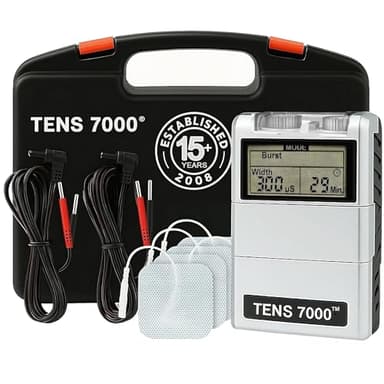
| 1 |  TENS 7000 Digital TENS Unit Manual pulse width and rate with a genuinely fine low end. For altered sensation you want to creep up from almost nothing, and fixed programs will not let you. | Best overall for nerve pain | 8.4 | $38.88 · View on Amazon Price as of October 5, 2026. #ad How we’re funded |
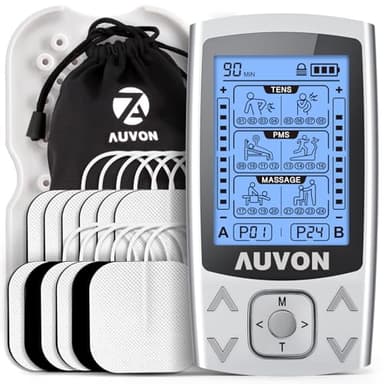
| 2 |  AUVON Dual Channel TENS Unit Dual channel with small intensity steps and an automatic shut-off, which is the feature that matters when you cannot reliably feel how hot a pad has become. | If you want presets and a timer | 8.0 | $35.99 · View on Amazon Price as of October 5, 2026. #ad How we’re funded |
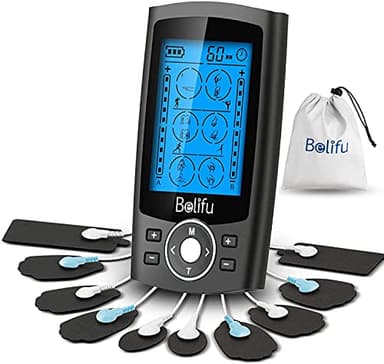
| 3 |  Belifu Dual Channel TENS EMS Unit Generous pad count, so you can cover two feet and two calves without peeling electrodes off and restarting. Modes are a long unnamed list; ignore most of them. | Treating both feet and both calves | 7.6 | $32.99 · View on Amazon Price as of October 5, 2026. #ad How we’re funded |
| ✕ |  KingPavonini Wireless TENS + EMS Muscle Stimulator Pod-shaped wireless pads are hard to place accurately on a foot and its fixed programs remove the one control that matters. Premium money for the wrong shape. Skip this | The one to skip here | 6.2 |
Start with the uncomfortable number
A 2025 systematic review and meta-analysis of TENS for neuropathic pain searched eight databases from 1999 to May 2024, included thirty studies and pooled twenty-five of them. Across all causes, TENS produced a small reduction in neuropathic pain against placebo that did not reach clinical significance: standardized mean difference −0.35, with a confidence interval from −0.90 to 0.10 that crosses zero (p= 0.13). For the specific group most people reading this belong to — patients with diabetic neuropathic pain — TENS performed about the same as placebo and about the same as other electrotherapies. The one subgroup where it beat both placebo and the alternatives was spinal cord injury, where the effect was large.
We lead with that because it determines the whole shape of this page. If the expected benefit is small and uncertain, then the right purchase is a cheap unit with real control that you can try honestly and set aside if it does nothing for you. It is not a premium wireless system, and it is certainly not a unit sold with language about repairing nerves, which nothing in this category does. Our top pick costs about as much as two restaurant meals, and that is the correct amount of money to put behind a small, uncertain effect you can evaluate for yourself in a fortnight.
Why numb skin changes the rules
Peripheral neuropathy means the nerves carrying sensation from the feet and legs are not reporting accurately. That is the condition. It also means the normal feedback loop that stops people hurting themselves with a self-applied device is missing.
With a TENS unit, three things follow. First, you cannot trust “turn it up until it is strong but comfortable” on skin that under-reports, so you set intensity by the number on the display and by what you see, not by what you feel. Second, electrode gel and adhesive sit against skin that may heal slowly — and in diabetes, a small skin breakdown on a foot is not a small problem. Third, if the pads are placed on a foot you cannot feel properly, you may not notice a hot spot developing. This is the reason the automatic shut-off timer on the AUVON is a genuine safety feature rather than a convenience, and the reason we would place pads on the calf rather than the sole wherever that still reaches the pain.
How we ranked these for neuropathic pain
- How low the low end goes. The single most important spec for altered sensation, and the one no maker advertises. You want many small steps at the bottom of the range, because the useful setting is often far lower than a healthy-skin user would pick.
- Manual pulse width and rate. Neuropathic pain responds differently to different pulse characteristics, and a device with twenty unnamed programs gives you no way to explore that. We rank manual control above mode count every time.
- A shut-off timer. Not a luxury here. It is the feature that compensates for the missing sensory feedback, so a unit that runs indefinitely is marked down.
- Pad size and pad cost. Two feet and two calves is four to eight electrodes per session, and in this population the adhesive gets changed more often, not less. We price the refills.
- Price, deliberately weighted heavily. Given the pooled effect above, a unit that costs four times as much has to do something four times as useful. None of them do.
Where the pads go
Calves first. Two pads on the back of each calf, below the knee and above the ankle, is the placement we would try before anything on the foot itself. It reaches the tibial nerve distribution that feeds the sole, the skin there is more robust, and you can see what is happening.
Around the ankle, not under the foot. If the burning is in the sole, bracket it: one pad on the inside of the ankle below the bony bump, one on the outside. Avoid the sole and the heel pad where the skin takes load all day and any irritation is slow to settle.
Never over broken, ulcerated or completely numb skin. That is not a preference. If a patch of skin cannot feel the pad at all, it cannot tell you when something is going wrong under it.
Twenty to thirty minutes, once or twice a day, with the intensity set by the display rather than by sensation, and skin inspected before and after every single session. The general operating procedure — and the reason you bracket a pain rather than aim at its center — is in how to use a TENS unit.
Which unit for which person, in one line each
- You want the honest default: the TENS 7000. Manual pulse width and rate, a fine low end, the unit clinicians hand out most often, and cheap enough that trying it for two weeks costs you almost nothing if it turns out to do nothing for you.
- You want it to be simple and to switch itself off: the AUVON. Dual channel, small intensity steps, preset modes you can live with, and the shut-off timer that is a real safety feature when sensation is unreliable.
- You are treating both legs every day: the Belifu. Buy it for the pads, use four or five of the modes, ignore the rest of the menu.
- Skip the wireless one. The pods are the wrong shape for an ankle and the fixed programs take away the only control that matters for nerve pain. It is a reasonable device aimed at a different job.
The alternatives, ranked honestly
Because the TENS evidence here is weak, the alternatives deserve a fair hearing rather than a token mention. A heated foot massager does nothing for a nerve either, but it is pleasant, it needs no pads, and plenty of people with neuropathic feet use one nightly — see the best foot massagers for neuropathy. If swelling is part of your picture, intermittent pneumatic compression is a mechanically different intervention with its own literature; start at compression boots for older adults and poor circulation. And a massage gun is the wrong tool for a numb foot at any price — percussion over skin that cannot report back is the one combination we tell people to avoid outright. If you want the comparison between the two electrical categories, TENS vs EMS explains why a unit that makes your calf contract is not treating your pain, and the main TENS roundup covers the general case.
Every pick, in full
Specs below are the manufacturer’s own published figures, each linked to the page it came from. Where a maker does not publish a number, the table says so and names the page we checked — that absence is information too.
Price as of October 5, 2026. #ad How we’re funded
TENS 7000 Digital TENS Unit
The unit clinics hand out, with manual control over pulse width and rate rather than a menu of preset programs — which is what you want once you know what setting helps.
What it gets right
- Manual pulse-width and rate control instead of fixed presets
- The long-standing clinic default, so accessories are everywhere
What it does not
- Runs on a 9 V battery
- Manual control is only an advantage if you know what you are adjusting
Price as of October 5, 2026. #ad How we’re funded
AUVON Dual Channel TENS Unit
Two independent channels so you can treat both sides of a problem at once, at a price where trying TENS costs less than one session of anything else.
What it gets right
- Two independent channels with separate intensity control
- Rechargeable rather than eating 9 V batteries
- Cheap enough to find out whether TENS does anything for you
What it does not
- Pad adhesive life is the real running cost, not the unit
- Interface is fiddly with cold hands
Price as of October 5, 2026. #ad How we’re funded
Belifu Dual Channel TENS EMS Unit
Twenty-four modes at the lowest price in the category, and the mode count is marketing — but the hardware underneath is a competent dual-channel stimulator.
What it gets right
- Cheapest dual-channel unit here
- Rechargeable
- Pads and leads included
What it does not
- Mode count is noise, not a feature
- Thin documentation of what each mode does
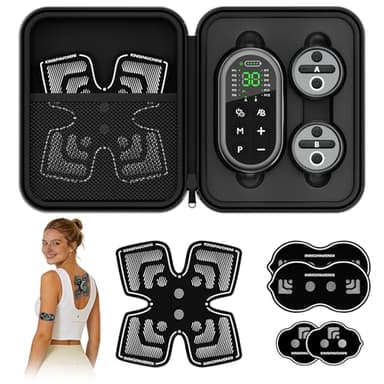
KingPavonini Wireless TENS + EMS Muscle Stimulator
TENS and EMS from two pods you stick on and wear, with no lead wires anywhere — which is the whole reason to pay this much, because it is the only version of the device you can use under a shirt and still move around in. The 48-mode count is marketing; the dual-zone independent control underneath it is not.
What it gets right
- Wireless pods rather than lead wires, so it works under clothing and while moving
- Two pods run independently — separate mode and intensity each, so a shoulder and a leg can run different settings at once
- Published 20 hours per pod on the 1040 mAh cell, charged over USB-C rather than off a disposable battery
- Ships with three pad sizes including a 4.3 in butterfly pad, which is the one that actually covers a lower back
What it does not
- Forty-eight modes is a mode count, not a specification — the same marketing this site flags on every cheap unit
- Several times the price of a wired dual-channel unit that treats a back just as well
- Two pods and a remote are three things to keep charged and not lose
- Listed only in December 2025 and rated 4.1 across 69 reviews, so there is very little ownership history behind it
Common questions
Does a TENS unit help neuropathy?
Less than the marketing suggests. A 2025 systematic review and meta-analysis pooling twenty-five studies found TENS produced only a small reduction in neuropathic pain versus placebo, which was not clinically significant, and in diabetic neuropathic pain specifically it performed about the same as placebo and about the same as other electrotherapies. It is cheap and low risk, so trying it is reasonable. Expect symptom modulation while it runs, not nerve repair.
Where do you put TENS pads for neuropathy in the feet?
Start on the calves rather than the feet: two pads on the back of each calf, below the knee and above the ankle. That reaches the nerve distribution feeding the sole, and the skin there is more robust. If the burning is in the sole itself, bracket the ankle instead — one pad inside, one outside, below the bony bumps. Never place pads on broken, ulcerated or completely numb skin, and never on the sole.
Is a TENS unit safe if you have diabetes?
With care, and with your clinician in the loop. The specific risk is that reduced sensation removes the feedback that normally stops you irritating your own skin, and a small skin breakdown on a diabetic foot is not a small event. Set intensity by the number on the display rather than by feel, use a unit with a shut-off timer, inspect the skin before and after every session, keep pads off the sole, and stop entirely if you find any redness that does not fade within an hour.
Should I buy an expensive TENS unit for nerve pain?
No. Given that the pooled effect against placebo was small and not clinically significant, the sensible purchase is the cheapest unit that gives you manual control of pulse width and rate, plus a timer. That is roughly a twenty-to-forty-dollar device. Spend the difference on the appointment that works out why the nerves are behaving this way, which is the only part of this problem with a real fix.
Sources
- 1.Neuropathic Pain Relief Through Transcutaneous Electrical Neuromuscular Stimulation: Insights From a Systematic Review and Meta-Analysis of Clinical Evidence - BioMed Research International 2025 (PMC12543013) — 30 studies, 25 pooled; SMD -0.35 (95% CI -0.90 to 0.10); diabetic subgroup no better than placebo
- 2.Transcutaneous electrostimulation for osteoarthritis of the knee - Cochrane Database of Systematic Reviews (PubMed 19821296) — the Cochrane review of TENS in knee osteoarthritis, for calibration on effect sizes
- 3.camelcamelcamel — TENS 7000 price history — price history for the top pick
- 4.camelcamelcamel — AUVON TENS price history — price history for the preset-and-timer pick