Recovery Tech
The Best Compression Boots
There is exactly one specification that matters before any other, and a surprising number of products sold as recovery boots fail it. Everything else — modes, app control, pressure levels — is downstream of whether the chambers fire in sequence.
By Stephen V.Published Updated
Disclosure:Grip & Gait earns a commission when you buy through links on this page, at no extra cost to you. It never changes what we recommend or the order we rank things in — here is exactly how we’re funded.
Quick picks
Ranked on published manufacturer specs and what they mean for the job, not on testing we have not done. Tap a row for the full reasoning. How we score.
| # | Product | Best for | Score | Price |
|---|---|---|---|---|
| 1 |  FIT KING Air Compression Recovery Boots Genuinely sequential chambers with real size options, at roughly a third of the category leader. | Sequential, sized, sanely priced | 8.5 | |
| 2 |  QUINEAR Leg Recovery Compression System Includes the foot, which many budget systems omit and where a lot of the swelling actually sits. | Foot-to-thigh coverage | 8.2 | |
| 3 |  Musugy Sequential Leg Compression Massager The entry point at which compression boots stop being an aspiration and start being something you own. | Cheapest sequential system | 7.7 | |
| ✕ | 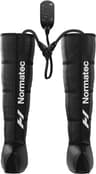 Hyperice Normatec 3 Recovery System The most refined system in the category. For one person at home the price gap buys refinement, not mechanism. Skip this | Teams and clinics | 6.9 | $899.00 · View on Amazon Price as of October 21, 2026. #ad How we’re funded |
The one specification that matters
Sequential inflation. The ankle chamber inflates first, then the calf, then the thigh, so pressure travels up the limb as a wave. That directional movement is the entire mechanism — it is what external pneumatic compression does clinically and what these systems are copying.
A system that inflates every chamber simultaneously is squeezing your leg, not moving anything along it. Plenty of products marketed as “leg massagers” do exactly that, and no number of modes compensates. Check this before checking anything else.
The second thing to check: does it include the foot? Many budget systems start at the calf, and the foot is where a large share of the swelling sits after a day standing. A sequential system that begins above the ankle has skipped the start of the wave.
What we can and cannot tell you about the evidence
The mechanism is not in dispute. Sequential external compression moves fluid proximally, and it was a clinical intervention long before anyone marketed it to runners.
Whether it meaningfully accelerates recovery in a healthy, trained person is a different and much less settled question. We have not located a body of evidence on that specific claim that we are prepared to summarize here, and rather than write “studies show” over a gap, we would rather say plainly that we have not read enough to make the claim.
What is reliably reported by users is the subjective one: legs feel lighter and less heavy afterward. That is a genuine reason to own a set. It is a smaller claim than the marketing makes, and it is one we can stand behind.
Where the premium price stops buying anything
The reference system costs several times what a competent sequential competitor costs. As far as published information allows us to tell, that buys: a quieter pump, finer pressure control, better-finished sleeves, app integration, and a brand far more likely to still support the product in five years.
It does not buy a different mechanism. That is why the premium unit is the skip on this page rather than the pick. For a team, a clinic, or anywhere the unit runs daily across many people, reliability and support genuinely justify the gap. For one person recovering from their own training, the mid-price sequential systems deliver the thing you are buying.
We go further into the value question on are compression boots worth it.
Sizing, which is where most of the complaints come from
Compression sleeves are sized garments, not one-size devices, and the single most common complaint about every system in this category is fit. Measure before ordering: thigh circumference at the widest point, calf circumference at the widest point, and inseam or leg length. Manufacturers publish size charts and they are worth reading properly.
Too large and the chambers cannot generate meaningful pressure against the limb. Too small and it is uncomfortable, and the pressure distribution is wrong. Neither is fixable after purchase. Systems sold in multiple sizes are meaningfully better buys than one-size systems for exactly this reason.
Pressure, modes, and what to ignore
- Pressure range. Most consumer systems operate somewhere in the range clinical devices use. What matters more than the top figure is having a genuinely comfortable low setting, because the first several sessions want to be gentler than you expect.
- Session timer.20–30 minutes is the standard block. Auto shutoff is not optional given how many people fall asleep in these.
- Mode count. Ignore it, as with TENS units. Two or three genuinely different patterns is plenty and eight numbered programs is a listing feature.
- Pump noise. Under-rated. If the point is doing something else while you recover, a loud pump undermines the entire proposition. This is where premium money is genuinely visible.
- Cordless versus mains. Cordless is more expensive and more convenient. It is a real feature rather than a spec-sheet one, since it decides whether you can use them on a sofa away from a socket.
Who should buy these
- People training at genuine volume. Back-to-back hard days, long runs, multi-day events. The passive nature is the point: you can recover while working.
- People who stand all day. This is the under-served use case and arguably the strongest one. Heavy, swollen legs after twelve hours on a hard floor is precisely what sequential compression addresses.
- People who will not do active recovery. A device requiring nothing but sitting down gets used far more consistently than one requiring twenty minutes of attention.
Who should not
- Anyone whose problem is local. One tight calf is a massage gun or a foam roller, at a fraction of the price.
- Anyone with a budget under a few hundred dollars. There is no compression system worth owning below the sequential threshold, and a foam roller plus a ball plus a gun costs less and covers more.
- Anyone who needs portability. A pump and two sleeves is luggage.
- Anyone over sixty-five, or buying for someone who is, without reading the contraindications first. Clots, arterial disease, heart failure and fragile skin are common at that age and all of them rule the boots out; compression boots for older adults and poor circulation goes through the list.
- Anyone buying these to treat varicose veins.A vein leaks when you are standing up and these only work while you are lying down, which is a mismatch no pressure setting fixes — compression boots for varicose veins explains what they can and cannot do there.
If the real question is which big-ticket recovery method to spend on, compression boots vs an ice bath is the comparison worth reading first — one of the two has a documented cost to strength and muscle growth, and it is not the boots.
Two audiences want a different order from the one above. Runners should read the best compression boots for runners, where calf circumference outranks refinement and the premium system is defensible for the first time. And anyone who arrived here because of swelling rather than soreness should start at massage guns and lymphatic drainage, which explains which mechanism matches which problem and lists the things to get checked before buying a pump at all.
There is one condition where this device class has a double-blinded, sham-controlled randomized trial behind it rather than a soreness study, and it is not athletic recovery: restless legs at night covers that trial and how the protocol differs from a post-workout session.
Every pick, in full
Specs below are the manufacturer’s own published figures, each linked to the page it came from. Where a maker does not publish a number, the table says so and names the page we checked — that absence is information too.
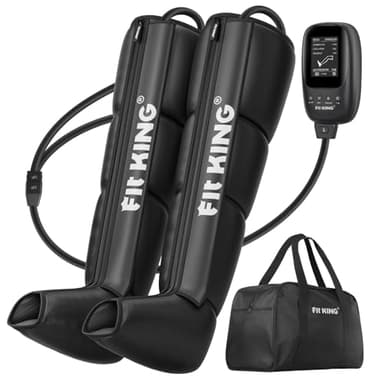
FIT KING Air Compression Recovery Boots
Sequential chamber inflation — the mechanism that actually distinguishes recovery boots from a leg-shaped pressure cuff — at a third of what the category leader charges.
What it gets right
- Genuinely sequential: chambers fire ankle-upward rather than all at once
- Sized options rather than one-size-fits-nobody
- A fraction of the premium system price
What it does not
- Louder pump than the premium units
- Bulky to store and not remotely portable
- Sizing runs specific — measure before buying
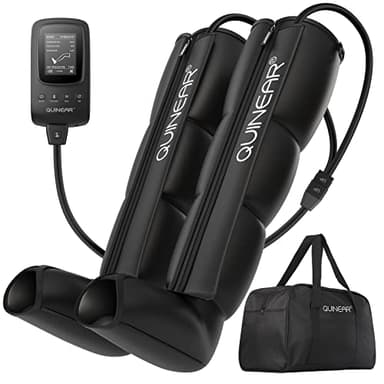
QUINEAR Leg Recovery Compression System
Covers foot, calf and thigh in one sleeve, which matters because the foot is where most budget systems stop and where a lot of the swelling sits.
What it gets right
- Includes the foot, which many systems omit
- Multiple pressure levels and modes
What it does not
- Pump noise
- Not portable
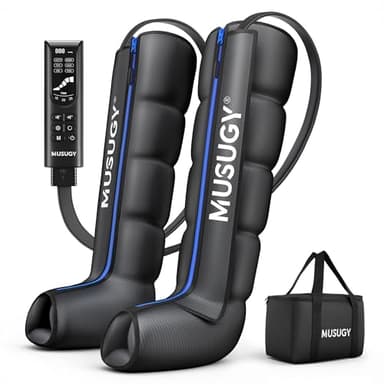
Musugy Sequential Leg Compression Massager
The cheapest genuinely sequential system here — the entry point at which compression boots stop being an aspiration and start being a thing you own.
What it gets right
- Sequential inflation at the lowest price in the category
- Full-leg coverage
What it does not
- Basic controls
- Build quality reflects the price
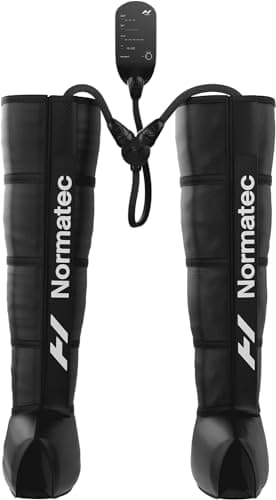
Price as of October 21, 2026. #ad How we’re funded
Hyperice Normatec 3 Recovery System
The reference system in the category, and also the one whose price gap over a sequential competitor buys refinement rather than a different mechanism — which is why it is our skip for a home buyer.
What it gets right
- The most refined pressure control and the quietest pump in the category
- The system most likely to still be supported in five years
What it does not
- Several times the price of boots that inflate sequentially the same way
- The added refinement does not change the mechanism
Common questions
What should I look for in compression boots?
Sequential inflation, before anything else — ankle first, then calf, then thigh, so pressure travels up the limb. A system that inflates every chamber at once is squeezing your leg rather than moving anything along it, and plenty of products sold as leg massagers do exactly that. Second, whether the foot is included, since many budget systems start at the calf.
Are expensive compression boots better?
They buy a quieter pump, finer pressure control, better-finished sleeves and stronger long-term support — not a different mechanism. For one person recovering from their own training, a mid-price sequential system delivers the thing you are actually buying. For a team or clinic running a unit daily across many people, the reliability justifies the gap.
How do I size compression boots?
Measure thigh circumference at the widest point, calf circumference at the widest point, and leg length, then read the manufacturer’s chart properly. Fit is the single most common complaint in this category and it cannot be fixed after purchase — too large and the chambers cannot generate pressure against the limb, too small and the distribution is wrong. Prefer systems sold in multiple sizes.
Who should not use compression boots?
Anyone with known or suspected deep vein thrombosis, active infection or cellulitis in the limb, severe peripheral arterial disease, uncontrolled congestive heart failure, an open wound or recent skin graft on the limb, or significantly reduced sensation. Sequential compression was a clinical mechanism before it was a recovery product and the cautions are real — ask a clinician.