Symptoms
Restless Legs at Night
Of everything sold for restless legs, exactly one home device has a double-blinded, sham-controlled randomized trial behind it, and it is pneumatic compression - the recovery boots. Worn for an hour before symptoms usually start, they beat a sham device on severity, sleepiness and fatigue. Here is that trial, the blood test you should ask for first, and the honest status of everything else.
By Stephen V.Published
Disclosure:Grip & Gait earns a commission when you buy through links on this page, at no extra cost to you. It never changes what we recommend or the order we rank things in — here is exactly how we’re funded.
The thirty-second version
If your legs get an uncomfortable, creeping urge to move the moment you sit or lie down, and moving relieves it, and it is worse in the evening, that is the pattern clinicians call restless legs syndrome. Two things are worth doing before you spend anything. First, ask your doctor for iron studies — the current sleep-medicine guideline treats that as basic practice, not an optional extra, and low iron stores are a genuinely treatable cause. Second, if you want a device, the one with real trial evidence is a pneumatic compression device: recovery boots, worn for about an hour before your symptoms normally start.
Everything else on the shelf — guns, rollers, sprays, magnesium patches — ranges from plausible to nonsense, and we will say which is which.
What restless legs actually is
It is a neurological condition, not a muscle problem, which is the single most useful fact on this page. The sensation is generated centrally, not in the calf you are rubbing, and the diagnostic pattern is specific: an urge to move the legs usually accompanied by an uncomfortable sensation, worse at rest, relieved by movement, and worse in the evening or at night. That last point is why it wrecks sleep and why so many people arrive here at 1am.
Because it is central rather than muscular, the tools this site is mostly about — percussion, rolling, trigger-point work — are aiming at the wrong thing. They can feel good. They are not treating the mechanism. The American Academy of Sleep Medicine’s 2025 clinical practice guideline on restless legs syndrome opens with a good-practice statement that has nothing to do with devices at all: in all patients with clinically significant RLS, clinicians should regularly test serum iron studies including ferritin and transferrin saturation, ideally in the morning and with iron-containing supplements and foods avoided for at least 24 hours before the draw. The guideline notes that consensus suggests supplementing iron in adults with RLS when serum ferritin is at or below 75 ng/mL, while being explicit that this threshold has not been empirically tested. If you read one thing on this page twice, read that paragraph: it is a blood test, it is cheap, and it is the step most people skip.
The one device with a sham-controlled trial
This is unusual enough to be worth spelling out. A prospective, randomized, double-blinded, sham-controlled trial published in Chest enrolled 35 people with RLS and had them wear either a therapeutic pneumatic compression device or a sham device for at least one hour daily, before the usual onset of their symptoms. After one month, the therapeutic group improved more than sham on every measured variable. Restless Legs Severity Score fell from 14.1 to 8.4 (p = 0.006). The Johns Hopkins Restless Legs Scale fell from 2.2 to 1.2 (p = 0.01). Epworth sleepiness scores were 6.5 in the therapeutic group against 11.3 in the sham group (p = 0.04), and fatigue 4.1 against 6.9 (p = 0.01). Quality-of-life domains moved in the therapeutic group’s favour — daytime function 21% versus 6%, social function 14% versus 1%. Complete relief occurred in one third of people using the therapeutic device and in none of those using sham.
Thirty-five people is a small trial and the authors position compression as an adjunctive or alternative therapy rather than a cure. But it is double-blinded and sham-controlled, which is more than almost anything else in the recovery-device aisle can claim, and the device class is the same one sold today as recovery boots.
Two practical details from the protocol are easy to miss and change everything. An hour, and before symptoms start. This is not a thing you reach for at midnight when your legs are already going; it is a thing you do at eight in the evening while watching television, which happens to be the easiest possible compliance ask.
A useful counterweight on the compression theme: a 2024 randomized controlled study of compression stockings in 63 pregnant women with RLS found severity scores and sleep quality improved in both the compression and the placebo stocking groups. That is a reminder that RLS responds strongly to placebo and that static stockings are not the same intervention as intermittent pneumatic compression. It is also why we are quoting the sham-controlled trial rather than an uncontrolled one.
Which class of tool fits restless legs
| Tool class | Cost | Why it does or doesn’t work here | Verdict |
|---|---|---|---|
| Compression boots | Cost: Mid-range | The only home device class with a double-blinded, sham-controlled randomized trial for RLS. Worn an hour before symptoms normally start.Where it fails: Not for anyone with a current or suspected blood clot, active infection, or uncontrolled heart failure - ask a clinician first. | Start here |
| Heating pad | Cost: Budget | No trial evidence in RLS. Cheap, pleasant, and a lot of people find warmth on the calves takes the edge off the urge for a while.Where it fails: Useless if your symptoms are worse with warmth, which is a real subgroup. Never fall asleep on one. | Sometimes |
| Roller stick or foam roller | Cost: Budget | Rolling the calves is movement, and movement is the thing that reliably relieves RLS for as long as you keep doing it.Where it fails: It relieves the urge temporarily rather than treating anything. If your legs feel tight rather than restless, you have a different problem. | Sometimes |
| Massage gun | Cost: Mid-range | Plausible as counter-stimulation and widely used for it. There is no trial evidence for percussion in RLS and we will not invent any.Where it fails: A poor use of the money if RLS is your only complaint - buy compression instead. Never use one on a leg with suspected clot. | Sometimes |
| TENS or EMS unit | Cost: Budget | Counter-stimulation that some people find settles the sensation. Cheap to try and low risk if you respect the contraindications.Where it fails: The meta-analysis evidence for TENS in neuropathic pain is weak, and RLS is not neuropathic pain. Do not buy it expecting a fix. | Sometimes |
| Insoles or arch support | Cost: Budget | Sold in the same aisle and occasionally suggested for leg symptoms generally.Where it fails: Nothing to do with this condition. Insoles address load through the foot; restless legs is generated centrally. If your feet ache rather than feeling restless, you are on the wrong page. | Not for this |
What to look for if you buy compression
- Genuinely sequential inflation. The chambers should fire ankle-upward in turn, not all at once. That is the mechanism the trial used and the thing that distinguishes a recovery boot from a leg-shaped pressure cuff.
- A session length that fits the protocol. You are aiming for roughly an hour in the evening, so a unit with a timer that goes to 30 minutes and needs restarting twice is mildly annoying rather than disqualifying. Check it before you buy.
- Sizing you have actually measured. Boots that do not close properly on a calf do not compress it. Every maker publishes a circumference range; measure first.
- Pump noise you can tolerate at 9pm. This is an evening-in-front-of-the- television device. The cheapest pumps are the loudest.
- Adjustable pressure, with a low setting. You want comfortable, not maximal. Nothing in the trial rewards cranking it up.
What we would actually buy
One of these is the thing with the trial behind it; the second is the cheapest version of the same mechanism; the third is the cheap comfort measure almost everybody tries first. In that order.
The one with a trial
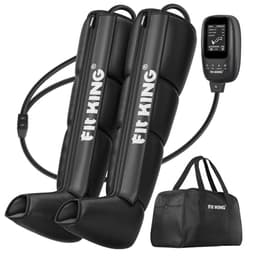
FIT KING Air Compression Recovery Boots
Genuinely sequential chamber inflation - the mechanism used in the sham-controlled trial - with sized options and adjustable pressure, at a fraction of the premium systems. Measure your calf before ordering.
The cheapest way in
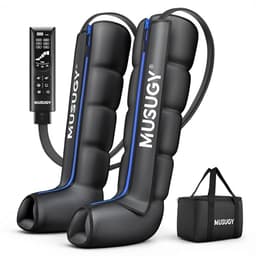
Musugy Sequential Leg Compression Massager
The lowest-priced genuinely sequential system we cover. Basic controls and build, same mechanism. The right buy if you want to test an hour of evening compression without committing much.
The cheap comfort measure
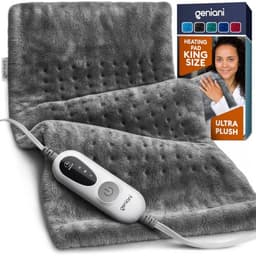
GENIANI Electric Heating Pad
No trial evidence in restless legs, and the thing most people reach for while they wait for a blood test result. Moist heat with an auto shutoff, for the nights when warmth on the calves helps.
How to run the compression session
Mirroring the trial protocol: one hour, daily, before your symptoms usually start.For most people that means early evening rather than bedtime. Comfortable pressure, both legs, sitting with the legs supported. Give it a month before judging it — the trial measured at one month, and the people who report nothing after two nights have not run the intervention that was tested.
While the boots are on you are sitting still, which is exactly when RLS is worst, so expect the first few sessions to feel counterintuitive. That is also the point: the trial’s whole premise is that the compression is doing something to the sensation rather than simply distracting you by making you move.
Keep the rest of it boring and free: a consistent bed time, legs moved during the day, caffeine earlier, alcohol lower. None of that is a product and all of it is in the standard advice for this condition.
The things sold for this that we will not recommend
Magnesium sprays and “restless leg” patches have no trial evidence behind them that we could verify, and a cheap unverified thing is still a thing you bought instead of a blood test. Percussion is pleasant and untested here. Static compression stockings are not the same intervention as intermittent pneumatic compression, and the one randomized study we found in pregnancy showed the placebo stocking working about as well as the real one. If you want to spend money on this condition, spend it on the device class with the sham-controlled trial, and spend the appointment on iron studies.
Where to go next
If your legs cramp hard at night rather than feeling restless, that is a different problem with a different trial behind it — see leg cramps. If the sensation is burning or numb rather than an urge to move, neuropathy is the closer match. For heavy, swollen legs at the end of the day, compression boots for circulation covers who should ask a doctor first, and the budget boots roundup is the page if you have decided on compression and want the cheapest sound option.
Common questions
Do compression boots help restless legs?
There is a double-blinded, sham-controlled randomized trial that says yes. Published in Chest, it had 35 people with RLS wear either a therapeutic pneumatic compression device or a sham for at least an hour daily before their symptoms usually started. After a month the therapeutic group improved more than sham on every measure: severity score 14.1 to 8.4 (p = 0.006), Epworth sleepiness 6.5 versus 11.3 (p = 0.04), fatigue 4.1 versus 6.9 (p = 0.01), with complete relief in a third of the therapeutic group and none of the sham group. It is a small trial, and it is the best evidence any home device for this condition has.
How do you stop restless legs immediately at night?
Move them — that is the diagnostic feature of the condition and also the fastest relief. Stand and walk, stretch the calves, or roll them. Warmth on the calves helps some people and makes it worse for others. What the trial evidence supports is not a rescue at midnight but a routine: an hour of pneumatic compression earlier in the evening, before symptoms usually start. If you are up most nights, that is a reason to be seen rather than to keep troubleshooting at 1am.
Is restless legs caused by low iron?
It can be, and it is the first thing worth ruling out. The American Academy of Sleep Medicine’s 2025 clinical practice guideline includes a good-practice statement that clinicians should regularly test serum iron studies, including ferritin and transferrin saturation, in all patients with clinically significant RLS — taken in the morning, with iron-containing supplements and foods avoided for at least 24 hours beforehand. Consensus cited in the guideline suggests iron supplementation in adults when ferritin is at or below 75 ng/mL, while noting that threshold has not been empirically tested.
Does a massage gun help restless legs?
Possibly, as counter-stimulation, and there is no trial evidence for percussion in restless legs syndrome. Plenty of people use one and find it takes the edge off for a while, which is what movement of any kind does for this condition. If restless legs is your only complaint, the money is better spent on pneumatic compression, which has a sham-controlled trial behind it. If you have sore, tight muscles as well, a gun earns its place for that reason instead.
Sources
- 1.Pneumatic compression devices are an effective therapy for restless legs syndrome: a prospective, randomized, double-blinded, sham-controlled trial - Chest 2009 (PMID 19017878) — 35 subjects, 1 h daily before symptom onset; severity 14.1 to 8.4 (p=0.006); complete relief in one third vs none on sham
- 2.Treatment of restless legs syndrome and periodic limb movement disorder: an American Academy of Sleep Medicine clinical practice guideline - Journal of Clinical Sleep Medicine 2025 (PMC11701286) — good-practice statement: test ferritin and transferrin saturation in all clinically significant RLS
- 3.The effect of compression stockings on the complaints, well-being and sleep quality of pregnant women with restless legs syndrome: a randomized controlled study - Revista da Associacao Medica Brasileira 2024 (PMC11329251) — 63 pregnant women; both compression and placebo stocking groups improved - the placebo caveat
- 4.Neuropathic Pain Relief Through Transcutaneous Electrical Neuromuscular Stimulation: Insights From a Systematic Review and Meta-Analysis of Clinical Evidence - BioMed Research International 2025 (PMC12543013) — why we do not oversell TENS here
- 5.camelcamelcamel — FIT KING compression boots price history — price history for the top pick