Guides
How to Foam Roll Properly
Foam rolling is simple, which is exactly why most people do it slightly wrong: too fast, too long on the wrong tissue, and rolling straight over the one structure they should never roll over. Here is how to do each muscle, how long to spend, and where to stop.
By Stephen V.Published
Disclosure:Grip & Gait earns a commission when you buy through links on this page, at no extra cost to you. It never changes what we recommend or the order we rank things in — here is exactly how we’re funded.
Quick picks
Ranked on published manufacturer specs and what they mean for the job, not on testing we have not done. Tap a row for the full reasoning. How we score.
| # | Product | Best for | Score | Price |
|---|---|---|---|---|
| 1 |  TriggerPoint GRID Foam Roller (13 in) Multi-density surface concentrates pressure in strips, and the rigid core does not compress into a soft log after a year. | The roller this guide assumes | 8.5 | |
| 2 |  Amazon Basics High-Density Foam Roller (18 in) A plain high-density cylinder does the same mechanical work. An 18 in length lies along your spine, which a 13 in roller cannot. | Cheapest way to start | 8.0 | $15.29 · View on Amazon Price as of October 21, 2026. #ad How we’re funded |
| 3 |  Kieba Massage Lacrosse Balls A ball reaches the deep glute and the muscle under the shoulder blade that a cylinder rolls straight past. | For the spots a roller skims | 8.8 | $7.99 · View on Amazon Price as of October 21, 2026. #ad How we’re funded |
The three rules that fix most of it
- Go slowly. Roll about an inch per second, not the fast scrubbing motion you see in gyms. The sustained, slow pressure is the point; speed just skims the surface.
- Spend 30-60 seconds per muscle, not five minutes. When you find a tender spot, pause and hold on it for 20-30 seconds and let it ease, rather than grinding at it.
- Control the load with your body.More pressure is not better. You regulate intensity by how much of your weight you put through the roller — stack your other leg on top to add load, take it off to reduce it.
How to roll the muscles worth rolling
- Calves. Sit with the roller under one calf, the other leg stacked on top for load, and roll slowly from just below the knee to just above the ankle. Turn the leg in and out to catch the inner and outer heads.
- Quads.Face down, roller under the thighs, and roll from just above the knee to the hip. This is the muscle the roller is best at — broad, superficial, easy to load.
- Hamstrings and IT band.Sit or lie on the roller and work the back and outer thigh slowly. Much of what feels like a tight IT band responds better to working the glute and hip above it — see the IT band page.
- Upper back.Roller across the mid-back, hands supporting your head, and roll the thoracic spine. This is also where a roller does mobility work no gun can — a gentle extension over the roller.
- Glutes. Sit on the roller, cross one ankle over the opposite knee, and lean into that side. For a deep, specific glute spot a ball is better than the roller.
Where not to roll
Never roll directly over your lower back (the lumbar spine).Rolling the lumbar region can cause the spinal muscles to guard and is a common way people make a sore back worse. Work the glutes and the mid-back instead, and treat the lower back with heat or gentle movement — the routing is on the lower back pain page. Also avoid rolling directly over joints, bones and the front of the shin, and go carefully near the neck.
What foam rolling does, and what it does not
Rolling reliably improves short-term range of motion and feels good, and it is a legitimate part of a warm-up. A study on foam roller or massage gun use during a warm-up examined its effect on performance, and a direct comparison of foam rolling and percussive massage found both accelerated the recovery of muscle properties disrupted by soreness — while finding that neither reduced pain significantly more than resting. So roll for mobility and because it feels good; do not expect it to be the thing that shortens your soreness.
If a plain cylinder feels too blunt or too intense, the options are covered in foam roller vs massage ball and vibrating foam rollers. And if you are deciding between a roller and a gun in the first place, start with massage gun vs foam roller.
Every pick, in full
Specs below are the manufacturer’s own published figures, each linked to the page it came from. Where a maker does not publish a number, the table says so and names the page we checked — that absence is information too.
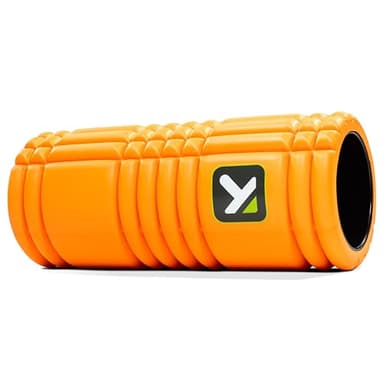
TriggerPoint GRID Foam Roller (13 in)
The multi-density surface is the reason to buy this over a plain foam cylinder: the raised sections concentrate pressure in strips instead of spreading it flat, which is what makes it usable on an IT band without needing to hold your breath.
What it gets right
- Hollow rigid core does not compress into a soft log the way plain EVA foam does after a year
- Multi-density surface gives you three pressure intensities on one roller
- 13 in length fits in a gym bag; the 26 in version does not
What it does not
- Costs roughly three times a plain high-density cylinder that also works
- The hollow core makes it noisier on a hard floor
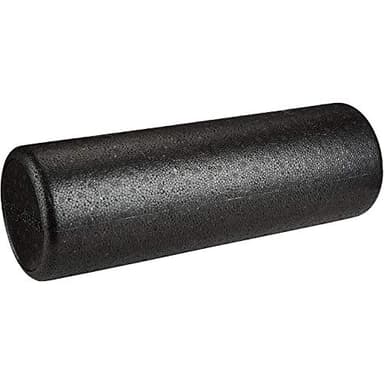
Price as of October 21, 2026. #ad How we’re funded
Amazon Basics High-Density Foam Roller (18 in)
A dense foam cylinder does the same mechanical job as a textured roller for a fraction of the money, and for a first roller that is the correct purchase.
What it gets right
- Does the actual mechanical work — sustained pressure across a broad contact area
- Nothing to break; no core, no seams, no electronics
- 18 in is long enough to lie along your spine, which the 13 in rollers are not
What it does not
- Flat surface spreads pressure rather than concentrating it
- Solid EVA softens over a few years of heavy use
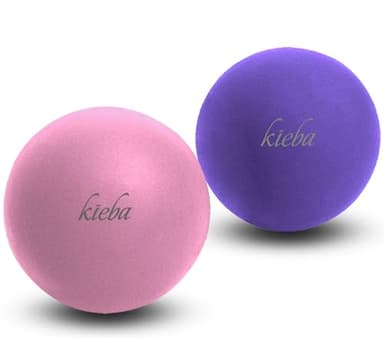
Price as of October 21, 2026. #ad How we’re funded
Kieba Massage Lacrosse Balls
The highest work-per-dollar tool on this entire site. A hard rubber sphere concentrates all your body weight into one square inch, which is more pressure than any handheld gun can generate.
What it gets right
- Concentrates body weight into a single point — more local pressure than any percussion device
- Nothing to charge, nothing to break, fits in a coat pocket
- Reaches under the shoulder blade against a wall, which a roller physically cannot
What it does not
- Unforgiving — very easy to overdo on a first session
- Wrong tool for broad surfaces like quads or lats
Common questions
How long should you foam roll each muscle?
About 30 to 60 seconds per muscle group, rolling slowly at roughly an inch per second. When you find a tender spot, pause and hold on it for 20-30 seconds rather than grinding back and forth. Longer is not better; once a muscle has eased, move on. A whole-body session is usually done in ten minutes or so.
Should foam rolling hurt?
It should be uncomfortable but bearable — a “good hurt” around 4 to 6 out of 10 that you can breathe through. If you are holding your breath, clenching, or bruising, you are pressing too hard, and extra pressure does not buy extra benefit. You control the load by how much body weight you put through the roller, so ease off.
Can you foam roll your lower back?
You should not roll directly over the lumbar spine. Rolling the lower back can make the spinal muscles guard and is a common way to worsen a sore back. Work the glutes and the mid-back instead, and treat the lower back itself with heat and gentle movement. If lower-back pain is the problem, the tool routing is on our lower back page.
Sources
- 1.Does Massage Gun or Foam Roller Use During a Warm-Up Improve Performance in Trained Athletes? (PMC12473898)
- 2.Foam Rolling or Percussive Massage for Muscle Recovery: Insights into DOMS (PMC12286022)
- 3.The Effect of Percussive Therapy on Musculoskeletal Performance and Experiences of Pain: A Systematic Literature Review (PubMed 37020441)