Massage Guns
Ekrin B37v2 vs Theragun Prime
One of these guns solves the problem of reaching your own mid-back; the other has the longest stroke and the strongest brand. The choice is less about which is better and more about which problem is actually yours — and whether either is the cheapest correct answer.
By Stephen V.Published
Disclosure:Grip & Gait earns a commission when you buy through links on this page, at no extra cost to you. It never changes what we recommend or the order we rank things in — here is exactly how we’re funded.
Quick picks
Ranked on published manufacturer specs and what they mean for the job, not on testing we have not done. Tap a row for the full reasoning. How we score.
| # | Product | Best for | Score | Price |
|---|---|---|---|---|
| 1 |  Ekrin Athletics B37v2 Massage Gun Angled handle, a standout warranty, quieter than most, and much less than the Prime. | Reaching your own back, value | 8.4 | $224.99 · View on Amazon Price as of October 21, 2026. #ad How we’re funded |
| 2 |  Therabody Theragun Prime (6th Gen) A long stroke and pressure feedback from a brand that builds well, at a higher price with its depth numbers hidden. | Long-stroke brand hardware | 7.8 | $329.99 · View on Amazon Price as of October 21, 2026. #ad How we’re funded |
| ✕ |  Bob and Brad C2 Massage Gun Publishes the depth numbers both of these omit, at a fraction of the price. Skip both if specs decide it for you. Skip this | The value spoiler | 8.6 |
The short answer
For treating your own body without a second person in the room, buy the Ekrin B37v2. Its angled handle is the one genuinely useful ergonomic idea in this category, and it is backed by a warranty that embarrasses everything sitting above it on price. Buy the Theragun Primeinstead if your real targets are thick, dense muscle — glutes, quads, a heavy lower back — where a longer stroke does work a shorter one cannot, and if a brand that will still exist and still sell you replacement heads in a few years is worth paying a premium for. Both are good hardware. Neither is the cheapest correct answer, which is the awkward third pick we get to at the end.
What you are actually choosing between
This is a mid-priced gun against a premium one, and the price gap is real but not enormous. The Ekrin is the more affordable of the two and sits in the sensible middle of the market; the Theragun is a premium device from the brand that more or less defined the category. Because the gap is narrow, the decision does not come down to money the way a cheap-versus-expensive fight would. It comes down to two specific strengths that point at two specific buyers. Work out which buyer you are and the rest follows.
Where the Ekrin wins: the handle you can actually reach with
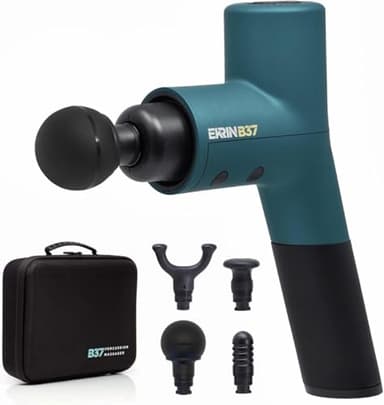
Almost every massage gun is a pistol grip that assumes someone else is holding it. Point one at your own mid-back and you discover the problem immediately: your wrist runs out of angle before the head reaches the muscle. The Ekrin’s angled handle is a small change to the geometry that quietly fixes this. It tilts the head into the plane of your own spine so you can drive pressure into a spot you would otherwise have to ask a partner to reach. That is not a marketing flourish. It is the difference between a gun you use on your whole body and a gun you use on the half of your body you can comfortably point at.
It is also quieter than most mid-priced guns, which matters more than the spec sheets admit. A tool you can run in a shared room in the evening is a tool you actually pick up; a tool that forces you into another room is one you use twice and abandon. The Ekrin is not the quietest premium unit on the market, but it is quiet enough that noise stops being a reason not to use it.
The warranty nobody else matches
Warranty length is the closest thing this category has to a published durability signal, since no manufacturer prints a mean-time-to-failure figure. On that signal the Ekrin is an outlier: its coverage runs far longer than what the premium brands offer, and it does so at a lower price than the Prime. The Theragun, by contrast, carries a notably short warranty for a device at its price. If you want a proxy for how long the maker expects its own gun to last, the two companies are telling you very different things, and the cheaper one is making the bolder promise. That is unusual enough to be worth weighting heavily.
Where the Theragun wins: stroke length and permanence
The Prime’s case is stroke. Stroke length — how far the head travels on each pass — is the single specification that determines how deep a percussion gun reaches, and the Theragun has one of the longer strokes in consumer hardware. On thin muscle it makes no difference, because a short stroke is already past the tissue. On a glute, a quad or a thick lower back, the extra travel reaches muscle a shorter stroke skates over. If those dense groups are your reason for buying a gun at all, this is the stronger argument on the page.
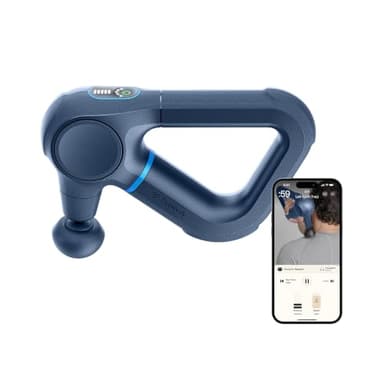
The Prime adds two more things worth naming. Its pressure-feedback display corrects the single most common user error in the category — leaning on the gun far too hard, for far too long — which is more useful to a first-time buyer than another attachment. And it comes from a brand with real permanence: Therabody will exist in five years and will still sell you a head that fits. A large share of this category will not, and a gun you cannot get parts for is a gun with an expiry date.
The specs that do not settle it
A lot of what fills a mid-versus-premium comparison turns out not to matter here. Attachment count is the obvious example: both ship with enough heads, and the truth is that most people settle on one or two and ignore the rest, so a bigger box is not a better gun. Speed settings are similar — the gap between the lowest and highest setting is what you use, and a longer list of intermediate steps is a spec-sheet flourish more than a daily benefit. Battery life is a wash for home use, because a gun that charges between sessions never runs flat mid-session regardless of the quoted figure.
Weight is the one downstream spec that does earn attention, because it decides whether you can finish a session on your own shoulder before your arm gives out. Both of these are manageable in the hand, and neither is the lightest thing on the market, so weight nudges the decision rather than making it. If a light gun for overhead work on your own upper body is the priority, weigh that alongside the Ekrin’s handle angle — together they are the reason it is the easier gun to use on yourself, quite apart from any single number.
One group should think twice about both. Percussion at the aggressive end is a lot for stiff hands and thin skin, and the answer there is a gentler tool rather than the most powerful one you can afford. If that is the buyer, read our guide to massage guns for older hands before choosing either of these.
The blind spot they share
Here is the part neither product page invites. On the numbers that decide depth, the premium gun is the one flying blind. Therabody’s current US product page publishes dimensions, weight, battery and warranty, and does not publish amplitude, stall force, percussions per minute or noise — we checked the page you buy from. The Ekrin does not lead with those figures either. So between these two, you are choosing on stroke length that one company quotes in its wider marketing but not on the page, and on ergonomics and warranty that you can verify. That is a strange situation for a premium purchase, and it is exactly why the third pick below exists.
The value spoiler that undercuts both
If specifications are what actually decide this for you, neither of these is the gun to buy. The Bob and Brad C2 is the only unit in this conversation whose maker publishes all four depth-relevant numbers — amplitude, stall force, speed range and noise — on the page you buy from, at a fraction of the Prime’s price. Its published stall force, the figure that decides whether the stroke survives contact with your body, is higher than the number Therabody has historically quoted for the Prime, and it is light enough to hold overhead against your own shoulder. It is also FSA and HSA eligible, which quietly cuts the real price again for a lot of buyers.
The honest caveat cuts the other way too: the C2’s stroke is genuinely shorter than the Theragun’s, and it has no angled handle to match the Ekrin’s reach and no pressure display. It wins on transparency and price, not on every axis. But if you are the sort of buyer who reads spec sheets before deciding, the gun that actually prints its specs is hard to argue past. Skip both of the headline picks if numbers are what you are shopping on, and read our full Bob and Brad vs Theragun breakdown before you spend.
What either gun will and will not do
Whichever you choose, buy on the right claim. Percussion is a percussion device regardless of the badge, and the research does not care which brand made it. A study using a Theragun found real reductions in tissue stiffness and a short-term improvement in range of motion, and a systematic review supports gains in acute and explosive strength when percussion is used before activity. But the randomized trial on soreness found percussion offered immediate, temporary relief without actually accelerating recovery. In plain terms: either gun will make you move a little better for a while and neither will make you heal faster. Buy for the first thing, which the evidence supports, and ignore the marketing that implies the second.
Our verdict
Buy the Ekrin B37v2if you treat your own body and value reach and a long warranty over the last few millimeters of stroke — for most solo users, that is the right call and the better value of the two. Buy the Theragun Prime if dense muscle and brand permanence justify the premium, and you want the pressure display to keep yourself honest. And if the whole thing comes down to which gun tells you what it does, buy neither and read the case for the fully-specified budget gun instead. The money you keep covers a roller and a ball that handle the jobs no gun does well.
Every pick, in full
Specs below are the manufacturer’s own published figures, each linked to the page it came from. Where a maker does not publish a number, the table says so and names the page we checked — that absence is information too.
Price as of October 21, 2026. #ad How we’re funded
Ekrin Athletics B37v2 Massage Gun
The 15-degree angled handle is the one genuine ergonomic idea in this category — it is the difference between reaching your own mid-back and asking someone else to.
What it gets right
- Angled handle materially extends self-treatment reach
- Lifetime warranty is unusual at any price in this category
- Quieter than most mid-priced guns
What it does not
- Costs several times a fully-specified budget gun
- Heavier than the lightest premium handhelds
Price as of October 21, 2026. #ad How we’re funded
Therabody Theragun Prime (6th Gen)
The long-stroke option, and the build quality is not in question — but Therabody's current US product page publishes dimensions, weight, battery and warranty and does not publish amplitude, stall force, PPM or noise, so the numbers most buyers are shopping on are not on the page they are shopping from.
What it gets right
- The 16 mm stroke Therabody quotes is genuinely long, and stroke length is what determines depth
- Real-time pressure feedback stops the most common user error — leaning on it far too hard
- Rated by Therabody to survive drops from 10 feet, which matters more than it sounds for a thing you use on a hard floor
What it does not
- Amplitude, stall force, PPM and dB are absent from the current US product page — we checked
- Two attachments in the box, against five on guns costing a fifth as much
- 120 minutes of battery is quoted at the LOWEST speed setting, which is not the setting you will use
- One-year limited warranty on a device at this price
| Amplitude | Not published page we checked |
|---|---|
| Stall force | Not published page we checked |
| Speed range | Not published page we checked |
| Speed settings | 5 source |
| Weight | 2 lb source |
| Noise | Not published page we checked |
| Battery | 2 h source |
| Attachments | 2 source |
| Warranty | 1-year limited source |
| Dimensions | 238 × 153 × 61 mm source |
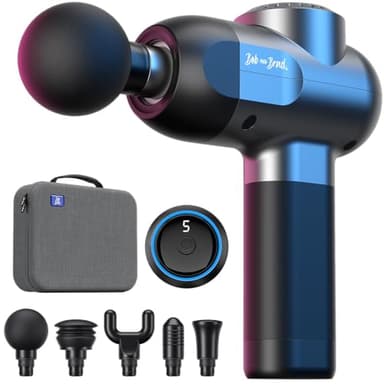
Bob and Brad C2 Massage Gun
The only gun in this roundup whose maker publishes all four numbers that decide whether it reaches the muscle — amplitude, stall force, speed range and noise — and the stall-force figure is higher than the premium units that hide theirs.
What it gets right
- Publishes amplitude, stall force, speed range and noise — the two market leaders publish none of the first three
- Published stall force of over 44 lb is higher than the figure Therabody publishes for the Prime
- 1.5 lb is light enough to hold overhead against your own shoulder without your arm giving out first
- FSA/HSA eligible, which quietly makes it cheaper again for a lot of buyers
What it does not
- 10 mm amplitude is genuinely shorter than a 16 mm premium stroke — that difference is real for glutes and thick back muscle
- No app, no pressure-feedback screen, no ecosystem
- Five fixed speeds rather than a continuous range
Common questions
Is the Ekrin B37v2 better than the Theragun Prime?
For treating your own body, usually yes. The Ekrin’s angled handle reaches your own mid-back and shoulders in a way a straight pistol grip cannot, it is quieter than most mid-priced guns, and it carries a far longer warranty at a lower price. The Theragun wins if your targets are dense glutes and thick back muscle, where its longer stroke does real work, and if brand permanence and a pressure-feedback display are worth the premium to you.
Does the Theragun Prime reach deeper than the Ekrin B37v2?
On stroke length, which is what determines depth, the Theragun is the longer-stroke gun and reaches thick muscle a shorter stroke skates over. The catch is that Therabody does not publish its amplitude on the current US product page, so you are trusting a figure quoted in wider marketing rather than one you can read at the point of purchase. For glutes and a heavy lower back the extra reach is real; for calves, forearms and shoulders it changes nothing, because a shorter stroke is already past that tissue.
Should I just buy a cheaper gun than either of these?
If specifications decide it for you, yes. The Bob and Brad C2 is the only gun in this comparison whose maker publishes amplitude, stall force, speed range and noise on the page you buy from, at a fraction of the Prime’s price, and it is FSA and HSA eligible. What you give up is the Ekrin’s angled-handle reach and the Theragun’s longer stroke and pressure display — all real, none of them transparency. Buy the C2 for numbers and value; pay up only for a specific feature you will use.
Sources
- 1.Therabody — Theragun Prime product page — amplitude, stall force, PPM and noise not published on the current US product page
- 2.Bob and Brad — C2 massage gun product page — amplitude, stall force, speed range and noise published
- 3.Acute Effects of Theragun Percussive Therapy on Viscoelastic Tissue Dynamics and Hamstring Range of Motion (PMC10499144)
- 4.The Effect of Percussive Therapy on Musculoskeletal Performance and Experiences of Pain: A Systematic Literature Review (PubMed 37020441)
- 5.Percussion massage therapy and recovery from delayed onset muscle soreness — randomized controlled trial (PMC11979224)
- 6.Therabody — Product Safety & Precautions