Recovery Tech
The Best TENS Units
Three specifications decide whether a TENS unit is worth owning, and the number printed largest on the box is not one of them. Also: the real cost of ownership is the pads, and nobody tells you that.
By Stephen V.Published Updated
Disclosure:Grip & Gait earns a commission when you buy through links on this page, at no extra cost to you. It never changes what we recommend or the order we rank things in — here is exactly how we’re funded.
Quick picks
Ranked on published manufacturer specs and what they mean for the job, not on testing we have not done. Tap a row for the full reasoning. How we score.
| # | Product | Best for | Score | Price |
|---|---|---|---|---|
| 1 |  AUVON Dual Channel TENS Unit Two independent channels with separate intensity, rechargeable, and cheap enough to find out whether TENS works for you. | First unit, dual channel | 8.5 | $35.99 · View on Amazon Price as of October 21, 2026. #ad How we’re funded |
| 2 |  TENS 7000 Digital TENS Unit The clinic default. Manual parameter control instead of presets, and accessories are available everywhere. | Manual pulse width and rate | 8.3 | $38.88 · View on Amazon Price as of October 21, 2026. #ad How we’re funded |
| 3 |  KingPavonini Wireless TENS + EMS Muscle Stimulator Runs both from two pods you wear rather than from lead wires, each pod on its own mode and intensity. | TENS and EMS, no lead wires | 7.8 | |
| 4 |  Belifu Dual Channel TENS EMS Unit Twenty-four modes at the cheapest price here. Competent hardware under a marketing-driven mode count. | Absolute lowest cost | 7.3 | $35.99 · View on Amazon Price as of October 21, 2026. #ad How we’re funded |
| ✕ |  GENIANI Electric Heating Pad For general back stiffness, heat is cheaper, simpler and has no electrode pads to replace. Skip this | The alternative to try first | 8.0 |
The three specifications that matter
1. Dual channel
Two independent electrode pairs with separate intensity control. This matters because most real applications are bilateral or need two placements at different strengths — both sides of a lower back, or a knee and the muscle above it. A single-channel unit forces you to treat one area at a time at one intensity.
Nearly everything worth buying is dual channel now. It is still the first thing to confirm. For a knee specifically, where the joint bends under the pads, the ranking and the placement are in the best TENS unit for knee pain.
2. Manual pulse width and rate control
Most units offer named preset programs. Some also let you set pulse width (in microseconds) and rate (in Hz) directly. That distinction is invisible on day one and decisive on day thirty.
Responses to TENS vary considerably between people and between problems. Once you find that a particular frequency helps you and another does nothing, manual control lets you go straight there. Preset-only units make you hunt through numbered programs hoping to land on it again.
This is the specification that separates the unit clinics hand out from the one that looks nicer.
3. Standard connector pads
The unit is not the cost of ownership. The pads are.Electrodes lose adhesion after roughly 10–30 applications depending on skin, hair and storage, and they are a permanent consumable.
A unit taking standard 2 mm pin connectors can use pads from any manufacturer, which keeps replacement cheap and available indefinitely. A unit using a proprietary connector or a proprietary pad shape has locked you into one supplier for the life of the device. Over three years that difference exceeds the price gap between any two units on this page.
What to ignore
- Mode count. Twenty-four modes, thirty-two modes, forty. The difference between programs is pulse characteristics a microcontroller generates for nothing. Adding a mode costs a manufacturer a line of firmware and gains a line on the listing.
- Named body-part programs.“Shoulder,” “Knee,” “Waist.” These are marketing labels on frequency patterns, not clinically distinct protocols. Useful as starting points, meaningless as specifications.
- App control. Adds a phone dependency to a device with four buttons.
- Anything advertising muscle-building. That is EMS, it is a different function, and the abdominal-belt claims do not hold up. See TENS vs EMS.
Rechargeable or 9V?
Rechargeable, generally. A 9V battery unit is fine and the batteries are everywhere, but a rechargeable unit removes a small recurring annoyance and most modern units are.
One argument for the 9V clinic-standard units: they have been made unchanged for years, so pads, leads and support are abundant and cheap. That reliability is worth something, especially since leads fail more often than units do.
Using it well
- Clean, dry skin. Lotion and oil kill pad adhesion faster than anything.
- Place pads around the painful area, not directly on the worst point — bracketing it is the conventional approach.
- Turn intensity up until you feel a strong but comfortable tingle, never to the point of muscle contraction or pain. Contraction means you have wandered into EMS territory.
- 20–30 minutes, repeatable through the day.
- Expect accommodation. The sensation fades as your nervous system adjusts. Nudging intensity up slightly mid-session is normal.
- Peel pads from the edge and return them to the backing sheet in a sealed bag. This single habit roughly doubles pad life.
An honest note on expectations
Responses to TENS vary enormously. Some people find it genuinely useful for chronic pain and use it for years. Others feel the tingle and no benefit at all. There is no way to predict which you are, and no specification that changes the odds.
That is the strongest argument for buying a cheap dual-channel unit first. It costs less than a single appointment, it answers the question in a week or two, and if the answer is yes you can move up to something with manual control. If the answer is no, you have lost very little.
For general back stiffness with no nerve component, a heating pad is cheaper, simpler and has no consumables — which is why it is the skip entry on this page. Try it first if that describes you.
Three problems are common enough to have their own page, because the unit that suits them is not always the one at the top of this list. For a referred nerve pain, see the best TENS units for sciatica; for traps and a stiff neck, where a wireless unit finally earns its price, see the best TENS units for neck and shoulder pain; and for burning, numb feet, see the best TENS units for neuropathy, which leads with the meta-analysis rather than the marketing. Night cramps are their own case again — the one problem here where the EMS half of these units is the relevant half, covered in leg and night cramps.
Two pages go deeper than this one on the decisions people actually get stuck on: AUVON vs Belifu compares the two cheapest dual-channel units head to head, and the best TENS units for hip pain covers the deepest region on this site, where channel count matters more than anything on the box.
Two more, both about the format rather than the body part. Fibromyalgia is the one condition where the trial protocol names a setting rather than a product, so the best TENS units for fibromyalgia ranks on whether a unit can be set that way at all. And if you are weighing stick-on pods against lead wires, wireless vs wired TENS units is the page that says which situation justifies the premium.
Every pick, in full
Specs below are the manufacturer’s own published figures, each linked to the page it came from. Where a maker does not publish a number, the table says so and names the page we checked — that absence is information too.
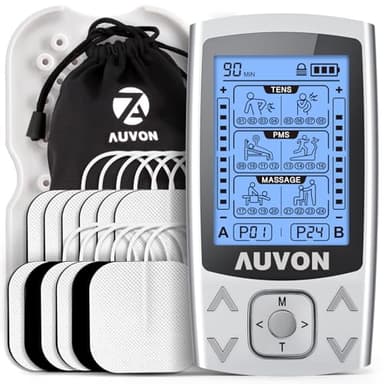
Price as of October 21, 2026. #ad How we’re funded
AUVON Dual Channel TENS Unit
Two independent channels so you can treat both sides of a problem at once, at a price where trying TENS costs less than one session of anything else.
What it gets right
- Two independent channels with separate intensity control
- Rechargeable rather than eating 9 V batteries
- Cheap enough to find out whether TENS does anything for you
What it does not
- Pad adhesive life is the real running cost, not the unit
- Interface is fiddly with cold hands
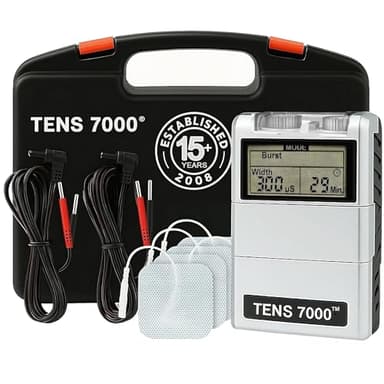
Price as of October 21, 2026. #ad How we’re funded
TENS 7000 Digital TENS Unit
The unit clinics hand out, with manual control over pulse width and rate rather than a menu of preset programs — which is what you want once you know what setting helps.
What it gets right
- Manual pulse-width and rate control instead of fixed presets
- The long-standing clinic default, so accessories are everywhere
What it does not
- Runs on a 9 V battery
- Manual control is only an advantage if you know what you are adjusting
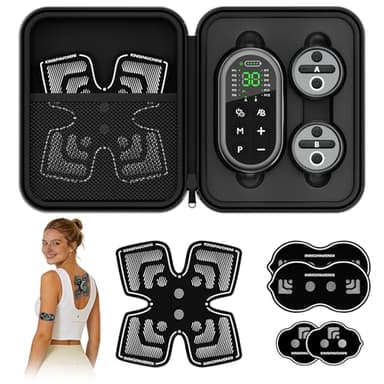
KingPavonini Wireless TENS + EMS Muscle Stimulator
TENS and EMS from two pods you stick on and wear, with no lead wires anywhere — which is the whole reason to pay this much, because it is the only version of the device you can use under a shirt and still move around in. The 48-mode count is marketing; the dual-zone independent control underneath it is not.
What it gets right
- Wireless pods rather than lead wires, so it works under clothing and while moving
- Two pods run independently — separate mode and intensity each, so a shoulder and a leg can run different settings at once
- Published 20 hours per pod on the 1040 mAh cell, charged over USB-C rather than off a disposable battery
- Ships with three pad sizes including a 4.3 in butterfly pad, which is the one that actually covers a lower back
What it does not
- Forty-eight modes is a mode count, not a specification — the same marketing this site flags on every cheap unit
- Several times the price of a wired dual-channel unit that treats a back just as well
- Two pods and a remote are three things to keep charged and not lose
- Listed only in December 2025 and rated 4.1 across 69 reviews, so there is very little ownership history behind it
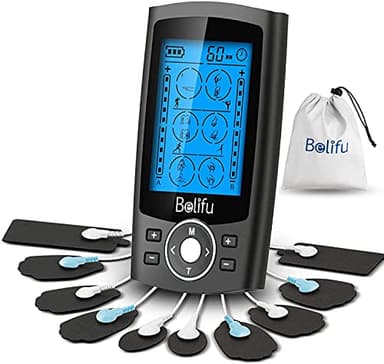
Price as of October 21, 2026. #ad How we’re funded
Belifu Dual Channel TENS EMS Unit
Twenty-four modes at the lowest price in the category, and the mode count is marketing — but the hardware underneath is a competent dual-channel stimulator.
What it gets right
- Cheapest dual-channel unit here
- Rechargeable
- Pads and leads included
What it does not
- Mode count is noise, not a feature
- Thin documentation of what each mode does
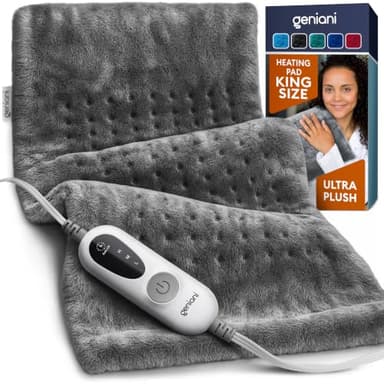
GENIANI Electric Heating Pad
Moist-heat capable with an auto-shutoff, which is the specification that decides whether a heating pad is safe to use lying down — and lying down is when you want it.
What it gets right
- Auto shutoff — the safety feature that matters if you fall asleep on it
- Moist-heat option penetrates better than dry
- Machine-washable cover
What it does not
- Corded, so your position is fixed
- Smaller than the XXL pads
Common questions
What should I look for in a TENS unit?
Three things: dual independent channels with separate intensity control; manual pulse-width and rate control rather than presets only; and standard 2 mm pin connectors so you can buy pads from anyone. Ignore the mode count entirely — it is a firmware line, not a feature.
How much do TENS pads cost to replace?
Pads, not the unit, are the real cost of ownership — they lose adhesion after roughly 10 to 30 applications depending on skin, hair and storage. Buy a unit with standard 2 mm pin connectors so any manufacturer’s pads fit, and store used pads on their backing sheet in a sealed bag, which roughly doubles their life.
Where do you place TENS pads?
Conventionally, bracketing the painful area rather than directly on the worst point — one pad either side, so the current passes through the region. Turn the intensity up to a strong but comfortable tingle, never to muscle contraction or pain. Never place electrodes over the front of the neck, across the chest, over the eyes, or on the abdomen or lower back during pregnancy.
How long should you use a TENS unit for?
Twenty to thirty minutes per session, repeatable through the day. Expect the sensation to fade as your nervous system accommodates — nudging the intensity up slightly mid-session is normal and expected rather than a sign anything is wrong.
Does a TENS unit actually work?
Responses vary enormously. Some people find it genuinely useful for chronic pain and use it for years; others feel the tingle and no benefit at all. There is no way to predict which you are and no specification that changes the odds — which is the strongest argument for buying a cheap dual-channel unit first and finding out.