Recovery Tech
AUVON vs Belifu TENS
These are the two units almost everybody ends up choosing between, and the honest answer is that they are more alike than either listing suggests. Buy the AUVON if you want the better day-to-day unit; buy the Belifu if the lowest possible price is the whole point. The thing that will actually decide whether you keep using it is neither - it is the pads.
By Stephen V.Published
Disclosure:Grip & Gait earns a commission when you buy through links on this page, at no extra cost to you. It never changes what we recommend or the order we rank things in — here is exactly how we’re funded.
Quick picks
Ranked on published manufacturer specs and what they mean for the job, not on testing we have not done. Tap a row for the full reasoning. How we score.
| # | Product | Best for | Score | Price |
|---|---|---|---|---|
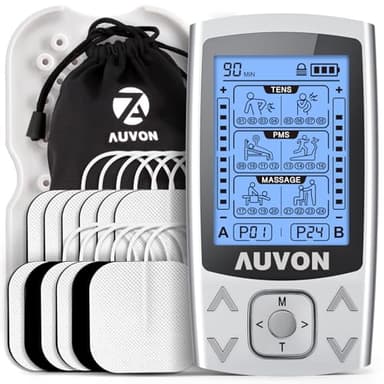
| 1 |  AUVON Dual Channel TENS Unit Two independent channels with separate intensity, rechargeable rather than battery-fed, and the interface most people get along with on the first evening. | Best overall of the two | 8.5 | $35.99 · View on Amazon Price as of October 21, 2026. #ad How we’re funded |
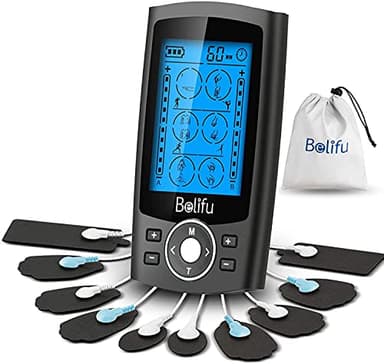
| 2 |  Belifu Dual Channel TENS EMS Unit The same dual-channel architecture at the lowest price here, with pads and leads in the box. The twenty-four modes are marketing; the stimulator underneath is competent. | Lowest price, same core job | 7.8 | $35.99 · View on Amazon Price as of October 21, 2026. #ad How we’re funded |
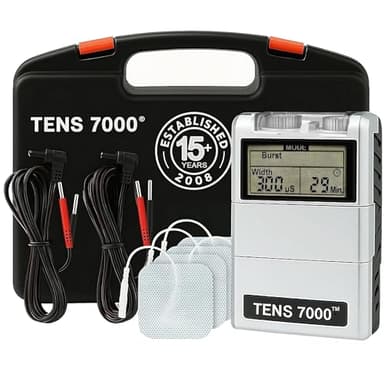
| 3 |  TENS 7000 Digital TENS Unit Neither unit above lets you set pulse width and rate by hand. This one does, which is what you want once you know which setting helps you - and it is the unit clinics hand out. | If you want manual control | 8.3 | $38.88 · View on Amazon Price as of October 21, 2026. #ad How we’re funded |
| ✕ |  KingPavonini Wireless TENS + EMS Muscle Stimulator Wireless pods are lovely and several times the price of either unit in the title. Worth it only if lead wires are the specific reason you would not use a TENS unit at all. Skip this | The one to skip in this decision | 6.8 |
The verdict in one paragraph
Buy the AUVON dual channel. It is rechargeable, the two channels have genuinely separate intensity control, and the controls are the ones most people work out without a manual — which matters at 11pm with a sore back. Buy the Belifuif you want to spend the absolute minimum to find out whether TENS does anything for you; the core hardware does the same job. Buy neither if you already know you want to set pulse width yourself — that is the TENS 7000. And budget for electrodes before you buy any of them, because pad adhesive, not the unit, is what this hobby actually costs.
Where these two units are the same
Both are dual-channel transcutaneous electrical nerve stimulators in the same price bracket, both ship with leads and a starter set of electrodes, both run a list of numbered preset programs, and both will produce the same class of sensation at the same placements. Nobody should expect a different therapeutic outcome from one versus the other, and any review claiming one “penetrates deeper” than the other is describing an intensity setting, not a hardware difference.
Both also share the category’s favourite piece of theatre: the mode count. The Belifu advertises twenty-four modes; other units advertise forty-eight. Neither number tells you anything, because the manufacturers do not publish what each mode does in terms of frequency and pulse width — which is the only way a mode could be compared to another mode. We rank mode counts down on every unit on this site for that reason.
Where they actually differ
| What you care about | Winner | Why |
|---|---|---|
| Power source | AUVON | Rechargeable rather than feeding it batteries. Over a year of regular use this is both cheaper and less annoying. |
| Price paid today | Belifu | The cheapest dual-channel unit we cover. Live prices for both are at the top of this page with the date they were checked. |
| Separate intensity per channel | AUVON | Two channels with independent intensity is the feature that lets you bracket one area hard and a tender one gently at the same time. |
| What is in the box | Belifu | Generous on included pads and leads for the money, which softens the first few weeks of running cost. |
| Working it out at night | AUVON | Fewer, clearer presets beat a longer menu nobody documents. Both interfaces are fiddly with cold hands. |
| Knowing what each program does | Neither | Neither brand publishes the frequency and pulse width behind its numbered modes. If that matters to you, buy the TENS 7000 and set them yourself. |
The spec that neither listing leads with
Pulse width. It is the control that decides whether a sensation sits in the skin or spreads into muscle, and on both of these units it is baked into the presets rather than exposed as a dial. For a shallow target — a forearm, the back of a neck — that is fine. For anything under a thick muscle layer, such as a glute or a hip, it is the reason a cheap unit can feel like it is doing nothing while a clinic unit on the same body feels useful. That is the single best argument for spending a little more on the TENS 7000, and it is covered in detail in TENS 7000 vs AUVON.
What you are buying into, honestly
TENS is pain modulation while the device is switched on. It is not a treatment for the tissue underneath. Two pieces of evidence set the expectation.
The 2025 systematic review and meta-analysis of thirty studies on TENS for neuropathic pain — twenty-five of them pooled — found only a small reduction against placebo that did not reach clinical significance (standardized mean difference −0.35, 95% CI −0.90 to 0.10), with the one clear win confined to spinal cord injury. And the Cochrane review of transcutaneous electrostimulation for knee osteoarthritis could not conclude that TENS reliably beats sham on that joint either.
That is not an argument against buying one. A twenty-dollar device that makes an evening tolerable is excellent value even with a small average effect, and the risk profile is very low if you respect the contraindications. It is an argument against spending real money on one, which is exactly why this comparison is between the two cheapest units rather than between the two fanciest.
So which one, in one line each
- You want the better unit and the difference is pocket change: AUVON. Rechargeable, independent channel intensity, the interface that makes sense first time.
- You want to spend the least possible to try TENS: Belifu. Same architecture, lowest price, generous on pads in the box.
- You already know TENS helps you and want control: TENS 7000. Manual pulse width and rate, clinic-standard, accessories everywhere.
- Skip the wireless unit unless wires are the dealbreaker.It is the right answer for treating a shoulder while walking around and the wrong answer for a sore back on a sofa — see the neck and shoulder roundup for the case it does suit.
Where to go next, by what hurts
Pad placement is most of the result with either unit, and it is region-specific. For a back that stays put, the back-pain roundup; for pain that travels down a leg, sciatica; for a deep hip, hip pain; for burning feet, neuropathy. If you are not sure TENS is the right class of device at all, massage gun vs TENS and TENS vs EMS are the two comparisons that sort it out, and how to use a TENS unit is the operating manual neither box really includes.
Every pick, in full
Specs below are the manufacturer’s own published figures, each linked to the page it came from. Where a maker does not publish a number, the table says so and names the page we checked — that absence is information too.
Price as of October 21, 2026. #ad How we’re funded
AUVON Dual Channel TENS Unit
Two independent channels so you can treat both sides of a problem at once, at a price where trying TENS costs less than one session of anything else.
What it gets right
- Two independent channels with separate intensity control
- Rechargeable rather than eating 9 V batteries
- Cheap enough to find out whether TENS does anything for you
What it does not
- Pad adhesive life is the real running cost, not the unit
- Interface is fiddly with cold hands
Price as of October 21, 2026. #ad How we’re funded
Belifu Dual Channel TENS EMS Unit
Twenty-four modes at the lowest price in the category, and the mode count is marketing — but the hardware underneath is a competent dual-channel stimulator.
What it gets right
- Cheapest dual-channel unit here
- Rechargeable
- Pads and leads included
What it does not
- Mode count is noise, not a feature
- Thin documentation of what each mode does
Price as of October 21, 2026. #ad How we’re funded
TENS 7000 Digital TENS Unit
The unit clinics hand out, with manual control over pulse width and rate rather than a menu of preset programs — which is what you want once you know what setting helps.
What it gets right
- Manual pulse-width and rate control instead of fixed presets
- The long-standing clinic default, so accessories are everywhere
What it does not
- Runs on a 9 V battery
- Manual control is only an advantage if you know what you are adjusting
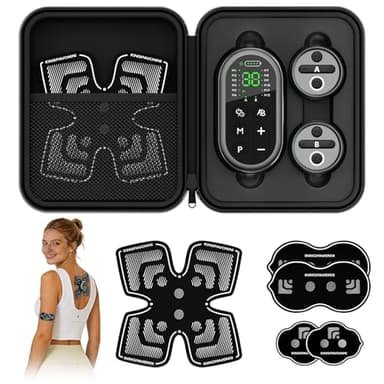
KingPavonini Wireless TENS + EMS Muscle Stimulator
TENS and EMS from two pods you stick on and wear, with no lead wires anywhere — which is the whole reason to pay this much, because it is the only version of the device you can use under a shirt and still move around in. The 48-mode count is marketing; the dual-zone independent control underneath it is not.
What it gets right
- Wireless pods rather than lead wires, so it works under clothing and while moving
- Two pods run independently — separate mode and intensity each, so a shoulder and a leg can run different settings at once
- Published 20 hours per pod on the 1040 mAh cell, charged over USB-C rather than off a disposable battery
- Ships with three pad sizes including a 4.3 in butterfly pad, which is the one that actually covers a lower back
What it does not
- Forty-eight modes is a mode count, not a specification — the same marketing this site flags on every cheap unit
- Several times the price of a wired dual-channel unit that treats a back just as well
- Two pods and a remote are three things to keep charged and not lose
- Listed only in December 2025 and rated 4.1 across 69 reviews, so there is very little ownership history behind it
Common questions
Is AUVON or Belifu better?
AUVON, by a small margin, and for unglamorous reasons: it is rechargeable rather than battery-powered, its two channels have genuinely separate intensity control, and most people work out its interface without the manual. The Belifu is the cheaper unit with the same dual-channel architecture and a generous bundle of pads, so it is the better choice if the lowest possible price is the point. Neither is therapeutically different from the other.
Do more TENS modes mean a better unit?
No. Mode counts are a marketing specification. Neither AUVON nor Belifu publishes the frequency and pulse width behind each numbered program, so there is no way to compare mode twelve on one unit with mode twelve on another, and nothing in the clinical literature suggests a longer menu produces better outcomes. What is worth paying for is two independent channels and, if you will use it, manual control of pulse width.
How often do you have to replace TENS pads?
Expect roughly a dozen uses per electrode in practice, less if you are treating a hairy or sweaty area or peeling them off while damp. Replacement pads cost a fraction of the unit and are the real running cost of owning one. Store them on their plastic backing in the fridge rather than loose in a drawer, and wipe the skin clean and dry before each session.
Can you use one TENS unit for two people?
The unit, yes. The electrodes, no — pads are a personal item and sharing them is a skin infection route for no benefit, given a 20-pack costs very little. Buy a second set of pads rather than a second unit, and if two people want to treat different areas at the same time, that is the one scenario where a second cheap unit beats upgrading the first one.
Sources
- 1.Neuropathic Pain Relief Through Transcutaneous Electrical Neuromuscular Stimulation: Insights From a Systematic Review and Meta-Analysis of Clinical Evidence - BioMed Research International 2025 (PMC12543013) — 30 studies; SMD -0.35 vs placebo, not clinically significant
- 2.Transcutaneous electrostimulation for osteoarthritis of the knee - Cochrane Database of Systematic Reviews (PubMed 19821296) — Cochrane could not conclude TENS reliably beats sham for knee OA
- 3.camelcamelcamel — AUVON TENS price history — price history for the AUVON
- 4.camelcamelcamel — TENS 7000 price history — price history for the manual-control alternative