Recovery Tech
The Best TENS Units for Hip Pain
A hip joint sits under the thickest muscle on the body, and a TENS unit is a surface device. The one we would buy is the AUVON dual channel, because bracketing the sore area from two sides is what makes a sensation reach anything on a hip. Here is the ranking, the placements, and an honest note on how much of what people call hip pain is not coming from the hip.
By Stephen V.Published
Disclosure:Grip & Gait earns a commission when you buy through links on this page, at no extra cost to you. It never changes what we recommend or the order we rank things in — here is exactly how we’re funded.
Quick picks
Ranked on published manufacturer specs and what they mean for the job, not on testing we have not done. Tap a row for the full reasoning. How we score.
| # | Product | Best for | Score | Price |
|---|---|---|---|---|
| 1 |  AUVON Dual Channel TENS Unit Two independent channels with separate intensity, which is how you bracket a sore trochanter from front and back instead of pushing one pair of pads harder and harder. | Best overall for a hip | 8.5 | $35.99 · View on Amazon Price as of October 21, 2026. #ad How we’re funded |
| 2 |  TENS 7000 Digital TENS Unit Manual pulse-width and rate control. On a hip, width is the dial that decides whether the sensation sits in the skin or spreads into the muscle, and this is the unit that lets you turn it. | Reaching through a glute | 8.3 | $38.88 · View on Amazon Price as of October 21, 2026. #ad How we’re funded |
| 3 |  Belifu Dual Channel TENS EMS Unit A big area needs pads staged around it rather than moved every ten minutes, and this is the lowest-cost dual-channel unit here that ships with enough of them to do that. | Cheapest way to cover the area | 7.6 | $35.99 · View on Amazon Price as of October 21, 2026. #ad How we’re funded |
| ✕ |  KingPavonini Wireless TENS + EMS Muscle Stimulator Genuinely the nicest unit to wear, and wrong for this job: a hip is treated sitting or lying down, where a wire costs nothing, and two pods cannot bracket a joint the way four wired pads can. Skip this | The one to skip here | 6.6 |
The short version
Buy the AUVON dual channel. Hip pain is the one region where the number of independent channels matters more than anything else on the box, because you cannot put an electrode on a hip joint — you can only surround the area it refers into. If the sensation refuses to feel like anything other than tingling skin, the TENS 7000 is the unit with the manual pulse-width control that fixes that. And before you buy either: a large share of what people search for as hip pain is coming from the lumbar spine or the glute, not the joint, which changes where the pads go.
Why a hip is the hardest region on this site to stimulate
TENS works by putting current through tissue between two electrodes. That makes depth the governing constraint, and the hip joint is the deepest joint you will ever aim a home device at — it sits inside the pelvis behind the gluteus maximus, gluteus medius and a layer of fat, and no consumer unit is reaching the joint capsule. What a TENS unit can reach is everything on the way there: the glute, the tensor fasciae latae, the tissue over the greater trochanter (the bony bump on the side of your hip), and the nerves running through all of it.
That is not a reason to skip the category. Most hip pain that sends people shopping is not joint-surface pain at all. It is a deep ache in the side of the hip when lying on it, a tight band at the front when standing from a chair, or a referred ache from the lower back. Those are soft-tissue and nerve problems sitting within an inch or two of the skin, which is exactly where surface stimulation does its work. It is a reason to buy for placement capability rather than for mode count.
Which hip problem you actually have
| If your hip pain is | Treat | Why |
|---|---|---|
| Sore on the bony side, worse lying on it | Around the trochanter | This pattern behaves like tissue irritation over the bony prominence. Bracket it: one pad above, one below, current crossing the sore point. Never a pad directly on the bone. |
| Deep in the buttock, worse sitting | The glute, two channels | A deep gluteal ache is muscle and sometimes nerve, and it is a big target. Stage pads across the muscle rather than hunting for one spot. |
| At the front, a pinch when you stand up | The hip flexor, lower intensity | Thin tissue over a sensitive area, so the useful intensity sits low. This one usually responds better to loaded stretching than to current. |
| Running from the back into the hip and down | The lumbar spine first | A referral from a nerve root is treated where the root is, not where it hurts. Pads across the lower back, level with where the pain starts. |
How we ranked these for a hip
- Two independent channels, with separate intensity. Bracketing needs four pads in two pairs that can run at different strengths, because the front of a hip tolerates far less than the glute does.
- Manual pulse width, or at least honest presets. Pulse width is what spreads a sensation from skin into muscle. On every other region you can get away without it; over a glute it is the difference between a unit that works and one that tickles.
- Pad size and pad count. A hip is a big surface. Small square pads mean constant repositioning, and repositioning is how people give up on a device in week two.
- Intensity headroom and small steps. You need more output here than on a neck, and you still need fine control at the bottom of the range for the front of the hip.
- We rank down mode counts. Twenty-four or forty-eight numbered programs is a marketing specification. Two channels and a width dial is a real one.
What the evidence supports, and what it does not
There is no good body of trials on TENS for hip pain specifically, and we are not going to pretend otherwise. What exists is adjacent and worth reading honestly.
On the joint itself, the closest analogue is the Cochrane review of transcutaneous electrostimulation for osteoarthritis of the knee — a shallower joint, better studied, and the reviewers still could not conclude that TENS reliably beats sham. If that is the state of the evidence on a joint you can almost touch through the skin, nobody should be promising you results on a joint buried under the glute.
On nerve-flavoured pain, the 2025 systematic review and meta-analysis of thirty studies found TENS produced only a small reduction in neuropathic pain against placebo that did not reach clinical significance (SMD −0.35, 95% CI −0.90 to 0.10), with clear benefit confined to spinal cord injury. And on the referral case, the 2026 systematic review of conservative care for lumbar radiculopathy reviewed nineteen RCTs and put the quantified wins with movement-based care — spinal mobilization with leg movement reduced leg pain by a mean 2.0 points at two weeks and 2.6 at six months — while electrotherapy sat inside the “physical modalities” bucket rather than at the top of the list.
The honest summary: a TENS unit is a cheap, low-risk way to turn the volume down on hip pain while it is switched on, and the things with numbers attached are loading, hip strengthening and, for stubborn tissue over the trochanter, a clinic procedure. The 2026 network meta-analysis of extracorporeal shockwave therapy covers greater trochanteric pain syndrome as one of its five tendinopathies across 65 studies and 3,921 patients — that is a clinician’s machine, not a purchase, and it is the route to ask about if nothing at home is touching it.
Three placements worth trying, in order
Bracketing the trochanter. Lie on your good side. One pad a couple of inches above the bony point, one a couple of inches below, so the current crosses the sore area. Nothing on the bone itself. This is the first thing to try for side-of-hip pain and often the only one you need.
Across the glute, on both channels. For a deep buttock ache: one pair of pads on the upper outer quadrant, one pair lower and more central, intensity higher here than anywhere else on the body. Keep the pads off the midline over the tailbone. Deep gluteal pain with a muscular character has its own page at glute and piriformis pain.
The lumbar pair, if the pain travels. If the ache starts in your back and arrives at the hip, treat the back: two pads either side of the spine at the level the pain begins, never on the bony midline. That case is the sciatica roundup, not this one.
Intensity goes to a strong but comfortable tingle with no visible muscle twitch. Twenty to thirty minutes is a session and two or three sessions a day is a sane ceiling. The full operating procedure, including how to tell a good sensation from a useless one, is in how to use a TENS unit.
Which unit for which person, in one line each
- You want one unit and you want it to work on day one: the AUVON dual channel. Two channels with separate intensity, rechargeable, presets usable without reading a manual, and cheap enough that finding out whether TENS helps you costs less than a single appointment.
- You have tried a cheap unit and it only tingled: the TENS 7000. Manual pulse width and rate is the control that gets a sensation to spread through a glute instead of buzzing on the skin, and it is the unit most clinics hand out, so pads and leads are everywhere.
- You want the lowest possible outlay: the Belifu. The twenty-four modes are noise; the dual-channel hardware and the included pads are the reason it is here, and a hip is a big enough target that having plenty of electrodes matters more than refinement.
- Skip the wireless pods for a hip.They are the right answer for a neck you want to treat while walking around — see the neck and shoulder roundup — and the wrong answer for a joint you treat lying on a bed, where four wired pads buy you far more than cordlessness does.
Where a TENS unit is the wrong purchase for a hip
If the problem is a tight, overworked muscle you can press and reproduce — glute, TFL, hip flexor — percussion or a ball does more for less, and the gun roundup for glutes and hips is the page. If the hip feels stiff rather than sore, that is a mobility problem: tight hips covers the routine. If both legs feel heavy and swollen rather than one hip hurting, the category is compression boots. And if you are choosing between classes of device rather than between units, massage gun vs TENS is the honest comparison.
Every pick, in full
Specs below are the manufacturer’s own published figures, each linked to the page it came from. Where a maker does not publish a number, the table says so and names the page we checked — that absence is information too.
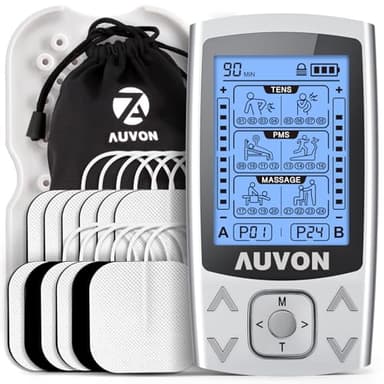
Price as of October 21, 2026. #ad How we’re funded
AUVON Dual Channel TENS Unit
Two independent channels so you can treat both sides of a problem at once, at a price where trying TENS costs less than one session of anything else.
What it gets right
- Two independent channels with separate intensity control
- Rechargeable rather than eating 9 V batteries
- Cheap enough to find out whether TENS does anything for you
What it does not
- Pad adhesive life is the real running cost, not the unit
- Interface is fiddly with cold hands
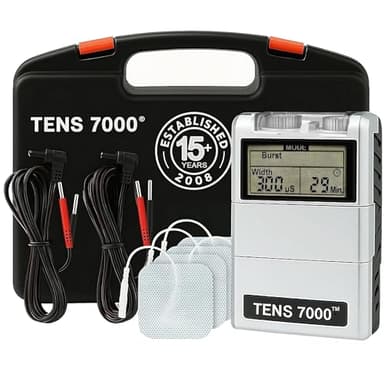
Price as of October 21, 2026. #ad How we’re funded
TENS 7000 Digital TENS Unit
The unit clinics hand out, with manual control over pulse width and rate rather than a menu of preset programs — which is what you want once you know what setting helps.
What it gets right
- Manual pulse-width and rate control instead of fixed presets
- The long-standing clinic default, so accessories are everywhere
What it does not
- Runs on a 9 V battery
- Manual control is only an advantage if you know what you are adjusting
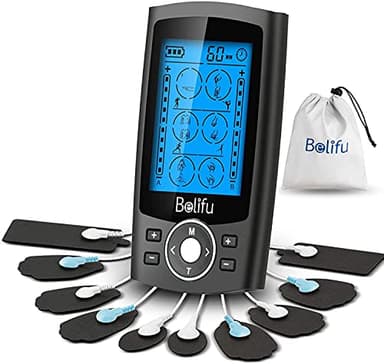
Price as of October 21, 2026. #ad How we’re funded
Belifu Dual Channel TENS EMS Unit
Twenty-four modes at the lowest price in the category, and the mode count is marketing — but the hardware underneath is a competent dual-channel stimulator.
What it gets right
- Cheapest dual-channel unit here
- Rechargeable
- Pads and leads included
What it does not
- Mode count is noise, not a feature
- Thin documentation of what each mode does
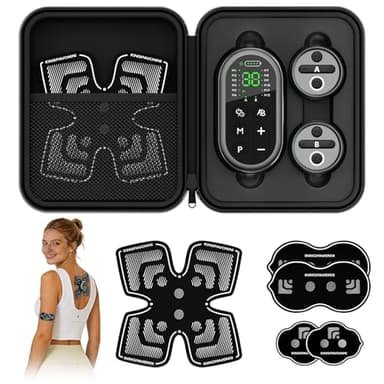
KingPavonini Wireless TENS + EMS Muscle Stimulator
TENS and EMS from two pods you stick on and wear, with no lead wires anywhere — which is the whole reason to pay this much, because it is the only version of the device you can use under a shirt and still move around in. The 48-mode count is marketing; the dual-zone independent control underneath it is not.
What it gets right
- Wireless pods rather than lead wires, so it works under clothing and while moving
- Two pods run independently — separate mode and intensity each, so a shoulder and a leg can run different settings at once
- Published 20 hours per pod on the 1040 mAh cell, charged over USB-C rather than off a disposable battery
- Ships with three pad sizes including a 4.3 in butterfly pad, which is the one that actually covers a lower back
What it does not
- Forty-eight modes is a mode count, not a specification — the same marketing this site flags on every cheap unit
- Several times the price of a wired dual-channel unit that treats a back just as well
- Two pods and a remote are three things to keep charged and not lose
- Listed only in December 2025 and rated 4.1 across 69 reviews, so there is very little ownership history behind it
Common questions
Where do you put TENS pads for hip pain?
Around the sore area, never on the bony point of the hip. For pain on the side of the hip, place one pad a couple of inches above the bony prominence and one a couple of inches below it so the current crosses the sore spot. For a deep buttock ache, stage two pairs of pads across the glute and run them on separate channels. If the pain starts in your lower back and travels to the hip, put the pads across the lower back either side of the spine instead — that pain is referred, and treating where it lands does nothing for where it comes from.
Does a TENS unit help hip arthritis?
It may take the edge off while it is running, and there is no good trial evidence that it treats the joint. The Cochrane review of transcutaneous electrostimulation for knee osteoarthritis — a shallower, better-studied joint — could not conclude that TENS reliably beats sham, and a hip joint sits far deeper than a knee, under the gluteal muscles. Use it as a cheap symptom tool alongside strengthening and weight-bearing work, not instead of them.
Can you use a TENS unit after a hip replacement?
Ask the surgeon who performed it. Implanted metal changes how current distributes through the area, scars can have altered sensation, and the people best placed to tell you whether stimulation over your specific hardware is sensible are the ones holding your notes. Many people are cleared for it after healing; that is a clinical decision, not a product one.
How many channels do you need for hip pain?
Two. A hip is treated by surrounding an area rather than by hitting a point, and two independent channels with separate intensity let you bracket the sore spot with one pair while running a second pair elsewhere — usually lower at the front of the hip, higher over the glute. Single-channel units force you to choose one placement, and the one you pick is almost never enough on a surface this large.
Sources
- 1.Transcutaneous electrostimulation for osteoarthritis of the knee - Cochrane Database of Systematic Reviews (PubMed 19821296) — the closest joint analogue, and the reviewers could not conclude TENS beats sham
- 2.Neuropathic Pain Relief Through Transcutaneous Electrical Neuromuscular Stimulation: Insights From a Systematic Review and Meta-Analysis of Clinical Evidence - BioMed Research International 2025 (PMC12543013) — SMD -0.35 vs placebo, not clinically significant; clear benefit only in spinal cord injury
- 3.Evidence-Based Conservative Treatment Strategies for Lumbar Radiculopathy: A Systematic Review - Cureus 2026 (PMC13349735) — 19 RCTs; quantified gains came from mobilization and exercise, not electrotherapy
- 4.The Effect of Extracorporeal Shockwave Therapy in Tendinopathy: A Systematic Review and Network Meta-Analysis of Randomized Controlled Trials - Orthopaedic Surgery 2026 (PMC13572833) — 65 studies, 3,921 patients; greater trochanteric pain syndrome is one of the five tendinopathies covered
- 5.camelcamelcamel — AUVON TENS price history — price history for the top pick
- 6.camelcamelcamel — TENS 7000 price history — price history for the manual-control pick