Feet & Gait
Foot Massagers and Neuropathy
When sensation is reduced, pain stops being a reliable stop signal — and every safety assumption behind a heated, kneading machine depends on that signal. This page leads with the caution because the caution is the useful part.
By Stephen V.Published Updated
Disclosure:Grip & Gait earns a commission when you buy through links on this page, at no extra cost to you. It never changes what we recommend or the order we rank things in — here is exactly how we’re funded.
Quick picks
Ranked on published manufacturer specs and what they mean for the job, not on testing we have not done. Tap a row for the full reasoning. How we score.
| # | Product | Best for | Score | Price |
|---|---|---|---|---|
| 1 |  RENPHO Foot Massager Machine with Heat Three kneading levels and three compression intensities, so it adjusts down as well as up, plus a 15 or 30 minute timer. | Widest adjustable range | 8.3 | |
| 2 |  Nekteck Shiatsu Foot Massager with Heat You can lift your foot out the moment something is wrong. Enclosed units cannot say that. | Open-top, foot comes out instantly | 8.1 | |
| 3 |  RENPHO Foot Massager with Heat Air compression spreads pressure across the whole foot instead of concentrating it on kneading points. | Compression rather than nodes | 7.9 | |
| 4 |  THERABAND Foot Roller Included deliberately. You control pressure with your own leg and there is no heating element to burn you. | No machine at all | 7.7 | $19.57 · View on Amazon Price as of October 21, 2026. #ad How we’re funded |
Why heat is the setting to be most careful with
Almost every foot massager sold now includes heat, and it is the feature most people want. It is also the one that causes harm when sensation is reduced.
Low-temperature burns happen from prolonged contact with a surface that is not hot enough to trigger an immediate withdrawal reflex. On a foot with normal sensation you notice discomfort building and move. On a foot with reduced sensation, you may not — and the temperature does not need to be dramatic for damage to occur over twenty or thirty minutes.
Practical consequences, and these are the buying criteria that actually matter:
- Buy a machine where heat runs independently of the massage. Being able to use kneading with heat off is not a minor convenience here.
- Use a timer, externally if the machine has none you trust.
- Check the skin visually after every session — color, redness, any mark. Visual inspection substitutes for the sensation you cannot rely on. This is standard diabetic foot-care practice and it applies exactly here.
- If a clinician has said no heat, that is the answer. A machine that cannot have its heat turned off is then not a candidate at all.
Open-top versus enclosed
This is the design distinction that matters most and almost nobody discusses it.
Open-top machines — where your foot rests on a surface rather than sliding into a cavity — let you lift your foot away instantly. If a kneading node lands wrong, if something feels off, if the heat is more than you expected, you move your foot and it stops.
Enclosed machines hold heat better and generally feel more thorough. They also require you to slide your foot out, which takes a second or two you may not want to spend. With normal sensation that is a fair trade for better warmth. With reduced sensation, the ability to disengage instantly is worth more.
What to look for, in order
- Independent heat control.Non-negotiable — and, as of our last check on 27 September 2026, not documented by any of the three machines below. None of their listings states whether the kneading can run with the heat off, so treat that as a question to answer from the manual or the control panel before you buy, not a feature to assume. A short auto-shutoff timer is the next best thing, and the adjustable RENPHO publishes one.
- A genuinely low low setting. Most listings quote the top intensity. The number that matters here is the bottom one — and it is almost never published, so read reviews for people describing the lowest setting as gentle rather than looking for a spec.
- An auto shutoff timer.15–20 minutes, not an hour.
- Compression rather than concentrated node pressure, if the choice exists. Air compression spreads load across the whole foot instead of driving it through a few rotating points.
- A washable, removable cover. Foot hygiene matters more, not less, when healing is impaired.
What a foot massager will and will not do
We are not going to claim a consumer foot machine treats neuropathy, improves nerve function, or reverses anything. We have not found evidence that supports those claims and we are not going to manufacture certainty on a subject this consequential.
What people with neuropathy commonly report from foot massage is that it is comfortable and that it helps with the sensation of tightness or heaviness in the foot. That is a real reason to own one. It is a comfort measure, and describing it as anything more would be the exact kind of claim our editorial policy exists to prevent.
The no-machine option, seriously considered
A simple contoured foot roller has no heating element, no motor, and no capacity to apply more pressure than you put through it. You control the load with your own leg and you can stop instantly. For someone whose main risk is that they will not feel a problem developing, removing the heat and the motor removes both of the ways a machine causes harm.
It does less. It is also the option with essentially no downside, and it costs a fraction as much. For a lot of people this is the right first purchase and the machine is a later decision made with a clinician’s input.
Our recommendation
Ask the clinician managing your neuropathy first, and take their answer over ours. If a machine is reasonable for you, buy one with independent heat control, a genuinely low low setting and an auto shutoff — in that order of priority — and inspect your feet after every session.
If you want something with no way to burn or over-press you, buy the manual roller. It is the conservative choice and there is nothing wrong with making it.
A foot massager is one of two device classes people with neuropathic feet ask about; the other is electrical stimulation. The best TENS units for neuropathy covers that side, including the meta-analysis finding that TENS performed about the same as placebo in diabetic neuropathic pain, and the reason pads belong on the calf rather than the sole.
Every pick, in full
Specs below are the manufacturer’s own published figures, each linked to the page it came from. Where a maker does not publish a number, the table says so and names the page we checked — that absence is information too.
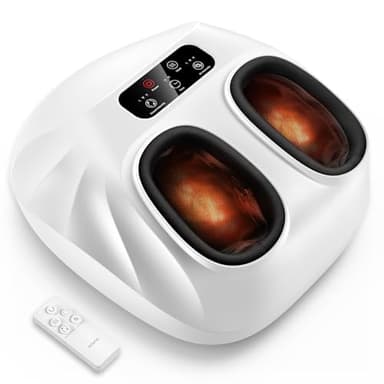
RENPHO Foot Massager Machine with Heat
Adjustable intensity across a wider range than most, which is the specification that actually matters when sensation is altered and you cannot trust pain as a feedback signal.
What it gets right
- Three kneading levels and three compression intensities, so it adjusts down as well as up
- A 15 or 30 minute timer, which is the control that limits heat exposure on this machine
- FSA/HSA eligible
What it does not
- Expensive
- Large footprint — RENPHO publishes 18.5 × 16.9 × 11.8 in and 12 lb
- RENPHO does not document a way to run the kneading with the heat off
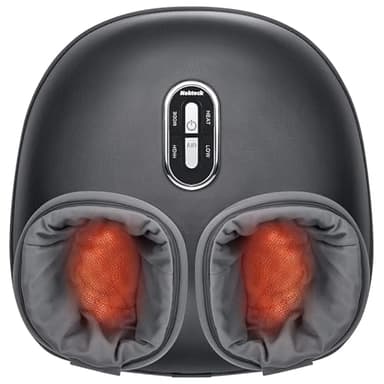
Nekteck Shiatsu Foot Massager with Heat
The entry point where shiatsu foot machines stop being a novelty — deep kneading nodes plus heat, in an open-top design your foot can leave instantly if a node lands wrong.
What it gets right
- Open-top design means you can lift your foot out immediately — not true of enclosed boot-style units
- Heat plus kneading, which is the combination that works on stiff morning feet
- Washable, removable cover
What it does not
- Kneading nodes are firm; there is no gentle setting worth the name
- Works the sole and not the arch specifically
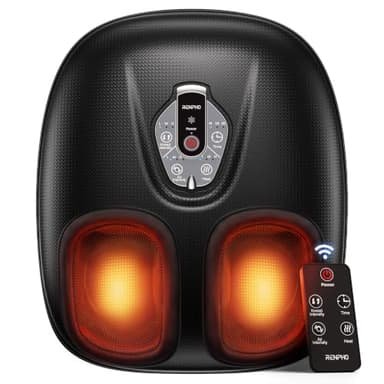
RENPHO Foot Massager with Heat
Compression plus kneading plus heat in one enclosed unit, and FSA eligible — the compression element is what separates it from a machine that only presses on the sole.
What it gets right
- Air compression works the whole foot, not only the contact points
- FSA/HSA eligible
- Enclosed design holds heat better than an open-top unit
What it does not
- Enclosed means you cannot pull your foot out instantly
- Bulky to store
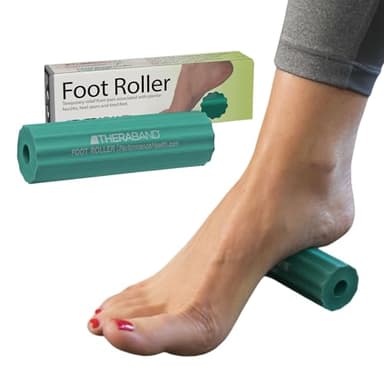
Price as of October 21, 2026. #ad How we’re funded
THERABAND Foot Roller
Shaped for the arch specifically rather than being a general-purpose ball, and it can be chilled — which covers both jobs a first-thing-in-the-morning heel needs.
What it gets right
- Contoured to the arch instead of a plain sphere
- Freezes, so you get cold and pressure in one pass
- Costs less than a takeaway lunch
What it does not
- Fixed shape suits some arches better than others
- Not usable anywhere but the foot
Common questions
Are foot massagers safe for neuropathy?
It depends on the individual and it is a question for the clinician managing your neuropathy, not for a website. The core problem is that reduced sensation removes the stop signal every safety assumption in a heated, kneading machine depends on. If you do use one, prioritize independent heat control, a genuinely low low setting and an auto shutoff, and inspect your feet visually after every session.
Should I use heat on neuropathic feet?
Be very careful, and ask first. Low-temperature burns occur from prolonged contact with a surface not hot enough to trigger immediate withdrawal — which is precisely the failure mode when sensation is reduced. Buy a machine where heat can be turned off independently of the massage, and if a clinician has said no heat, that is the answer.
Do foot massagers help neuropathy?
We are not going to claim a consumer foot machine treats neuropathy, improves nerve function or reverses anything — we have not found evidence supporting that and will not manufacture certainty on a subject this consequential. What people commonly report is that it is comfortable and helps with sensations of tightness or heaviness. That is a comfort measure, and a legitimate reason to own one.
Open-top or enclosed foot massager?
Open-top, if sensation is reduced. It lets you lift your foot away instantly when something feels wrong, where an enclosed unit requires you to slide out. Enclosed machines hold heat better and feel more thorough, which is a fair trade with normal sensation and a worse one without it.
What should I check after using a foot massager?
Look at both feet: any mark, blister, cut, redness that does not fade, or change in skin color. Visual inspection substitutes for the sensation you cannot rely on — it is standard diabetic foot-care practice and it applies exactly here. Any of those, plus new numbness, burning, swelling or a wound that is not healing, means seek advice rather than wait.