Symptoms
Best Tools for IT Band Pain
Everyone rolls the IT band and almost everyone rolls the wrong thing. The band is dense connective tissue with very little give — the muscles that tension it sit at the hip, and that is where the work belongs.
By Stephen V.Published
Disclosure:Grip & Gait earns a commission when you buy through links on this page, at no extra cost to you. It never changes what we recommend or the order we rank things in — here is exactly how we’re funded.
Work the gluteal muscles and the tensor fasciae latae at the side of the hip, not the length of the band itself — and definitely not the outside of the knee where it hurts. The band is dense connective tissue that barely deforms; the muscles pulling on it are what respond.
What the IT band is
The iliotibial band is a thick strip of connective tissue running down the outside of the thigh from the hip to just below the knee. It is not a muscle. It has no contractile tissue and it is extremely strong — the load required to meaningfully deform it is far beyond anything you generate lying on a foam roller.
At the top it connects to the gluteus maximus and the tensor fasciae latae. Those two muscles tension the band. When people talk about a “tight IT band,” what is usually variable is the tension those muscles apply — not the band’s own length.
The classic complaint is pain at the outside of the knee, worse when running, descending stairs or going downhill, often appearing at a consistent distance into a run. The painful point is where the band passes over a bony prominence at the outside of the knee.
Why rolling the band directly is mostly wasted
Two reasons.
First, you are not going to change its length. The forces involved are not in the range that produces lasting deformation in dense connective tissue. Whatever improvement you feel after rolling it is far more likely a change in tolerance and perception than a structural change — the same argument we make in the scar tissue and fascia guide.
Second, the painful part is where it crosses bone. Rolling directly over that spot is pressing an inflamed structure against a bony prominence. It hurts a great deal and there is no mechanism by which it helps.
Rolling the lateral thigh is not useless — some of what you are compressing is the vastus lateralis underneath, which is muscle and does respond. But it is not the most productive use of your time, and it is the most unpleasant.
Which class of tool fits
| Tool class | Cost | Why it does or doesn’t work here | Verdict |
|---|---|---|---|
| Massage ball (glute / TFL) | Cost: Budget | The muscles that tension the band sit at the hip, are deep, and respond to concentrated pressure. Sitting on a ball reaches the glute; the TFL sits just in front of the hip bone at the side.Where it fails: Unforgiving. Sixty to ninety seconds per spot. And stop if pressure produces radiating symptoms down the leg. | Start here |
| Foam roller (lateral thigh) | Cost: Budget | Compresses the vastus lateralis underneath the band, which is muscle and does respond. A textured roller concentrates pressure in strips, which is more useful here than a flat one.Where it fails: Will not change the band's length, and it is the most unpleasant thing most people do with a roller. | Sometimes |
| Hip strengthening | Cost: Budget | Free, and the intervention that changes anything durably. Weak hip abductors mean the band takes load it was not meant to. This is a program, not a session.Where it fails: Slow. Weeks, not days. Get a specific program from someone qualified. | Start here |
| Massage gun | Cost: Mid-range | On the glute and TFL - faster than a ball and easier to reach at the hip while standing.Where it fails: Less pressure than a ball on a deep glute. And never on the outside of the knee where the band crosses bone. | Sometimes |
| Rolling the outside of the knee | Cost: Budget | Nothing.Where it fails: That is an irritated structure being pressed against a bony prominence. Painful, and there is no mechanism by which it helps. | Not for this |
| Heat | Cost: Budget | Comfortable on a tight hip before working it, and asks nothing of you.Where it fails: Not on an area that is acutely inflamed, hot or swollen. | Sometimes |
What we would actually buy
Buy this first
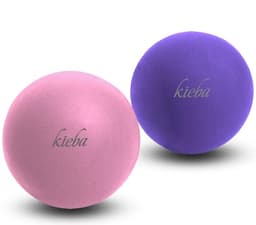
Kieba Massage Lacrosse Balls
The glute and TFL are deep and need concentrated pressure. Sitting on a ball delivers more of it than any motor, for the price of a sandwich.
Price as of October 21, 2026. #ad How we’re funded
For the lateral thigh
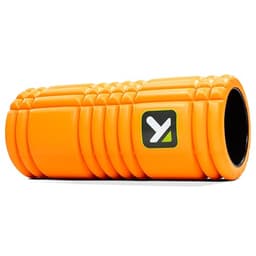
TriggerPoint GRID Foam Roller (13 in)
The multi-density surface concentrates pressure in strips rather than spreading it flat, which is the difference between tolerable and not on this particular structure.
For the hip, standing
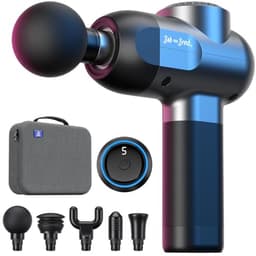
Bob and Brad C2 Massage Gun
Reaching the TFL at the side of your hip is awkward on the floor and easy standing up. Light, published specs, turns down.
Where to actually put the ball
- Gluteus medius. Lie on your side with the ball just behind and below the bony point at the side of your hip. This is usually the most productive single spot.
- Tensor fasciae latae. Lie face down with the ball just in front of and below that same bony point. Small muscle, often very tender, and directly connected to the band.
- Gluteus maximus. Sit on the ball, ankle crossed over the opposite knee to open the muscle. Deep and it takes some finding.
- 60–90 seconds per spot, then move the hip through its range. Pressure then movement, as always.
Each of those three has a specific landmark you can find with your own hand, and the reason the band itself is not on the list is anatomical rather than a matter of technique. Both are covered in IT band trigger points.
The thing that actually fixes it
For runners and cyclists, IT band pain is usually a load and control problem rather than a tissue problem. Weak or poorly-coordinated hip abductors mean the pelvis and femur move in a way that puts more load through the band than it should carry, and that happens repeatedly over thousands of steps.
Strengthening the hip, and looking at training volume, cadence, running surface and camber, is what changes the outcome. It takes weeks and nobody sells it in a box. Get a specific program from someone qualified — this is a case where seeing a person is a genuinely better purchase than any device on this page.
What the evidence supports
The percussion and rolling literature — reduced tissue stiffness and improved range of motion, and the foam rolling versus percussive massage comparison — is about muscle, which supports working the glute and TFL and does not support treating the band itself as a thing that can be lengthened.
That is the whole argument of this page, and it is why we point most of your effort at the hip and most of your money at an eight-dollar ball.
Common questions
Should you foam roll your IT band?
Rolling the lateral thigh compresses the vastus lateralis underneath, which is muscle and does respond — so it is not useless. But you will not change the band’s length; it is dense connective tissue that does not meaningfully deform under body weight. The productive targets are the glute and tensor fasciae latae at the hip, which tension it.
Where do you put a massage ball for IT band pain?
Three spots at the hip. Gluteus medius: on your side, ball just behind and below the bony point at the side of the hip — usually the most productive single spot. Tensor fasciae latae: face down, ball just in front of and below that same point. Gluteus maximus: sitting on it, ankle crossed over the opposite knee. Sixty to ninety seconds each, then move.
Why does my IT band hurt at the same point in every run?
Because it is usually a load and control problem rather than a tissue problem. Weak or poorly-coordinated hip abductors mean the pelvis and femur move in a way that puts more load through the band than it should carry, and that accumulates over thousands of steps until it becomes symptomatic at a consistent point.
Can I use a massage gun on my IT band?
On the glute and tensor fasciae latae at the hip, yes, and it is easier there standing up than on the floor. On the lateral thigh it works but produces less pressure than a textured roller. Never on the outside of the knee, where the band crosses a bony prominence and the painful structure sits directly against bone.
Sources
- 1.Acute Effects of Theragun Percussive Therapy on Viscoelastic Tissue Dynamics and Hamstring Range of Motion (PMC10499144)
- 2.Foam Rolling or Percussive Massage for Muscle Recovery: Insights into DOMS (PMC12286022)
- 3.The Effect of Percussive Therapy on Musculoskeletal Performance and Experiences of Pain: A Systematic Literature Review (PubMed 37020441)
- 4.Therabody — Product Safety & Precautions