Recovery Tech
TENS for Arthritis
TENS is the one tool on this site aimed at pain signaling rather than tissue mechanics, which makes it the reasonable option when an area is too tender to press on at all. It is not treating the joint, and being clear about that is the point.
By Stephen V.Published
Disclosure:Grip & Gait earns a commission when you buy through links on this page, at no extra cost to you. It never changes what we recommend or the order we rank things in — here is exactly how we’re funded.
Quick picks
Ranked on published manufacturer specs and what they mean for the job, not on testing we have not done. Tap a row for the full reasoning. How we score.
| # | Product | Best for | Score | Price |
|---|---|---|---|---|
| 1 |  AUVON Dual Channel TENS Unit Dual channel, rechargeable, and inexpensive enough that finding out whether it helps you costs less than one appointment. | Cheap enough to just try | 8.4 | $35.99 · View on Amazon Price as of October 21, 2026. #ad How we’re funded |
| 2 |  TENS 7000 Digital TENS Unit Manual pulse width and rate, so once you find a setting that helps you can return to it exactly. | Manual control once you know | 8.2 | $38.88 · View on Amazon Price as of October 21, 2026. #ad How we’re funded |
| 3 |  GENIANI Electric Heating Pad Heat and TENS are complementary and heat is the older, simpler answer for stiff arthritic joints. | The thing to pair it with | 8.1 | |
| ✕ |  Therabody Theragun Relief Included as the honest counterpoint: percussion directly over an arthritic joint is generally a bad idea, however gentle the device. Skip this | Where percussion is the wrong idea | 6.6 | $159.99 · View on Amazon Price as of October 21, 2026. #ad How we’re funded |
Why TENS specifically, for this
Everything else on this site works mechanically. A roller presses, a ball concentrates pressure, a gun percusses, boots compress. All of them require the tissue to tolerate being physically loaded.
An arthritic joint frequently does not. It is tender, often swollen, and pressing on it makes it worse rather than better. That is the gap TENS fills — it is applied to the skin near a joint and works on how pain signals are perceived, without loading anything.
That is a genuinely different proposition, and it is the reason this page exists separately from the rest of the site.
This page is about TENS specifically. If you are still deciding which class of tool fits at all — heat, stimulation, graded exercise or a gun on the muscle around the joint — start with our tool routing for arthritis pain, which lays out what each one is for and what the trial evidence behind it actually says.
What TENS is not doing
We want to be unambiguous here, because arthritis is a space where overclaiming is normal and damaging.
TENS does not repair cartilage. It does not slow joint degeneration. It does not reduce inflammation in a joint. It does not substitute for whatever your clinician has you on. Anything you read claiming a consumer TENS unit does those things is not describing a mechanism anyone has established.
What it addresses is the experience of pain, generally while it is running and for some period afterward. For a chronic condition where the underlying joint change is not reversible, managing the pain is a legitimate and important goal in its own right — but it is a different goal from treating the arthritis, and conflating the two is how people end up disappointed or, worse, delay care.
Pad placement by joint
Knee
The most straightforward. Place pads either side of the kneecap, or one above and one below the joint line, so current passes through the painful region. Avoid placing directly over the kneecap itself. If both knees hurt, a dual-channel unit does both simultaneously.
Hands and wrists
Harder, because there is little flat surface. Small pads are essential — many units ship only large ones, and small replacement pads are worth buying separately. Place along the forearm proximal to the wrist rather than trying to stick something to a knuckle; current traveling through the region generally works better than trying to cover each joint.
Hips
Bracket the painful area with pads on the outside of the hip, or one above and one below. Hips are deep joints and TENS is a surface intervention, so expect less than you would at a knee. Some people get useful relief here and some get none.
Neck and shoulder
Pads on the muscle either side of the spine at the base of the neck, or across the top of the shoulder. Never on the front of the neck or over the carotid area. That is one of the firmest rules in electrical stimulation.
Why percussion is generally the wrong idea here
Massage guns get recommended for arthritis constantly and it is worth being careful about. Therabody’s own published precautions include several things that overlap heavily with an arthritic population:
“Deep vein thrombosis, osteomyelitis; bone fracture or myositis ossificans; bleeding disorders; peripheral vascular insufficiency or disease; medications that thin the blood or alter sensations; pacemaker, ICD.”
Beyond the list: an arthritic joint is a joint, and joints are where percussion devices should not go. Percussing the muscle around a joint that has gone tight from guarding is a defensible use. Percussing the joint itself is not, and the distinction gets lost in most advice you will read.
If a gun appeals for the surrounding muscle, use the gentlest setting and the softest attachment, and stay off the joint entirely. Our massage guns for older hands page goes through this in more detail, including why weight matters more than power for this group.
Heat is the other honest answer
Heat is the oldest, cheapest and least glamorous intervention for a stiff arthritic joint, and it is genuinely useful. It requires nothing of you, it has no consumables, and for morning stiffness it is frequently better than anything electrical.
TENS and heat are complementary rather than competing. Many people find heat helps the stiffness and TENS helps the pain, and using both is entirely reasonable — sequentially, not simultaneously on the same area. See our heating pad page.
Setting expectations
Responses to TENS vary enormously and there is no way to predict yours. Some people with arthritis use a unit daily for years; others feel the tingle, nothing more, and stop.
Which is why the advice is: buy a cheap dual-channel unit, use it properly for two or three weeks, and find out. It costs less than one appointment. If it works, upgrade to something with manual pulse-width and rate control so you can return exactly to the setting that helps. If it does not, you have learned that cheaply.
And keep it in proportion. It is a pain-management tool for a condition being managed elsewhere, and it does not replace any of that.
Every pick, in full
Specs below are the manufacturer’s own published figures, each linked to the page it came from. Where a maker does not publish a number, the table says so and names the page we checked — that absence is information too.
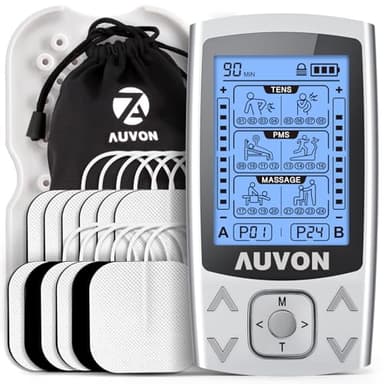
Price as of October 21, 2026. #ad How we’re funded
AUVON Dual Channel TENS Unit
Two independent channels so you can treat both sides of a problem at once, at a price where trying TENS costs less than one session of anything else.
What it gets right
- Two independent channels with separate intensity control
- Rechargeable rather than eating 9 V batteries
- Cheap enough to find out whether TENS does anything for you
What it does not
- Pad adhesive life is the real running cost, not the unit
- Interface is fiddly with cold hands
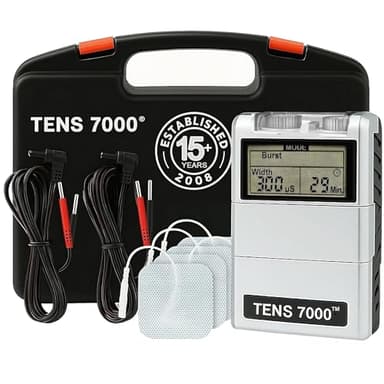
Price as of October 21, 2026. #ad How we’re funded
TENS 7000 Digital TENS Unit
The unit clinics hand out, with manual control over pulse width and rate rather than a menu of preset programs — which is what you want once you know what setting helps.
What it gets right
- Manual pulse-width and rate control instead of fixed presets
- The long-standing clinic default, so accessories are everywhere
What it does not
- Runs on a 9 V battery
- Manual control is only an advantage if you know what you are adjusting
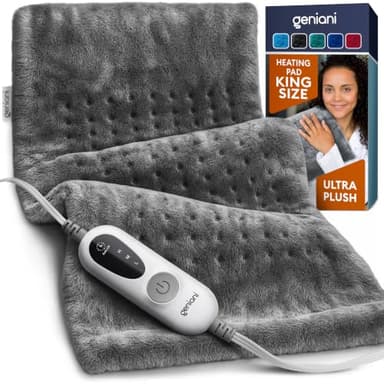
GENIANI Electric Heating Pad
Moist-heat capable with an auto-shutoff, which is the specification that decides whether a heating pad is safe to use lying down — and lying down is when you want it.
What it gets right
- Auto shutoff — the safety feature that matters if you fall asleep on it
- Moist-heat option penetrates better than dry
- Machine-washable cover
What it does not
- Corded, so your position is fixed
- Smaller than the XXL pads
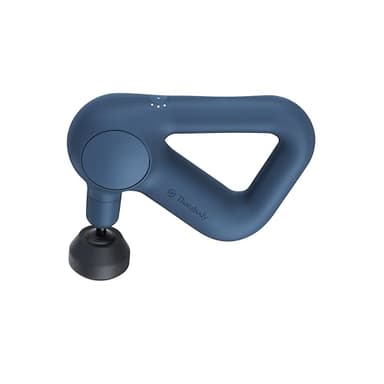
Price as of October 21, 2026. #ad How we’re funded
Therabody Theragun Relief
Therabody's deliberately gentle model — lighter, simpler and less aggressive than the Prime, which is the right direction for stiff hands and thin skin rather than a compromise.
What it gets right
- Simple controls with no app required — a real advantage if the buyer is not going to pair anything to a phone
- Lighter and less aggressive than the Prime, which is the point rather than a limitation
- Therabody's ergonomic handle geometry makes it easier to hold with a weak grip
What it does not
- Same missing-spec problem as the rest of the Therabody range
- Not the tool for dense glute or thick paraspinal muscle
- Costs more than fully-specified budget guns that hit harder
| Amplitude | Not published page we checked |
|---|---|
| Stall force | Not published page we checked |
| Speed range | Not published page we checked |
| Weight | 1.37 lb source |
| Noise | Not published page we checked |
| Battery | 2 h source |
| Attachments | 3 source |
| Warranty | 1-year source |
| Dimensions | 9.66 × 2.58 × 1.37 in source |
Common questions
Does TENS help arthritis pain?
Responses vary enormously — some people with arthritis use a unit daily for years, others feel the tingle and no benefit. What TENS addresses is the experience of pain, generally while it is running and for a period afterward. It does not repair cartilage, slow joint degeneration or reduce joint inflammation, and anything claiming otherwise is describing a mechanism nobody has established.
Where do you put TENS pads for arthritic knees?
Either side of the kneecap, or one above and one below the joint line, so current passes through the painful region. Avoid placing directly over the kneecap itself. A dual-channel unit lets you treat both knees at once at independent intensities.
Can I use a massage gun on an arthritic joint?
Not on the joint itself. Percussing the muscle around a joint that has tightened from guarding is defensible; percussing the joint is not, and that distinction gets lost in most advice. Therabody’s published precautions also name several conditions and medications that overlap heavily with an arthritic population, including blood thinners and pacemakers.
Is heat or TENS better for arthritis?
They are complementary rather than competing. Many people find heat helps the stiffness — particularly morning stiffness — and TENS helps the pain. Heat is cheaper, simpler and has no consumables, so it is the reasonable first thing to try. Use them sequentially rather than simultaneously on the same area.
What size TENS pads for hands and fingers?
Small ones, and most units ship only large pads — buying small replacements separately is usually necessary. Rather than trying to stick something to a knuckle, place pads along the forearm just above the wrist so current travels through the region. It generally works better than trying to cover each joint individually.
Sources
- 1.Therabody — Product Safety & Precautions — percussion contraindications, quoted verbatim above