Recovery Tech
TENS 7000 vs AUVON
Two of the most-bought entry TENS units, and the choice between them is really a choice about how much control you want. The TENS 7000 hands you manual pulse-width and rate; the AUVON gives you dual channels, a rechargeable battery and a friendlier interface. Neither is wrong — they suit different users.
By Stephen V.Published Updated
Disclosure:Grip & Gait earns a commission when you buy through links on this page, at no extra cost to you. It never changes what we recommend or the order we rank things in — here is exactly how we’re funded.
Quick picks
Ranked on published manufacturer specs and what they mean for the job, not on testing we have not done. Tap a row for the full reasoning. How we score.
| # | Product | Best for | Score | Price |
|---|---|---|---|---|
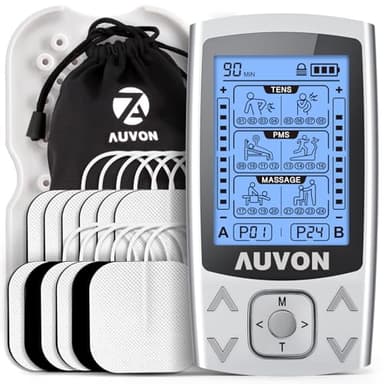
| 1 |  AUVON Dual Channel TENS Unit Two independent channels, rechargeable, and a friendly interface. The better starting point for most people. | First unit, easy dual channel | 8.5 | $35.99 · View on Amazon Price as of October 21, 2026. #ad How we’re funded |
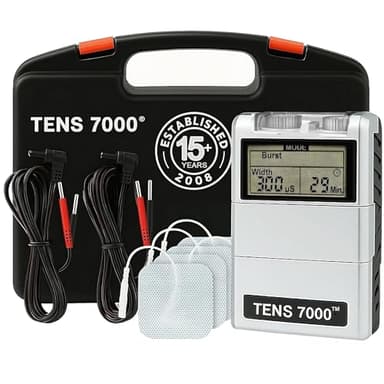
| 2 |  TENS 7000 Digital TENS Unit The clinic default. Manual pulse-width and rate rather than presets, and accessories are available everywhere. | Manual parameter control | 8.3 | $38.88 · View on Amazon Price as of October 21, 2026. #ad How we’re funded |
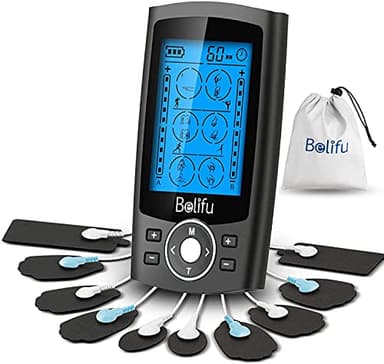
| 3 |  Belifu Dual Channel TENS EMS Unit The cheapest dual-channel option here, with a marketing-driven mode count over competent hardware. | Lowest cost, most modes | 7.3 | $35.99 · View on Amazon Price as of October 21, 2026. #ad How we’re funded |
The short answer
For a first TENS unit, most people are better off with the AUVON: two independent channels, a rechargeable battery instead of a 9 V, and an interface that does not require you to understand pulse width before you can use it. Choose the TENS 7000 if you specifically want manual control over the stimulation parameters — which is genuinely useful, but only once you know what setting helps you. Both are the general TENS overview applied to two specific units; the wider ranking is on the TENS units page.
Both of these are wired units, which is the right default. If you are also considering the stick-on-pod format, wireless vs wired TENS units covers the one situation that justifies paying several times as much for the same current.
Where they differ
- Control model.The TENS 7000 exposes manual pulse-width and rate control, which lets you dial in a specific sensation once you know what you are adjusting. The AUVON leans on preset programs with separate intensity per channel — simpler to start, less to fiddle with.
- Power. The AUVON is rechargeable; the TENS 7000 runs on a 9 V battery. Over time the rechargeable unit is cheaper and less of a nuisance, though a 9 V is easy to replace anywhere.
- Channels. Both offer dual channels, so you can treat two areas or both sides of a problem at once with independent intensity.
- Ecosystem.The TENS 7000 is the long-standing clinic default, so pads, leads and accessories are everywhere — a genuine advantage for a device whose real running cost is the pads.
The running cost nobody mentions
With any TENS unit, the electrode pads are the real cost of ownership, not the unit. Pads lose their tack after a number of uses and need replacing, and that recurring cost dwarfs the price difference between these two devices over a year. Both use widely available pads, so neither locks you into an expensive consumable — but factor pad replacement into the decision rather than the sticker price, because that is what you will actually keep paying.
What TENS does, honestly
A TENS unit sends a low-voltage current through the pads to stimulate the nerves under the skin, with the long-standing rationale that stimulating the nerves can reduce how strongly pain signals are perceived. The honest position is that the evidence for pain relief is mixed and the effect tends to be modest and temporary, varying a lot between people and conditions. That is exactly why buying a cheap unit to find out whether it helps you is the sensible approach — and why the choice between these two is about ergonomics and control, not about one relieving pain better than the other. If you are weighing TENS against a mechanical tool entirely, see massage gun vs TENS, and for the muscle-contraction cousin of TENS, TENS vs EMS.
Which one, in a line
AUVON if you want to plug in and go, with rechargeable convenience and a gentle learning curve. TENS 7000 if you want manual control over the parameters and the reassurance of the clinic-standard unit with accessories everywhere. Either is a low-cost way to find out whether TENS does anything for your particular pain, which is the only way to really know.
If your shortlist is the two cheapest units rather than the clinic standard against a budget one, AUVON vs Belifu is the other head-to-head worth reading before you buy.
Every pick, in full
Specs below are the manufacturer’s own published figures, each linked to the page it came from. Where a maker does not publish a number, the table says so and names the page we checked — that absence is information too.
Price as of October 21, 2026. #ad How we’re funded
AUVON Dual Channel TENS Unit
Two independent channels so you can treat both sides of a problem at once, at a price where trying TENS costs less than one session of anything else.
What it gets right
- Two independent channels with separate intensity control
- Rechargeable rather than eating 9 V batteries
- Cheap enough to find out whether TENS does anything for you
What it does not
- Pad adhesive life is the real running cost, not the unit
- Interface is fiddly with cold hands
Price as of October 21, 2026. #ad How we’re funded
TENS 7000 Digital TENS Unit
The unit clinics hand out, with manual control over pulse width and rate rather than a menu of preset programs — which is what you want once you know what setting helps.
What it gets right
- Manual pulse-width and rate control instead of fixed presets
- The long-standing clinic default, so accessories are everywhere
What it does not
- Runs on a 9 V battery
- Manual control is only an advantage if you know what you are adjusting
Price as of October 21, 2026. #ad How we’re funded
Belifu Dual Channel TENS EMS Unit
Twenty-four modes at the lowest price in the category, and the mode count is marketing — but the hardware underneath is a competent dual-channel stimulator.
What it gets right
- Cheapest dual-channel unit here
- Rechargeable
- Pads and leads included
What it does not
- Mode count is noise, not a feature
- Thin documentation of what each mode does
Common questions
Is the TENS 7000 or AUVON better?
For most first-time users, the AUVON — it is rechargeable, dual channel, and easy to use out of the box. The TENS 7000 is better if you specifically want manual control over pulse width and rate, which is useful once you know what setting helps you, and it is the clinic default with accessories everywhere. Neither relieves pain better than the other; they differ on control and convenience.
What is the difference between the TENS 7000 and AUVON?
The TENS 7000 offers manual pulse-width and rate control and runs on a 9 V battery; the AUVON uses preset programs with per-channel intensity and is rechargeable. Both are dual channel and both use widely available pads. The 7000 suits users who want to adjust parameters directly; the AUVON suits users who want simplicity and rechargeable convenience.
How much does it cost to run a TENS unit?
The real cost is the electrode pads, not the unit. Pads lose their stick after a number of uses and need replacing, and over a year that recurring cost outweighs the price difference between entry units. Both the TENS 7000 and AUVON use widely available pads, so you are not locked into an expensive consumable — but budget for pad replacement rather than judging on the sticker price.