Feet & Gait
Insoles and Arch Support
An insole is not a treatment. It changes the mechanical environment your foot works in all day, which is a different and sometimes better thing — provided you buy the type that actually resists load rather than the one that just feels soft.
By Stephen V.Published
Disclosure:Grip & Gait earns a commission when you buy through links on this page, at no extra cost to you. It never changes what we recommend or the order we rank things in — here is exactly how we’re funded.
Quick picks
Ranked on published manufacturer specs and what they mean for the job, not on testing we have not done. Tap a row for the full reasoning. How we score.
| # | Product | Best for | Score | Price |
|---|---|---|---|---|
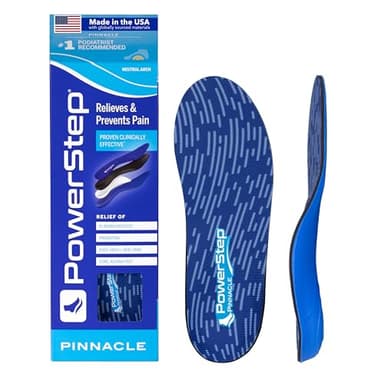
| 1 |  PowerStep Pinnacle Orthotic Insoles A shell that resists arch collapse rather than padding it, sold in real shoe sizes rather than trim-to-fit. | Semi-rigid, properly sized | 8.6 | $52.49 · View on Amazon Price as of October 21, 2026. #ad How we’re funded |
| 2 |  WalkHero Heavy Duty Arch Support Insoles Explicitly rated for higher body weight - a spec almost nobody publishes and exactly the variable that flattens soft insoles. | Heavier body weight | 8.2 | |
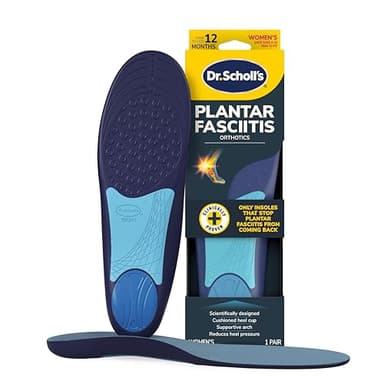
| 3 |  Dr. Scholl's Plantar Fasciitis Relief Orthotic Insoles Drugstore-priced and everywhere, which means you will actually replace them. Trim-to-fit is the trade. | Cheapest real support | 7.6 | $14.97 · View on Amazon Price as of October 21, 2026. #ad How we’re funded |
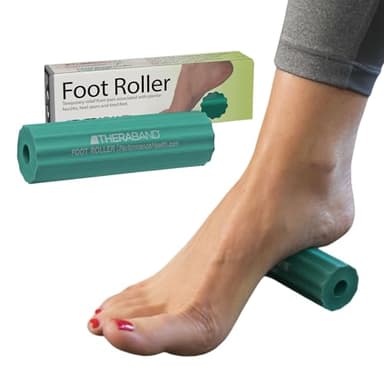
| 4 |  THERABAND Foot Roller An insole changes the day. A contoured roller handles the first-thing-in-the-morning problem an insole cannot. | The thing to buy alongside | 8.0 | $19.57 · View on Amazon Price as of October 21, 2026. #ad How we’re funded |
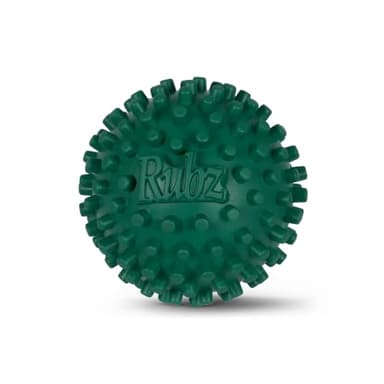
| 5 |  Due North Foot Rubz Massage Ball Under a fascia, standing, for the price of a coffee. Included because it is often the better first purchase. | The cheaper adjunct | 8.3 | $5.88 · View on Amazon Price as of October 21, 2026. #ad How we’re funded |
What an insole does and does not do
It does change the mechanical environment your foot spends 16 hours a day in. A semi-rigid shell resists the arch flattening under load, which reduces the tension cycling through the plantar fascia with every step. Over thousands of steps, that is a real intervention.
It does not treat anything. It manages load. Take the insole out and the foot returns to doing what it did before, which is why an insole is a management tool rather than a cure and why the evidence points at combining it with a stretching program rather than substituting for one.
Semi-rigid versus foam: the only distinction that matters
Foam insoles cushion. They compress under load and distribute pressure more evenly across the sole. Comfortable, cheap, and they do nothing to resist arch collapse — because compressing under load is what they do. If the problem is a bruised heel pad or a hard-floor job, cushioning is genuinely what you want.
Semi-rigid insoles have a structural shell that resists deformation, usually under a thinner cushioning layer. The shell holds the arch shape when your body weight tries to flatten it. That is the mechanism for plantar fasciitis and for overpronation, and a foam insole does not do it at any thickness.
The practical test before buying: press hard into the arch of the insole with your thumb. If it flattens easily, it will flatten under 175 lb of you, every step, all day. If it resists, it is doing the job the shell is for.
The spec almost nobody publishes
Body weight rating. An insole shell that holds shape at 150 lb may deform permanently at 250 lb, and most manufacturers say nothing at all about this. It is the single most consequential variable for whether an insole still works in three months, and it is almost universally absent from listings.
A handful of makers publish a rating — one of our picks states a 220+ lb figure. If you are above roughly 200 lb, look specifically for that number and prefer a product that gives one. This is exactly the kind of gap we look for: a spec that decides the outcome and that the category has quietly agreed not to mention.
Sized versus trim-to-fit
Trim-to-fit insoles come oversized with a cutting guide. Cheap and universal, but the arch support is molded at a fixed position, and trimming the length does not move it. If your foot is longer or shorter than the middle of the size band, the support lands in front of or behind your actual arch — which is worse than no support, because it puts pressure where the foot did not ask for it.
Sized insoles are made per shoe size, so the arch lands where an arch is. They cost more, and for a genuine arch problem the difference is the whole point.
What the multimodal evidence suggests
The picture that emerges from the trials is that combinations work better than single interventions. A randomized controlled trial of a multimodal rehabilitation program looked at pain, function and plantar fascia thickness together, and the general direction of this literature is that stretching plus load management plus supportive footwear beats any one of them alone.
Read that as permission to buy the insole — as part of a plan — rather than as a reason not to. It is the doing-nothing-else version that fails.
Fitting them properly
- Take the existing insole out first. Stacking a new insole on top of the factory one changes the volume of the shoe and usually makes it too tight, which is the most common reason people abandon a good insole in week one.
- Expect a break-in period. A semi-rigid shell feels odd for a few days because it is changing where load goes. Two to four hours a day for the first week, then build. Going straight to a full day is how people conclude the insole hurt them.
- Buy for the shoes you actually wear. A bulky orthotic in a snug dress shoe does not fit. Two cheaper pairs across two pairs of shoes often beats one expensive pair that lives in the shoes you wear least.
- Replace on compression, not on calendar. When the shell no longer springs back under thumb pressure, it has stopped working — regardless of how it looks.
Our recommendation
Do the plantar fascia-specific stretch first, because it is free and the evidence supports it best. Buy a semi-rigid, correctly-sized insole as the second step, and a contoured arch roller or spiked ball as the third — that one handles the first-steps-of-the-morning problem that an insole cannot, because at that moment you are not wearing shoes.
The whole set costs less than a mid-range massage gun and has better evidence behind it than anything else on this website. See the full plantar fasciitis page for the complete routing.
Every pick, in full
Specs below are the manufacturer’s own published figures, each linked to the page it came from. Where a maker does not publish a number, the table says so and names the page we checked — that absence is information too.
Price as of October 21, 2026. #ad How we’re funded
PowerStep Pinnacle Orthotic Insoles
A semi-rigid shell under a cushioned top, sized rather than trimmed — the closest thing to a dispensed orthotic you can buy without an appointment.
What it gets right
- Semi-rigid shell actually resists arch collapse rather than just padding it
- Sold in real shoe sizes rather than trim-to-fit
- Holds its shape far longer than foam
What it does not
- Three times the drugstore price
- Takes up volume — may not fit a snug shoe
- Needs a break-in period that some people give up during
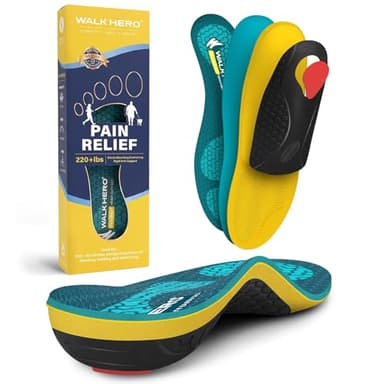
WalkHero Heavy Duty Arch Support Insoles
Rated for heavier body weights, which is a specification almost nobody publishes and which is exactly the variable that flattens a soft insole in a month.
What it gets right
- Explicitly rated for higher body weight — a spec that is usually silent
- Deep heel cup
- Priced between drugstore foam and semi-rigid orthotics
What it does not
- Firm from day one
- Bulky in dress shoes
Price as of October 21, 2026. #ad How we’re funded
Dr. Scholl's Plantar Fasciitis Relief Orthotic Insoles
Drugstore-priced and widely available, which matters more than it sounds: the insole you can replace in fifteen minutes is the one still in your shoe in six months.
What it gets right
- Cheap enough to buy a pair for every shoe you actually wear
- Available almost everywhere, so replacement is trivial
What it does not
- Trim-to-fit rather than sized, so the arch may not land under your arch
- Compresses faster than a rigid orthotic
Price as of October 21, 2026. #ad How we’re funded
THERABAND Foot Roller
Shaped for the arch specifically rather than being a general-purpose ball, and it can be chilled — which covers both jobs a first-thing-in-the-morning heel needs.
What it gets right
- Contoured to the arch instead of a plain sphere
- Freezes, so you get cold and pressure in one pass
- Costs less than a takeaway lunch
What it does not
- Fixed shape suits some arches better than others
- Not usable anywhere but the foot
Price as of October 21, 2026. #ad How we’re funded
Due North Foot Rubz Massage Ball
The cheapest thing on this site that genuinely competes with a $400 device for a specific job — a spiked rubber ball under a plantar fascia is hard to beat and impossible to overspend on.
What it gets right
- Spikes concentrate pressure into the fascia rather than spreading across the sole
- Small enough to keep beside the bed, which is where it needs to be
- Costs less than a coffee
What it does not
- Spikes are too sharp for some people barefoot
- Small contact area only
Common questions
Do insoles actually help plantar fasciitis?
A semi-rigid insole reduces the tension cycling through the fascia with every step by resisting arch collapse, and over thousands of steps that is a real intervention. But the published evidence favors plantar fascia-specific stretching over any single product, and the trials that work best combine stretching, load management and supportive footwear. Buy the insole as part of a plan, not instead of one.
Are rigid or soft insoles better for plantar fasciitis?
Semi-rigid. A foam insole compresses under load — that is what foam does — so it cushions but does not resist arch collapse. A semi-rigid shell holds the arch shape against your body weight, which is the mechanism that matters here. Test before buying: press hard into the arch with your thumb. If it flattens easily, it will flatten under you all day.
How long do orthotic insoles last?
Judge by compression rather than calendar. When the shell no longer springs back under firm thumb pressure it has stopped doing its job, whatever it looks like. Body weight is the variable that drives this and almost nobody publishes a rating — if you are above roughly 200 lb, specifically look for a product that states one.
Should I take the original insole out?
Yes, almost always. Stacking a new insole on the factory one changes the volume of the shoe and usually makes it too tight, which is the single most common reason people abandon a good insole in the first week.
Why do my new insoles hurt?
A semi-rigid shell changes where load goes, and that feels wrong for a few days. Two to four hours a day for the first week, then build. Going straight to a full day is how people conclude the insole hurt them. If pain is sharp, localized to one point, or persists past a couple of weeks of sensible break-in, stop and see a clinician.
Sources
- 1.Plantar fascia-specific stretching improves outcomes in chronic plantar fasciitis — two-year follow-up (PubMed 16882901)
- 2.Comparing the Role of Different Treatment Modalities for Plantar Fasciitis: A Double Blind Randomized Controlled Trial (PubMed 32257015)
- 3.Effect of a multimodal rehabilitation program on pain, function and plantar fascia thickness in plantar fasciitis — RCT (PMC12930778)