Compare
Massage Gun vs a Massage Therapist
The cost arithmetic favors the device so obviously that it obscures the actual question, which is what a trained person does that a motor cannot. There are several answers and one of them matters more than the money.
By Stephen V.Published
Disclosure:Grip & Gait earns a commission when you buy through links on this page, at no extra cost to you. It never changes what we recommend or the order we rank things in — here is exactly how we’re funded.
Quick picks
Ranked on published manufacturer specs and what they mean for the job, not on testing we have not done. Tap a row for the full reasoning. How we score.
| # | Product | Best for | Score | Price |
|---|---|---|---|---|
| 1 |  Bob and Brad C2 Massage Gun Published specs, light, cheap enough that the cost comparison stops being close. | The device side, done well | 8.6 | |
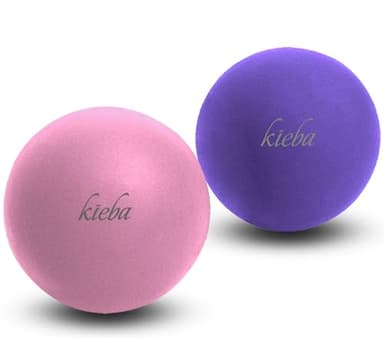
| 2 |  Kieba Massage Lacrosse Balls More local pressure than either a gun or, for a specific point, a pair of hands. | The cheapest possible answer | 8.8 | $7.99 · View on Amazon Price as of October 21, 2026. #ad How we’re funded |
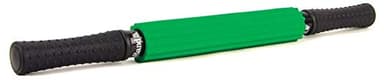
| 3 |  THERABAND Roller Massager+ You set the pressure with your arms, which is the closest a tool gets to the feedback a person has. | Self-treatment with control | 7.8 | $35.50 · View on Amazon Price as of October 21, 2026. #ad How we’re funded |
The cost arithmetic, since it is what people came for
A well-specified massage gun costs roughly what one hour of professional massage costs in most of the US. Owned for three years and used twice a week, that is somewhere around 300 sessions from a single purchase.
The device wins that comparison so overwhelmingly that the number stops being informative. If cost were the only variable, nobody would ever book a massage, and plenty of people who own three recovery devices still do. So the interesting question is what they are buying.
What a person does that no device can
- They find the thing you did not know was there. This is the big one. You treat where it hurts. A trained practitioner palpates and frequently finds that the painful spot is not the problem — that a sore shoulder traces to something in the opposite hip, or that the tender area is referred rather than local. No device has any capacity to do this, because a device goes exactly where you aim it and you aim it at the pain.
- They vary pressure continuously by feel. A gun has five settings. A hand has infinite gradations and adjusts within a single stroke based on what the tissue is doing. That responsiveness is not a feature that can be added to a motor.
- They reach everything. Your own mid-back, both shoulder blades, the back of your own neck. There is no device position that solves this and no amount of handle geometry fixes it.
- You do not have to do anything. Lying still while someone else works is categorically different from holding a vibrating object against yourself for fifteen minutes. The relaxation component is real and it is not incidental.
- Some are qualified to recognize when this is not a massage problem. A licensed therapist should refer you on when what you are describing is not something massage addresses. A device cannot notice anything.
What the device does that a person cannot
- It is available at 6am on a Tuesday. Frequency beats intensity for most maintenance work, and a tool you can use daily for two minutes will do more cumulative good than an excellent session once a month.
- It has no marginal cost. Once bought, using it more costs nothing, which changes how you use it.
- It travels. A mini gun in a bag covers a race weekend or a work trip.
- No appointment, no booking, no travel, no undressing, no small talk. For a lot of people the friction of booking is the actual barrier, and removing it is the whole value.
- Immediately before or during activity. You can use a gun in a warm-up or between sets. There is no version of this involving a therapist.
| Use case | Winner | Why |
|---|---|---|
| Daily maintenance | Device | Frequency beats intensity, and only one of these is available every morning. |
| You do not know what is wrong | Therapist | The diagnostic value of trained hands is the thing no device replaces. |
| Pain that keeps returning | Therapist | Recurrence usually means the cause is somewhere you are not treating. |
| Post-workout, at the gym | Device | Immediate, portable, no booking. |
| Your own upper back | Therapist | You cannot properly reach it. Nothing solves this. |
| Budget is the binding constraint | Device | One purchase against a recurring cost. Not close. |
| Stress and general tension | Therapist | The passive, whole-body component is most of the point and a device has none of it. |
| A specific known tight spot | Device | You know where it is; you do not need someone to find it. |
| Radiating pain, numbness, tingling | Neither | A clinician. Not a massage and not a device. |
The honest recommendation: both, in a specific order
If you have a persistent problem you do not understand, see a person first. The diagnostic value alone justifies it, and it may turn out the thing you were about to buy a device for is not a massage problem at all. That is money well spent even when the outcome is “this needs a different professional.”
Then buy the device for maintenance between visits, or instead of visits you would not otherwise have booked. A gun used four times a week for two minutes does more cumulative good than an excellent session you get around to twice a year, and it costs about one session.
What the device genuinely replaces is the frequency, not the expertise. Anyone selling it as a replacement for a trained person is overselling, and we would rather say so even though the device is the thing we earn a commission on.
What the research supports for the device half
Percussive therapy has real, modest, short-lived effects. A study on percussive therapy and hamstring range of motion found reduced tissue stiffness and improved range. A systematic review supports gains in acute and explosive strength.
For manual massage there is a systematic review and meta-analysis on delayed onset muscle soreness supporting a real effect on perceived soreness after strenuous exercise. That is a larger and older evidence base than the percussion literature, which is worth knowing when weighing the two.
Every pick, in full
Specs below are the manufacturer’s own published figures, each linked to the page it came from. Where a maker does not publish a number, the table says so and names the page we checked — that absence is information too.
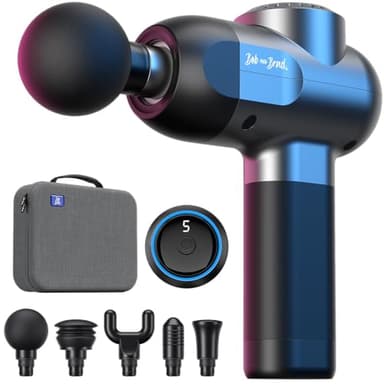
Bob and Brad C2 Massage Gun
The only gun in this roundup whose maker publishes all four numbers that decide whether it reaches the muscle — amplitude, stall force, speed range and noise — and the stall-force figure is higher than the premium units that hide theirs.
What it gets right
- Publishes amplitude, stall force, speed range and noise — the two market leaders publish none of the first three
- Published stall force of over 44 lb is higher than the figure Therabody publishes for the Prime
- 1.5 lb is light enough to hold overhead against your own shoulder without your arm giving out first
- FSA/HSA eligible, which quietly makes it cheaper again for a lot of buyers
What it does not
- 10 mm amplitude is genuinely shorter than a 16 mm premium stroke — that difference is real for glutes and thick back muscle
- No app, no pressure-feedback screen, no ecosystem
- Five fixed speeds rather than a continuous range
Price as of October 21, 2026. #ad How we’re funded
Kieba Massage Lacrosse Balls
The highest work-per-dollar tool on this entire site. A hard rubber sphere concentrates all your body weight into one square inch, which is more pressure than any handheld gun can generate.
What it gets right
- Concentrates body weight into a single point — more local pressure than any percussion device
- Nothing to charge, nothing to break, fits in a coat pocket
- Reaches under the shoulder blade against a wall, which a roller physically cannot
What it does not
- Unforgiving — very easy to overdo on a first session
- Wrong tool for broad surfaces like quads or lats
Price as of October 21, 2026. #ad How we’re funded
THERABAND Roller Massager+
A handheld stick lets you control the pressure with your arms instead of your body weight, which is the whole argument for it — you can treat a calf sitting in a chair, and you can back off instantly.
What it gets right
- You set the pressure with your arms, so you can stop the instant it is too much
- Usable on a calf without getting on the floor — a genuine accessibility point
- Nothing to charge
What it does not
- Cannot generate the pressure body weight on a ball produces
- Awkward on your own back
Common questions
Can a massage gun replace a massage therapist?
It replaces the frequency, not the expertise. A device is available daily at no marginal cost, which for maintenance work matters more than intensity. What it cannot do is palpate, find the problem you did not know you had, vary pressure continuously by feel, reach your own mid-back, or recognize when the issue is not a massage problem at all.
Is a massage gun as good as a real massage?
For a specific spot you can locate and reach, it is genuinely comparable and far more convenient. For finding the cause of a recurring problem, for whole-body work, for your own upper back, and for the passive relaxation component, it is not close. They are best used together: a person to work out what is going on, a device to maintain it between visits.
How much money does a massage gun save?
A well-specified gun costs roughly what one hour of professional massage costs in most of the US, and owned for three years at twice a week it delivers around 300 sessions. The arithmetic is so lopsided that it stops being the interesting question — plenty of people who own three devices still book massages, and what they are buying is the expertise rather than the pressure.
When should I see someone instead of using a device?
When pain radiates down a limb, when there is numbness, tingling or weakness, when pain wakes you at night, when it followed a fall or an impact, or when it has not shifted in several weeks. Also whenever a problem keeps coming back — recurrence usually means the cause is somewhere you are not treating, and a device aims exactly where you point it.
Sources
- 1.Massage Alleviates Delayed Onset Muscle Soreness after Strenuous Exercise: A Systematic Review and Meta-Analysis (PMC5623674)
- 2.Acute Effects of Theragun Percussive Therapy on Viscoelastic Tissue Dynamics and Hamstring Range of Motion (PMC10499144)
- 3.The Effect of Percussive Therapy on Musculoskeletal Performance and Experiences of Pain: A Systematic Literature Review (PubMed 37020441)
- 4.Percussion massage therapy and recovery from delayed onset muscle soreness — randomized controlled trial (PMC11979224)