Recovery Tech
The Best TENS Units for Sciatica
Sciatica is a nerve-root problem that hurts somewhere other than where the trouble is, which is why most people put the pads in the wrong place. Here is the unit we would buy for it, the three pad positions that make sense for a referred pain, and the honest size of the relief you should expect.
By Stephen V.Published
Disclosure:Grip & Gait earns a commission when you buy through links on this page, at no extra cost to you. It never changes what we recommend or the order we rank things in — here is exactly how we’re funded.
Quick picks
Ranked on published manufacturer specs and what they mean for the job, not on testing we have not done. Tap a row for the full reasoning. How we score.
| # | Product | Best for | Score | Price |
|---|---|---|---|---|
| 1 |  AUVON Dual Channel TENS Unit Dual channel, so you can bracket the lumbar nerve root with one pair and follow the leg with the other, and the preset modes mean you are not fighting a menu at 11pm. | Best overall for sciatica | 8.5 | $35.99 · View on Amazon Price as of October 5, 2026. #ad How we’re funded |
| 2 |  TENS 7000 Digital TENS Unit Adjustable pulse width and rate instead of fixed programs. For a referred pain you often need to tune the sensation until it reaches the leg, and this is the unit that lets you. | Manual control of the pulse | 8.3 | $38.88 · View on Amazon Price as of October 5, 2026. #ad How we’re funded |
| 3 |  Belifu Dual Channel TENS EMS Unit Ships with a large pad count, which matters when the pain runs from the glute to the calf and you want pads staged along it rather than moved around. | Covering a long referral | 7.8 | $32.99 · View on Amazon Price as of October 5, 2026. #ad How we’re funded |
| ✕ |  KingPavonini Wireless TENS + EMS Muscle Stimulator Wireless is genuinely nicer to wear, but the fixed programs and pod-shaped pads are the wrong tool for steering a sensation down a specific dermatome. Skip this | The one to skip here | 6.4 |
What sciatica is, and why that changes everything about the pads
Sciatica is not a muscle. It is a symptom — pain, pins and needles or weakness that travels along the path of the sciatic nerve, usually because a nerve root is irritated or compressed where it leaves the lumbar spine. The clinical name for the underlying problem is lumbar radiculopathy, and the word that matters in it is radiating. The pain shows up in the buttock, the back of the thigh, the calf, sometimes the foot. The problem is almost never in any of those places.
That one fact invalidates the instinct everybody has with a TENS unit, which is to stick the pads on the part that hurts. Putting four pads on a sore calf treats a calf that is not injured. The electrodes belong where the nerve can be reached: across the lower back either side of the spine at the level the pain starts from, and then, if you want, staged down the referral path as a second channel. That is a two-channel job, which is the first reason the unit we recommend is a dual-channel one.
The second reason is control. A referred pain needs a sensation that travels, and whether it travels depends on pulse width and frequency as much as intensity. A unit with twenty numbered programs and no manual adjustment gives you one lever — louder — and turning a TENS unit louder is how people end up with a twitching back and no change in the leg.
How we ranked these for sciatica
- Two independent channels. One pair of pads to bracket the nerve root, one pair to follow the referral. A single-channel unit forces you to choose, and the back is always the right choice, which makes the second channel the whole value.
- Manual pulse width and rate, or sensible presets. Either give us the dials or give us programs that were designed by someone who understood the difference between a deep ache and a nerve referral. A long list of unnamed modes is neither.
- Intensity steps that are small at the bottom. Sciatic pain is often accompanied by altered sensation, so the useful range sits low. A unit that jumps from nothing to startling in two presses is unusable for exactly the person buying it.
- Pad cost and pad size. The unit is the cheap part. A long referral eats electrodes, and large pads are what cover a glute. We price the consumable, not just the box.
- Honesty about what it does. TENS is pain modulation while it is switched on. Nothing on this page decompresses a nerve root, and we rank down any unit sold as if it did.
What the evidence actually supports
Two bodies of work matter here, and neither is as flattering as the category’s marketing.
On the problem itself, a 2026 systematic review of conservative treatment for lumbar radiculopathy screened the literature up to 2026 and included nineteen randomized controlled trials published between 2016 and 2026, covering manual therapy, neural mobilization, exercise rehabilitation, physical modalities and multimodal regimens. Heterogeneity was severe enough that the authors could not pool the results into a meta-analysis at all. What they could do was report the individual quantified wins, and those came from movement-based care: adding spinal mobilization with leg movement produced a mean reduction in leg pain of 2.0 points at two weeks and 2.6 at six months, and targeted neural mobilization beat conventional therapy at eight weeks on both pain and disability. The authors also note that clinical superiority was inconsistent across outcome domains, long-term follow-up was rare, and many trials carried a high risk of bias. Electrotherapy sits inside the “physical modalities” bucket in that review, not at the top of it.
On TENS and nerve pain specifically, a 2025 systematic review and meta-analysis of thirty studies — twenty-five of them pooled — found that TENS produced only a small reduction in neuropathic pain against placebo, and that the effect was not clinically significant (standardized mean difference −0.35, 95% CI −0.90 to 0.10). In diabetic neuropathic pain it performed about the same as placebo and about the same as other electrotherapies. The one subgroup where it clearly beat both placebo and the alternatives was spinal cord injury.
Read those together and the honest position is this: a TENS unit is a cheap, low-risk, on-demand way to turn the volume down on sciatic pain for as long as it is running, and it is not a treatment for the nerve root. The thing with the quantified numbers next to it is loading, movement and nerve glides — which cost nothing. Buy the unit as the thing that gets you through an evening, and spend the effort on the routine on our sciatica page.
Three pad positions that make sense for a referral
Across the lumbar spine, level with where the pain starts.Two pads, one either side of the spine, never on the bony midline. This is the position that addresses the nerve root and it is the one to start with every time. If the referral reaches the calf and this placement alone dulls it, you are done — that is the whole technique.
Bracketing the glute. For pain that stops at the buttock, one pad above and one below the sorest area so the current crosses it. Deep gluteal pain that behaves more like a muscle than a nerve is a different problem with a different answer; the distinction is in glute and piriformis pain.
Staged along the referral, on channel two. One pad high on the back of the thigh, one on the upper calf, with channel one still working the back. Keep intensity lower on this channel than on the lumbar pair. Never place a pad over the back of the knee where the nerve is close to the surface and the skin is thin.
Intensity on every placement goes to a strong but comfortable tingle and no further. Visible muscle contraction means you have crossed from TENS into stimulation you did not want. Twenty to thirty minutes is a session; two or three sessions a day is a normal ceiling. The full operating procedure is in how to use a TENS unit.
Which unit for which person, in one line each
- You want one unit and you do not want to learn a device: the AUVON dual channel. Two channels for the back-plus-leg job, preset modes that are usable without reading anything, small intensity steps at the bottom of the range, and a price that makes it an easy thing to own alongside the exercises that actually move the needle.
- You want to steer the sensation yourself: the TENS 7000. Adjustable pulse width and rate rather than fixed programs. If the tingle sits in your back and refuses to reach your calf, this is the unit where you can do something about it, and it is the one clinicians hand people most often.
- Your pain runs the whole leg:the Belifu. The pad count is the reason — staging electrodes along a long referral and leaving them there beats peeling and repositioning two pads every ten minutes.
- Skip the wireless unit for this job. The KingPavonini is a pleasant thing to wear under a shirt and a poor instrument for aiming a sensation at a nerve root. Buy it for a shoulder you want to treat while walking around, not for sciatica.
Where a TENS unit is the wrong purchase
If the pain is coming from a tight, overworked muscle rather than a nerve root — a deep ache in one spot that reproduces when you press it — a ball or a gun does more for less. Massage gun vs TENS is the honest comparison, and lower back painis the page to read if the pain never leaves your back. If the referral is driven by swelling and sitting, boots are a different mechanism entirely — see compression boots vs TENS. And if you are comparing units rather than categories, TENS 7000 vs AUVON puts the top two on this page head to head, while the back-pain roundup covers the case where the pain stays put.
Every pick, in full
Specs below are the manufacturer’s own published figures, each linked to the page it came from. Where a maker does not publish a number, the table says so and names the page we checked — that absence is information too.
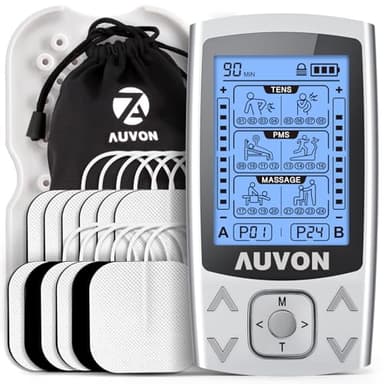
Price as of October 5, 2026. #ad How we’re funded
AUVON Dual Channel TENS Unit
Two independent channels so you can treat both sides of a problem at once, at a price where trying TENS costs less than one session of anything else.
What it gets right
- Two independent channels with separate intensity control
- Rechargeable rather than eating 9 V batteries
- Cheap enough to find out whether TENS does anything for you
What it does not
- Pad adhesive life is the real running cost, not the unit
- Interface is fiddly with cold hands
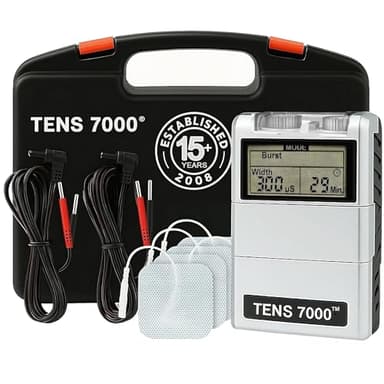
Price as of October 5, 2026. #ad How we’re funded
TENS 7000 Digital TENS Unit
The unit clinics hand out, with manual control over pulse width and rate rather than a menu of preset programs — which is what you want once you know what setting helps.
What it gets right
- Manual pulse-width and rate control instead of fixed presets
- The long-standing clinic default, so accessories are everywhere
What it does not
- Runs on a 9 V battery
- Manual control is only an advantage if you know what you are adjusting
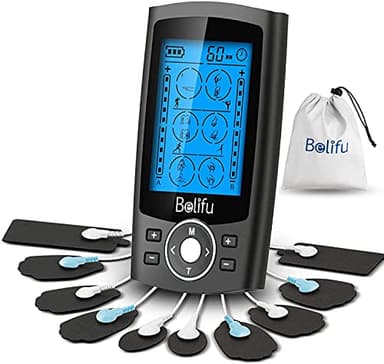
Price as of October 5, 2026. #ad How we’re funded
Belifu Dual Channel TENS EMS Unit
Twenty-four modes at the lowest price in the category, and the mode count is marketing — but the hardware underneath is a competent dual-channel stimulator.
What it gets right
- Cheapest dual-channel unit here
- Rechargeable
- Pads and leads included
What it does not
- Mode count is noise, not a feature
- Thin documentation of what each mode does
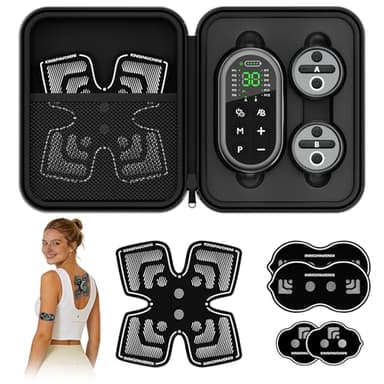
KingPavonini Wireless TENS + EMS Muscle Stimulator
TENS and EMS from two pods you stick on and wear, with no lead wires anywhere — which is the whole reason to pay this much, because it is the only version of the device you can use under a shirt and still move around in. The 48-mode count is marketing; the dual-zone independent control underneath it is not.
What it gets right
- Wireless pods rather than lead wires, so it works under clothing and while moving
- Two pods run independently — separate mode and intensity each, so a shoulder and a leg can run different settings at once
- Published 20 hours per pod on the 1040 mAh cell, charged over USB-C rather than off a disposable battery
- Ships with three pad sizes including a 4.3 in butterfly pad, which is the one that actually covers a lower back
What it does not
- Forty-eight modes is a mode count, not a specification — the same marketing this site flags on every cheap unit
- Several times the price of a wired dual-channel unit that treats a back just as well
- Two pods and a remote are three things to keep charged and not lose
- Listed only in December 2025 and rated 4.1 across 69 reviews, so there is very little ownership history behind it
Common questions
Where do you put TENS pads for sciatica?
On your lower back first, one pad either side of the spine at the level where the pain starts, never on the bony midline. The sciatic pain you feel in the thigh or calf is referred from a nerve root in the lumbar spine, so pads on the sore part of the leg are treating tissue that is not the problem. If you have a second channel, stage one pad high on the back of the thigh and one on the upper calf at a lower intensity. Avoid the back of the knee.
Does a TENS unit actually help sciatica?
It can take the edge off while it is running, and the published effect is small. A 2025 systematic review and meta-analysis of thirty studies on TENS for neuropathic pain found only a small reduction against placebo that did not reach clinical significance, with the clear benefit confined to spinal cord injury. A 2026 systematic review of conservative care for lumbar radiculopathy put the quantified wins with manual therapy, neural mobilization and exercise instead. Use the unit for symptom relief; do the movement work for the problem.
How long should you use a TENS unit for sciatic pain?
Twenty to thirty minutes per session, two or three sessions a day, at a strong but comfortable tingle with no visible muscle twitch. There is no benefit to leaving it running for hours and there is a real cost: the sensation habituates, so you keep turning it up and the skin under the pads gets irritated. Move the pads a centimeter or two between sessions.
When should you not use a TENS unit for sciatica?
If you have a pacemaker, an implanted defibrillator or any implanted electrical device, or if you are pregnant and the placement would be on the lower back or abdomen. Stop and see a clinician the same day for numbness in the saddle area, loss of bladder or bowel control, weakness that is worsening, numbness in both legs, or pain that started with a fall. Those are emergency signs and a device that masks them makes things worse.
Sources
- 1.Evidence-Based Conservative Treatment Strategies for Lumbar Radiculopathy: A Systematic Review - Cureus 2026 (PMC13349735) — 19 RCTs; meta-analysis precluded by heterogeneity; quantified gains from manual therapy and neural mobilization
- 2.Neuropathic Pain Relief Through Transcutaneous Electrical Neuromuscular Stimulation: Insights From a Systematic Review and Meta-Analysis of Clinical Evidence - BioMed Research International 2025 (PMC12543013) — SMD -0.35 vs placebo, not clinically significant; clear benefit only in spinal cord injury
- 3.Transcutaneous electrostimulation for osteoarthritis of the knee - Cochrane Database of Systematic Reviews (PubMed 19821296) — the Cochrane position on TENS for a different joint, for calibration
- 4.camelcamelcamel — AUVON TENS price history — price history for the top pick
- 5.camelcamelcamel — TENS 7000 price history — price history for the manual-control pick