Guides
How to Use a Massage Gun
Two minutes per muscle, keep it moving, and stay off bone. Most of what goes wrong with these devices comes from doing one of those three things backwards — usually the second.
By Stephen V.Published Updated
Disclosure:Grip & Gait earns a commission when you buy through links on this page, at no extra cost to you. It never changes what we recommend or the order we rank things in — here is exactly how we’re funded.
Quick picks
Ranked on published manufacturer specs and what they mean for the job, not on testing we have not done. Tap a row for the full reasoning. How we score.
| # | Product | Best for | Score | Price |
|---|---|---|---|---|
| 1 |  Bob and Brad C2 Massage Gun Published specs, light enough to hold at awkward angles, and it turns down far enough to follow this protocol. | The gun this guide assumes | 8.6 | |
| 2 |  Therabody Theragun Prime (6th Gen) The pressure-feedback display directly corrects the single most common error in this guide. | If you over-press | 7.9 | $329.99 · View on Amazon Price as of October 21, 2026. #ad How we’re funded |
| 3 |  THERABAND Roller Massager+ A stick removes the over-pressing problem entirely, because your arms are the motor. | Pressure you set yourself | 7.8 | $35.50 · View on Amazon Price as of October 21, 2026. #ad How we’re funded |
How long to use a massage gun
Thirty seconds to two minutes per muscle group, with the head moving continuously. Not more. A whole-body session should be under fifteen minutes, and most sessions should be far shorter than that — one or two areas, done properly.
Longer is not better and it is the most common way people bruise themselves. The effects percussion produces are short-term reductions in tissue stiffness and improvements in range of motion; there is no dose-response evidence suggesting eight minutes on a calf achieves more than ninety seconds does.
How hard to press
Much less than you think. This is the error that ruins more sessions than every other combined.
The device is doing the work. Your job is to hold it in contact and steer it — not to drive it into the muscle. If you are pressing hard enough that the motor note drops or the stroke visibly shortens, you have exceeded the stall force and the device has stopped doing what it was designed to do. You are now just pressing a vibrating object into yourself.
A useful rule: the weight of the device plus a little guidance. If your arm is working, you are pressing too hard. This is exactly the error the pressure-feedback display on some premium units exists to correct, and it is a genuinely good reason to buy one.
The protocol
- Start on the lowest speed. You can always go up. Starting at maximum on untested tissue is how first sessions go badly.
- Approach the muscle with the gun already running, and let it settle onto the tissue rather than pressing it on.
- Glide slowly — about an inch per second. Continuously moving. Parking the head on one point is the bruising mechanism.
- Cover the whole muscle belly, not just the sore spot. The tender point is often not where the problem is.
- Thirty to ninety seconds, then move on. Come back tomorrow rather than staying longer today.
- Then move. Gentle range-of-motion work afterward is what converts a temporary reduction in stiffness into something you can use.
Where not to use it
Never on bone. Shins, the spine itself, the kneecap, the point of an elbow, the collarbone, the top of the foot, the skull. No attachment makes any of these acceptable and no speed setting does either.
Never on the front or sides of the neck. Major vessels and nerves run there. The muscle at the back and side of the neck, gently, with a soft attachment, is reasonable. The front is not.
Never over a joint. Around it, on the muscle, yes. On the joint capsule itself, no.
Never on a fresh injury. First 48 hours after a strain, and anything swollen, bruised or hot.
Never over a nerve you can feel. If you get tingling, shooting, or numbness, that is not a knot — move immediately.
“Skin rash, open wounds, blisters, local tissue inflammation, bruises, or tumors; deep vein thrombosis, osteomyelitis; bone fracture or myositis ossificans; hypertension (uncontrolled); acute or severe cardiac, liver, or kidney disease; neurologic conditions resulting in loss or altered sensation; bleeding disorders; recent surgery or injury; connective tissue disorders; peripheral vascular insufficiency or disease; medications that thin the blood or alter sensations; pacemaker, ICD.”
The same document also specifies avoiding direct application to the face, throat or genitalia, and direct pressure over a surgical site or hardware. If any of those apply to you, this is a conversation with a clinician rather than a shopping decision. Our medical disclaimer sets out what this site is.
Before or after exercise?
Before: a short pass — 30 seconds per area — reduces perceived stiffness without the strength cost long static stretching was once blamed for. A study on massage gun and foam roller use during a warm-up examined this directly in trained athletes.
After: the more common use. A randomized controlled trial found percussion massage gave immediate, temporary relief in perceived soreness at 24, 48 and 72 hours after eccentric exercise, without accelerating recovery until the 72-hour mark. So: it will make you feel better now. It is not shortening the process.
During: a study on intra-exercise use looked at physiological responses to a percussive device between resistance sets. It is a niche application and not something most people need.
Which attachment for what
Short version — the full breakdown is in attachments explained:
- Ball — large muscles, general use, 80% of sessions.
- Flat or dampener — near bone, anywhere tender, first sessions.
- Fork — straddling the spine or an Achilles so pressure lands either side.
- Bullet — a specific small trigger point only, and only if you know where the nearby nerves run.
How often
Daily is fine for most people at these durations. Twice a day on a specific area is fine. Where it goes wrong is duration and pressure within a session rather than frequency across the week.
If an area is sore the next day in a way that feels like bruising rather than worked muscle, you did too much — reduce time first, then pressure, then speed.
The region-by-region version of the warning above now has its own page. Where not to use a massage gun maps eleven areas the device does not belong on, says why each one is off limits, and names the tool that does belong there instead.
Realistic expectations
What the evidence supports: reduced tissue stiffness and improved range of motion, and improvements in acute and explosive muscle strength. Both short-term, both real.
What it does not support: faster recovery, breaking down scar tissue, releasing fascia, flushing lactic acid, or treating an injury. A comparison against foam rolling found neither reduced pain significantly more than rest.
Used as described here it is a good tool for feeling and moving better in the short term. That is a genuinely useful thing for a device to do, and it is smaller than what it is sold as.
Every pick, in full
Specs below are the manufacturer’s own published figures, each linked to the page it came from. Where a maker does not publish a number, the table says so and names the page we checked — that absence is information too.
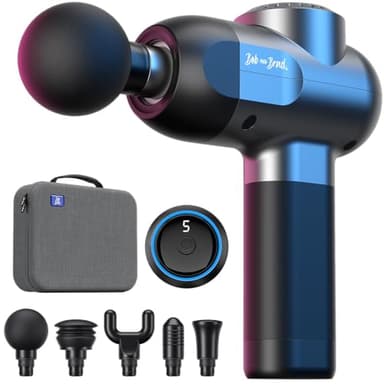
Bob and Brad C2 Massage Gun
The only gun in this roundup whose maker publishes all four numbers that decide whether it reaches the muscle — amplitude, stall force, speed range and noise — and the stall-force figure is higher than the premium units that hide theirs.
What it gets right
- Publishes amplitude, stall force, speed range and noise — the two market leaders publish none of the first three
- Published stall force of over 44 lb is higher than the figure Therabody publishes for the Prime
- 1.5 lb is light enough to hold overhead against your own shoulder without your arm giving out first
- FSA/HSA eligible, which quietly makes it cheaper again for a lot of buyers
What it does not
- 10 mm amplitude is genuinely shorter than a 16 mm premium stroke — that difference is real for glutes and thick back muscle
- No app, no pressure-feedback screen, no ecosystem
- Five fixed speeds rather than a continuous range
Price as of October 21, 2026. #ad How we’re funded
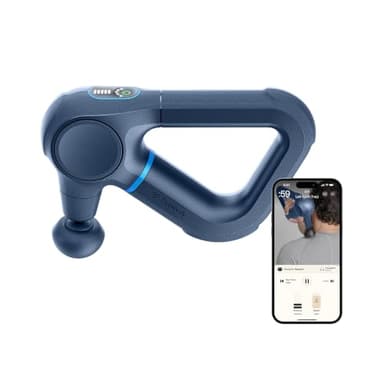
Therabody Theragun Prime (6th Gen)
The long-stroke option, and the build quality is not in question — but Therabody's current US product page publishes dimensions, weight, battery and warranty and does not publish amplitude, stall force, PPM or noise, so the numbers most buyers are shopping on are not on the page they are shopping from.
What it gets right
- The 16 mm stroke Therabody quotes is genuinely long, and stroke length is what determines depth
- Real-time pressure feedback stops the most common user error — leaning on it far too hard
- Rated by Therabody to survive drops from 10 feet, which matters more than it sounds for a thing you use on a hard floor
What it does not
- Amplitude, stall force, PPM and dB are absent from the current US product page — we checked
- Two attachments in the box, against five on guns costing a fifth as much
- 120 minutes of battery is quoted at the LOWEST speed setting, which is not the setting you will use
- One-year limited warranty on a device at this price
| Amplitude | Not published page we checked |
|---|---|
| Stall force | Not published page we checked |
| Speed range | Not published page we checked |
| Speed settings | 5 source |
| Weight | 2 lb source |
| Noise | Not published page we checked |
| Battery | 2 h source |
| Attachments | 2 source |
| Warranty | 1-year limited source |
| Dimensions | 238 × 153 × 61 mm source |
Price as of October 21, 2026. #ad How we’re funded
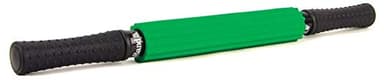
THERABAND Roller Massager+
A handheld stick lets you control the pressure with your arms instead of your body weight, which is the whole argument for it — you can treat a calf sitting in a chair, and you can back off instantly.
What it gets right
- You set the pressure with your arms, so you can stop the instant it is too much
- Usable on a calf without getting on the floor — a genuine accessibility point
- Nothing to charge
What it does not
- Cannot generate the pressure body weight on a ball produces
- Awkward on your own back
Common questions
How long should you use a massage gun on one muscle?
Thirty seconds to two minutes, with the head moving continuously. A whole-body session should stay under fifteen minutes. Longer is not better and it is the most common way people bruise themselves — there is no evidence that eight minutes on a calf achieves more than ninety seconds does.
How hard should you press a massage gun?
Much less than you think — roughly the weight of the device plus a little guidance. The device is doing the work; your job is to hold it in contact and steer it. If the motor note drops or the stroke visibly shortens, you have exceeded the stall force and it has stopped doing what it was designed to do. If your arm is working, you are pressing too hard.
Can you use a massage gun every day?
Yes, at these durations. Twice a day on a specific area is also fine. Where people go wrong is duration and pressure within a session, not frequency across the week. If an area feels bruised rather than worked the next day, reduce time first, then pressure, then speed.
Where should you not use a massage gun?
Never on bone — shins, the spine itself, the kneecap, the point of an elbow, the collarbone, the top of the foot, the skull. Never on the front or sides of the neck. Never over a joint capsule, on a fresh injury, or over a nerve you can feel. Therabody’s published precautions add a substantial list of conditions and medications, quoted in full above.
Should I use a massage gun before or after a workout?
Both work for different reasons. Before, a short 30-second-per-area pass reduces perceived stiffness. After is the more common use, and a randomized trial found it gives immediate temporary relief in perceived soreness at 24, 48 and 72 hours without accelerating recovery until the 72-hour mark. It will make you feel better now; it is not shortening the process.
Do massage guns break up lactic acid?
No, and the premise is wrong — lactate clears on its own within roughly an hour of exercise and is not what causes delayed onset muscle soreness. Soreness a day or two later relates to muscle damage and inflammation, not to anything left over needing flushing. The real, supported effects are short-term reductions in tissue stiffness and improvements in range of motion.
Sources
- 1.Therabody — Product Safety & Precautions — contraindications quoted verbatim above
- 2.Acute Effects of Theragun Percussive Therapy on Viscoelastic Tissue Dynamics and Hamstring Range of Motion (PMC10499144)
- 3.Percussion massage therapy and recovery from delayed onset muscle soreness — randomized controlled trial (PMC11979224)
- 4.The Effect of Percussive Therapy on Musculoskeletal Performance and Experiences of Pain: A Systematic Literature Review (PubMed 37020441)
- 5.Does Massage Gun or Foam Roller Use During a Warm-Up Improve Performance in Trained Athletes? (PMC12473898)
- 6.Massage It Out: Physiological Responses to a Percussive Therapy Device Used Intra-Resistance Exercise (PMC12225236)
- 7.Foam Rolling or Percussive Massage for Muscle Recovery: Insights into DOMS (PMC12286022)