Compare
Massage Gun vs Vibrating Foam Roller
Both add motion to pressure, but in different ways and for different muscles. A gun percusses a small area you aim by hand; a vibrating roller adds a buzz to the broad, body-weight pressure of ordinary rolling. The right one depends on whether your problem is a spot you cannot reach or a large muscle you can lie on.
By Stephen V.Published
Disclosure:Grip & Gait earns a commission when you buy through links on this page, at no extra cost to you. It never changes what we recommend or the order we rank things in — here is exactly how we’re funded.
Quick picks
Ranked on published manufacturer specs and what they mean for the job, not on testing we have not done. Tap a row for the full reasoning. How we score.
| # | Product | Best for | Score | Price |
|---|---|---|---|---|
| 1 |  Bob and Brad C2 Massage Gun Percussion you aim precisely, and it reaches your own shoulders and back where a roller cannot load. | Targeting and reach | 8.6 | |
| 2 |  Hyperice Vyper 3 Vibrating Foam Roller Three vibration speeds on a rigid roller. Real for quads and lats, and the honest question is whether it beats a plain cylinder. | Broad muscle, if you want vibration | 7.6 | |
| 3 | No image FITINDEX Vibrating Foam Roller Five vibration speeds at a quarter of the premium price, and FSA eligible. Where to buy vibration if you want it. | Vibration without the premium tax | 7.8 |
Two ways of adding motion to pressure
A massage gundelivers percussion — a head hammering into a small area — that you aim with your hand. Its strengths are targeting and reach: a precise spot, or a place you cannot get body weight onto, like your own upper back.
A vibrating foam rolleris an ordinary foam roller with a motor that adds vibration to the broad, body-weight pressure of rolling. Its strengths are coverage and the fact that the vibration makes rolling more comfortable, so people who find plain rolling too intense will actually do it. It works the big muscles you can lie on — quads, hamstrings, lats, the mid-back.
This is really the gun-versus-roller decision with vibration added to the roller side. The vibration does not change which tool suits which muscle; it just makes the rolling more tolerable.
Which wins, by use case
| Use case | Winner | Why |
|---|---|---|
| Quads, hamstrings, lats | Vibrating roller | Broad muscle you can lie on; the roller covers area a gun works slowly. |
| Your own upper back and shoulders | Massage gun | You cannot load these with body weight; a gun reaches them. |
| A specific tight spot | Massage gun | Precise targeting, or a ball for even more concentrated pressure. |
| Thoracic mobility work | Vibrating roller | A gun cannot do extension over a fulcrum; a roller can. |
| Making rolling tolerable | Vibrating roller | Vibration reduces the discomfort, so it actually gets used. |
| Travel and portability | Massage gun | A mini gun packs; a roller does not. |
| Lowest cost | Neither, really | A plain cylinder or a ball does the mechanical job for a fraction of either. |
What the evidence actually says
The honest summary is that neither has a strong edge on the outcome most people care about. A study comparing foam rolling and percussive massage found both accelerated the recovery of muscle properties disrupted by soreness, and that neither reduced pain significantly more than resting. A warm-up study looked at both during a warm-up. Vibration on top of rolling is pleasant and makes rolling easier to tolerate, which is a real, practical benefit — but the published evidence does not show it delivering a large effect beyond ordinary rolling. Choose on mechanics and comfort, not on a promise the research does not make.
If you can only buy one
Buy the gun if your problems are your own back and shoulders, specific spots, or anywhere you cannot apply body weight, and if portability matters. Buy the vibrating roller if your problems are the big leg and back muscles, if you want mobility work, and if the vibration is what will get you to roll consistently. And if budget is the deciding factor, a plain roller plus a massage ball covers most of both for far less than either.
Every pick, in full
Specs below are the manufacturer’s own published figures, each linked to the page it came from. Where a maker does not publish a number, the table says so and names the page we checked — that absence is information too.
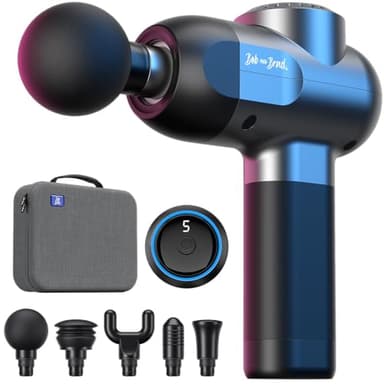
Bob and Brad C2 Massage Gun
The only gun in this roundup whose maker publishes all four numbers that decide whether it reaches the muscle — amplitude, stall force, speed range and noise — and the stall-force figure is higher than the premium units that hide theirs.
What it gets right
- Publishes amplitude, stall force, speed range and noise — the two market leaders publish none of the first three
- Published stall force of over 44 lb is higher than the figure Therabody publishes for the Prime
- 1.5 lb is light enough to hold overhead against your own shoulder without your arm giving out first
- FSA/HSA eligible, which quietly makes it cheaper again for a lot of buyers
What it does not
- 10 mm amplitude is genuinely shorter than a 16 mm premium stroke — that difference is real for glutes and thick back muscle
- No app, no pressure-feedback screen, no ecosystem
- Five fixed speeds rather than a continuous range
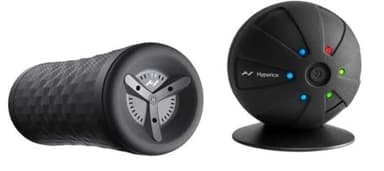
Hyperice Vyper 3 Vibrating Foam Roller
Three speeds of vibration on a 34 W motor, and the honest question is whether vibration adds enough over a $13 cylinder to justify twenty times the price — for most people it does not.
What it gets right
- Published motor, weight, dimensions and battery — more transparency than Hyperice gives its guns
- Vibration genuinely reduces the discomfort of rolling, which means people actually do it
What it does not
- Twenty times the price of a foam cylinder that does the mechanical part
- 2.7 lb and a 2-hour battery — it is a device, not a lump of foam
FITINDEX Vibrating Foam Roller
Five vibration speeds at a quarter of the premium vibrating roller's price, and FSA eligible — if vibration is the feature you want, this is where to buy it.
What it gets right
- Five speeds
- FSA/HSA eligible
- A fraction of the branded vibrating-roller price
What it does not
- Shorter than a full 18 in roller
- Battery adds weight over plain foam
Common questions
Is a massage gun or a vibrating foam roller better?
Neither is better in general; they suit different muscles. A gun targets specific spots and reaches places you cannot get body weight onto, like your own upper back. A vibrating roller covers the big muscles you can lie on and does mobility work a gun cannot. Choose the gun for reach and targeting, the roller for broad coverage. A published comparison of rolling and percussion found neither reduced pain more than rest.
Does a vibrating foam roller work better than a regular one?
Mostly it makes rolling more comfortable rather than more effective. The mechanical work — sustained body-weight pressure — is the same as a plain cylinder, and the published evidence does not show vibration delivering a large additional effect. Its real value is that the buzz makes rolling tolerable, so people keep doing it. Buy it for that, not for a therapeutic upgrade over a much cheaper plain roller.
Can a vibrating roller reach the same places as a massage gun?
No. A roller needs a muscle you can lie on and load with body weight, so it cannot treat your own upper back, the back of your shoulder, or a forearm the way a handheld gun can. The gun’s reach and precise targeting are its whole advantage. The roller’s advantage is broad coverage and mobility work. They cover different ground, which is why many people end up with both.
Sources
- 1.Foam Rolling or Percussive Massage for Muscle Recovery: Insights into DOMS (PMC12286022)
- 2.Does Massage Gun or Foam Roller Use During a Warm-Up Improve Performance in Trained Athletes? (PMC12473898)
- 3.The Effect of Percussive Therapy on Musculoskeletal Performance and Experiences of Pain: A Systematic Literature Review (PubMed 37020441)