Guides
Massage Guns and Lymphatic Drainage
A massage gun is the wrong instrument for lymph, and the reason is mechanical rather than a matter of taste: the lymphatic system responds to light, slow, directional pressure at skin level, and percussion is heavy, fast and undirected. The device with randomized trials behind it for lymphatic problems is a different one entirely - and if you have actual lymphedema, the first purchase is an appointment.
By Stephen V.Published
Disclosure:Grip & Gait earns a commission when you buy through links on this page, at no extra cost to you. It never changes what we recommend or the order we rank things in — here is exactly how we’re funded.
The short version
Do not buy a massage gun for lymphatic drainage. If your legs feel heavy and swollen at the end of the day and nothing is medically wrong, a pneumatic compression system is the device class with evidence behind it, and elevation plus walking is the free version. If you have diagnosed lymphedema — after lymph node surgery or radiotherapy, for instance — this is not a shopping problem: the standard of care involves a trained therapist, and a compression device is an adjunct they prescribe into, not a substitute you buy around them.
What the lymphatic system responds to
Lymph is the fluid that leaves your capillaries into the tissue and has to be returned to the bloodstream. It travels in a one-way network of very fine vessels that sit just under the skin, and it has no pump of its own. It moves because of three things: tiny valved segments in the vessel walls contracting, the squeeze of surrounding muscle as you move, and external pressure applied in the direction of flow.
That architecture dictates the technique, and manual lymphatic drainage as taught reflects it exactly: very light pressure, slow repetition, skin stretched rather than muscle compressed, and every stroke moving toward the drainage point rather than back and forth.
Now consider a percussion massage gun. It delivers high-frequency force — a budget gun publishes 2,000 to 3,200 percussions per minute — perpendicular to the skin, deep into muscle, with no directional component at all. On all three axes that matter it is the opposite of what the lymphatic system responds to: too hard, too fast, and aimed the wrong way. It is a well-designed tool for a different tissue.
That is not a claim that a gun damages your lymphatics in normal use on healthy tissue. It is a claim that there is no mechanism by which it drains them, and no trial showing it does. When a product listing says “promotes lymphatic drainage”, it is describing a hope.
| What you want | The right class | Why |
|---|---|---|
| Move lymph in a swollen limb | Pneumatic compression | Sequential chambers inflate from the foot upward, which is pressure applied in the direction of flow. The only consumer device whose mechanism matches the physiology. |
| Diagnosed lymphedema | A certified therapist first | Manual lymphatic drainage, compression garments and skin care are the standard of care; a pump is an adjunct within that, not an alternative to it. |
| Heavy, aching legs after standing all day | Elevation, walking, then compression | Muscle contraction is one of the three things that moves lymph, and it is free. A pump helps the passive half. |
| Sore muscles after training | Massage gun or foam roller | Percussion and rolling have randomized evidence for recovery of range of motion and soreness. This is their actual job. |
| A hard knot in a muscle | Massage ball or gun | Pressure into muscle tissue. Nothing to do with lymph. |
| Cellulite or facial contouring | Neither, honestly | This is where lymphatic language is used most and supported least. No device on this site is a cosmetic treatment. |
What the compression evidence actually says
Intermittent pneumatic compression is the device class with a genuine literature here, and it is worth being precise about what that literature covers.
A 2026 systematic review of contemporary randomized controlled trials examined intermittent pneumatic compression devices for the treatment of lower extremity lymphedema. That is the relevant evidence base for this question, and the existence of a body of randomized trials is exactly what separates this device class from percussion, where no comparable literature for lymphatic outcomes exists at all.
Separately, a 2025 systematic review with meta-analysis looked at pneumatic compression alongside photobiomodulation and neuromuscular electrical stimulation for muscle recovery — a different outcome from lymphatic drainage, and worth keeping separate. And a placebo-controlled trial in international-level youth soccer players found no improvement in neuromuscular, biochemical or perceptual recovery after a match. We cite that last one because it is the result that keeps this page honest: compression has real lymphatic indications and an unimpressive record as a sports-recovery accelerator. Those are two different claims and the marketing routinely merges them.
What to look for if a compression device is appropriate
Three things decide whether a consumer system is doing the job the physiology asks for.
Genuine sequential inflation.The chambers must fill in order from the foot upward and release in order, because direction is the whole point. A system that inflates every chamber at once applies a uniform squeeze, which is a less useful thing wearing the same name. The honest tell is a published cycle description rather than the word “sequential” in a bullet list.
Coverage that starts at the foot. Fluid pools distally. A sleeve that begins at the ankle leaves out the part of the limb most likely to be swollen.
A pressure range you can set low. Lymphatic work is light work. The useful setting for a swollen limb is usually well below the maximum, and a device whose lowest setting is already firm is the wrong device. If a clinician has given you a target pressure, that number beats everything else on this page.
Fit matters as much as specification — measure the widest part of the calf and the floor-to-below-knee length before ordering, because a sleeve that will not close cannot cycle. The full ranking of the category is in the best compression boots.
The sensible default
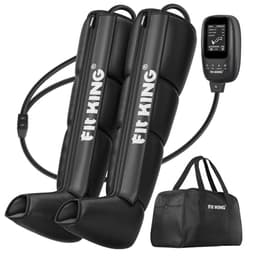
FIT KING Air Compression Recovery Boots
Genuinely sequential, sized rather than one-size, with a low enough pressure range to be useful for a heavy-legs problem rather than only for sore muscles. The pair we would own.
Foot-to-thigh coverage
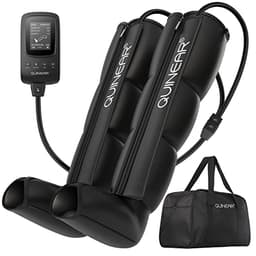
QUINEAR Leg Recovery Compression System
Covers from the foot upward, which is the right geometry when the swelling pools at the ankle and arch. The reason to pick it over the default is reach, not power.
Price as of October 5, 2026. #ad How we’re funded
If a clinician specified a pump
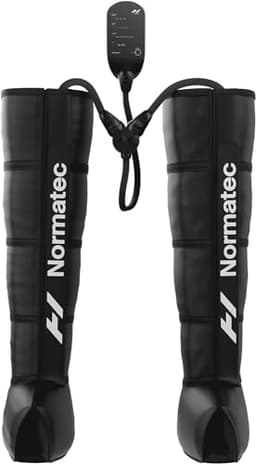
Hyperice Normatec 3 Recovery System
The refined option: quieter pump, finer control, longer support. Worth it when a device is part of an actual treatment plan you will run daily for years, not as an upgrade for feel.
Price as of October 5, 2026. #ad How we’re funded
If you own a massage gun already
Keep using it for what it is good at: sore muscles, stiffness, range of motion before and after training. The randomized evidence for percussion sits squarely there — a trial on squat-induced soreness found it better than static stretching for recovery of jump height and range of motion at 48 hours, and a study on eccentric muscle damage found faster return of range of motion with no change in strength or underlying repair. None of those outcomes is lymphatic.
And do not use it on a swollen limb. Percussion over an area where fluid is already accumulating in the tissue is at best pointless and, in a limb with compromised lymphatic drainage or fragile skin, a way to provoke inflammation in exactly the tissue you are trying to settle. The manufacturer’s own precaution list includes the vascular conditions this page keeps pointing at:
“Deep vein thrombosis, osteomyelitis; bone fracture or myositis ossificans; bleeding disorders; peripheral vascular insufficiency or disease; medications that thin the blood or alter sensations; pacemaker, ICD.”
Where to go next
If your real question was heavy, aching legs rather than lymphedema, start at compression boots for older adults and poor circulation, which covers the ask-first list in more detail, and are compression boots worth it before spending anything. If you were comparing device classes, massage gun vs compression boots sets the two mechanisms side by side and compression boots vs TENS adds the third. If you are a runner or a lifter who arrived here looking for faster recovery rather than drainage, the best compression boots for runners is the honest version of that question, and are massage guns worth it is the honest version of the other one.
Common questions
Can you use a massage gun for lymphatic drainage?
No, and the reason is mechanical. Lymph moves under light, slow pressure applied at skin level in the direction of flow. A percussion gun delivers thousands of hard, fast strokes per minute perpendicular to the skin and deep into muscle, with no directional component. It is the opposite on all three axes, there is no mechanism by which it drains lymph, and there is no trial showing it does. Pneumatic compression is the device class with randomized evidence for lymphatic outcomes.
Do compression boots help lymphedema?
Intermittent pneumatic compression has a body of randomized trials for lower extremity lymphedema, which a 2026 systematic review synthesizes — so unlike percussion, the mechanism and the evidence line up. But lymphedema is managed by a trained therapist using manual lymphatic drainage, compression garments and skin care, with a pump as an adjunct inside that plan. If you have had lymph nodes removed or irradiated, get the plan first and buy the device into it.
Is it safe to use a massage gun on a swollen leg?
We would not. At best it does nothing for the swelling; at worst, in a limb with compromised drainage or fragile skin, it provokes inflammation in the tissue you are trying to settle. And a swollen leg needs a cause before it needs a device — a red, warm or tender calf can be cellulitis or a deep vein thrombosis, both urgent, and the manufacturer’s own precaution list names deep vein thrombosis and peripheral vascular disease explicitly.
What actually moves lymph without a device?
Three things, and two of them are free. The fine valved segments of the lymph vessels contract on their own; the squeeze of surrounding muscle as you move pushes fluid along; and external pressure applied toward the drainage point helps the rest. In practice that means elevation, walking, and ankle pumps or calf raises with the legs raised. A pneumatic system is a way to add the third mechanism passively, not a replacement for the second.
Sources
- 1.A systematic review of contemporary randomized controlled trials for treatment of lower extremity lymphedema by intermittent pneumatic compression devices - Journal of Vascular Surgery: Venous and Lymphatic Disorders 2026 (PMC13197773) — randomized trials of intermittent pneumatic compression for lower extremity lymphedema
- 2.Effects of photobiomodulation, intermittent pneumatic compression and neuromuscular electrical stimulation on muscle recovery: systematic review with meta-analysis - Journal of Bodywork and Movement Therapies 2025 (PubMed 40954632) — pneumatic compression for muscle recovery - a different outcome from lymphatic drainage
- 3.Intermittent pneumatic compression does not improve post-match neuromuscular, biochemical or perceptual recovery in international-level youth soccer players: a randomized placebo-controlled trial - BMC Sports Science, Medicine and Rehabilitation 2026 (PMC12983609) — no neuromuscular, biochemical or perceptual recovery benefit after a match
- 4.Percussion massage therapy and recovery from delayed onset muscle soreness — randomized controlled trial (PMC11979224) — what percussion is actually supported for: soreness and range of motion
- 5.Effects of Percussive Massage Treatments on Symptoms Associated with Eccentric Exercise-Induced Muscle Damage (PMC10915620) — range of motion restored faster; strength and underlying repair unchanged
- 6.Therabody — Product Safety & Precautions — contraindications, quoted above