Recovery Tech
The Best Compression Boots for Lymphedema
If you have diagnosed lymphedema, the device decision belongs with your lymphedema therapist - and the honest reason is that a consumer recovery boot and a prescribed pneumatic compression pump are not the same class of thing. If you have been cleared for home compression as an adjunct, the system we would buy is the QUINEAR, because it is the one here that covers the foot. The budget pick is the Musugy. Here is what the trial evidence actually shows and what to ask before you spend anything.
By Stephen V.Published
Disclosure:Grip & Gait earns a commission when you buy through links on this page, at no extra cost to you. It never changes what we recommend or the order we rank things in — here is exactly how we’re funded.
Quick picks
Ranked on published manufacturer specs and what they mean for the job, not on testing we have not done. Tap a row for the full reasoning. How we score.
| # | Product | Best for | Score | Price |
|---|---|---|---|---|
| 1 |  QUINEAR Leg Recovery Compression System For anyone whose swelling starts at the toes and forefoot: most systems stop at the ankle, and this one does not. Multiple pressure levels, so you can work at the low end. | Best overall - it includes the foot | 8.1 | |
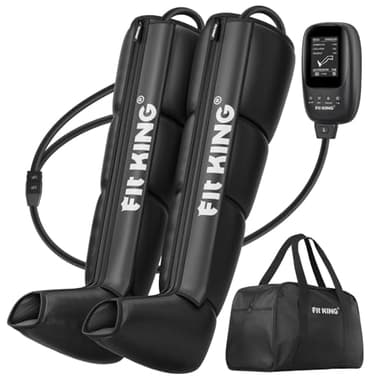
| 2 |  FIT KING Air Compression Recovery Boots For a limb that needs a correct fit rather than one-size-fits-nobody. Genuinely sequential ankle-upward chambers at a fraction of the premium price. | Sequential inflation, sized properly | 7.9 | $359.96 · View on Amazon Price as of November 12, 2026. #ad How we’re funded |
| 3 |  Musugy Sequential Leg Compression Massager For finding out whether home compression suits you before committing serious money. Sequential and full-leg; basic controls and build reflect the price. | Budget pick - cheapest sequential system | 7.4 | |
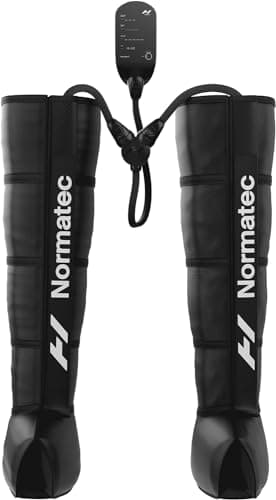
| ✕ | 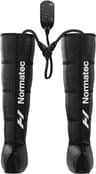 Hyperice Normatec 3 Recovery System The most refined system we cover, and the refinement is not what this use needs. Its price gap buys a quieter pump and nicer control, not a different mechanism or a medical indication. Skip this | The one to skip for this job | 6.5 | $899.00 · View on Amazon Price as of November 12, 2026. #ad How we’re funded |
The short version, and a caveat that comes first
Lymphedema is a diagnosed medical condition, and the device used to treat it in clinical practice is a prescribed pneumatic compression pump, chosen and programmed for your limb by the clinician managing it. The recovery boots sold to athletes — including every system on this page — are consumer fitness products. They move fluid, they are pleasant, and they are not a substitute for that. If you have lymphedema, the first thing to buy is an appointment with a lymphedema therapist, not a pump.
With that said: plenty of people reading this already have a diagnosis, already wear their garments, and want to know whether a home unit is a reasonable addition. If your therapist has cleared you for home pneumatic compression, the system we would buy is the QUINEAR, because it covers the foot and forefoot where a lot of lower-limb swelling actually sits and where most boots stop at the ankle. The FIT KING is the sized, properly sequential alternative, and the Musugy is the budget pick if you want to find out whether you will use one at all. The Normatec 3 is our skip here: it is the nicest machine in the category and its premium buys refinement, not a different mechanism and not a medical indication.
What the trials of pneumatic compression for leg lymphedema found
There is a current, directly relevant evidence summary and it is worth reading before any purchase: the systematic review of contemporary randomized controlled trials for treatment of lower extremity lymphedema by intermittent pneumatic compression devices. Two things to take from the fact that such a review exists at all. First, intermittent pneumatic compression is a real, studied intervention for this condition rather than a wellness idea — which is more than can be said for most of what gets sold to swollen legs. Second, the devices in those trials are medical pneumatic compression systems used within a managed program, not athletic recovery boots bought online, and the review is evidence about the former.
For the athletic claim, the picture is much weaker, and we say so on every compression page here. The 2025 systematic review and meta-analysis of intermittent pneumatic compression for muscle recovery and the placebo-controlled trial in international-level youth soccer players — which found no improvement in neuromuscular, biochemical or perceptual recovery — are both unflattering to the marketing. That is useful context here: the reason to consider one of these for a swollen limb is a fluid argument, not a recovery argument, and the two should not be mixed up.
Recovery boot versus prescribed pump: the differences that matter
| What differs | Consumer recovery boot | Why it matters for lymphedema |
|---|---|---|
| Who chose the settings | You did, from a menu of modes | In a managed program the pressure, cycle and session length are set for your limb and reviewed. A mode dial is not that. |
| Pressure range | Built for athletic recovery, which runs high | Lymphatic work is generally done at the gentler end. Buy a system with low settings you can actually select, and use them. |
| Coverage | Usually ankle to thigh; the foot is often omitted | If your swelling includes the foot and toes, a boot that starts at the ankle can push fluid into the area it skipped. |
| The rest of the program | Not included and not mentioned | Compression garments, skin care, movement and manual drainage are the backbone. A pump is an addition to that, never a replacement. |
| Regulatory status and insurance | A consumer fitness product | A prescribed device may be covered and comes with clinical oversight. Buying a fitness boot out of pocket forfeits both. |
None of that makes a recovery boot a bad object. It makes it a different object, and the single most expensive mistake in this category is buying one instead of getting the condition properly managed.
How we ranked these for a swollen limb
- Does it cover the foot? This is the top criterion on this page and it reorders the category, because the foot and forefoot are where lower-limb swelling is most visible and most boots stop above it.
- Is the inflation genuinely sequential? Chambers firing ankle-upward is the mechanism; a leg-shaped cuff that inflates all at once is not the same thing, whatever the listing says.
- Can you select a genuinely low pressure? More pressure is the wrong instinct here. A system with usable low settings is better than a system with a higher ceiling.
- Does it come in sizes? A sleeve that does not fit the limb cannot apply an even gradient, and fit is more important than any feature on the box.
- We rank down refinement. Quieter pumps and nicer screens are real, and they are not what this use needs. That is why the most expensive system here is the skip.
Which one for which person, in one line each
- Your swelling includes the foot and toes: the QUINEAR, for the coverage, at the lowest pressure setting that does anything.
- You need a sleeve that actually fits your leg: the FIT KING, which is sold in sizes rather than one universal shape.
- You want to find out whether you will use one at all: the Musugy as the budget pick. Sequential, full-leg, basic.
- You want the premium system because the swelling is serious: that is the wrong move and it is the reason the Normatec is our skip. Serious swelling is an argument for a clinic, not a nicer consumer pump.
Questions to put to your therapist before you spend anything
These are the five that change the answer, and they are worth writing down:
- Is home pneumatic compression appropriate for my limb at all, at this stage?
- What pressure and session length should I be using, and how often?
- Should the device include the foot, and does my swelling pattern require it?
- Would I qualify for a prescribed device that insurance might cover, rather than buying a fitness product?
- What should make me stop and call you?
If the answer to the first is no, the answer to the rest does not matter and you have saved yourself a few hundred dollars. If it is yes, you now have numbers to set the machine to, which is worth more than any feature comparison we could write.
Where compression boots are the wrong purchase
If the swelling is end-of-day heaviness in both legs with no diagnosis behind it, the page that fits is compression boots for circulation and swollen legs. If you have visible veins and aching rather than true swelling, read compression boots for varicose veins, which leads with the Cochrane evidence on stockings instead. If you want the category ranked for athletic recovery, that is the compression boots roundup and are compression boots worth it. And if the budget is the obstacle, the budget compression boots page covers the cheap end honestly.
Every pick, in full
Specs below are the manufacturer’s own published figures, each linked to the page it came from. Where a maker does not publish a number, the table says so and names the page we checked — that absence is information too.
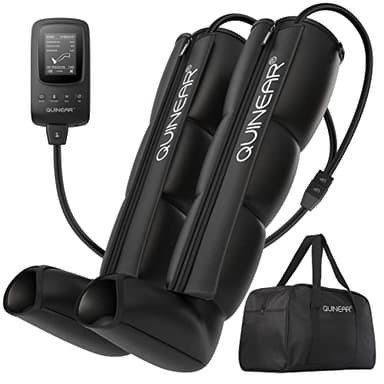
QUINEAR Leg Recovery Compression System
Covers foot, calf and thigh in one sleeve, which matters because the foot is where most budget systems stop and where a lot of the swelling sits.
What it gets right
- Includes the foot, which many systems omit
- Multiple pressure levels and modes
What it does not
- Pump noise
- Not portable
Price as of November 12, 2026. #ad How we’re funded
FIT KING Air Compression Recovery Boots
Sequential chamber inflation — the mechanism that actually distinguishes recovery boots from a leg-shaped pressure cuff — at a third of what the category leader charges.
What it gets right
- Genuinely sequential: chambers fire ankle-upward rather than all at once
- Sized options rather than one-size-fits-nobody
- A fraction of the premium system price
What it does not
- Louder pump than the premium units
- Bulky to store and not remotely portable
- Sizing runs specific — measure before buying
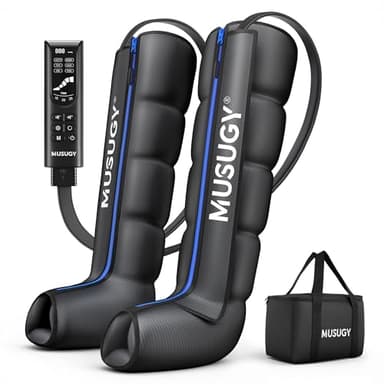
Musugy Sequential Leg Compression Massager
The cheapest genuinely sequential system here — the entry point at which compression boots stop being an aspiration and start being a thing you own.
What it gets right
- Sequential inflation at the lowest price in the category
- Full-leg coverage
What it does not
- Basic controls
- Build quality reflects the price
Price as of November 12, 2026. #ad How we’re funded
Hyperice Normatec 3 Recovery System
Still the refined end of the category and still sold by Hyperice, though the Normatec Elite line now sits above it in the range — and its price gap over a sequential competitor buys refinement rather than a different mechanism, which is why it is our skip for a home buyer.
What it gets right
- The most refined pressure control and the quietest pump of the systems we cover
- The system most likely to still be supported in five years
What it does not
- No longer the top of Hyperice's own range: the Normatec Elite line sits above it
- Several times the price of boots that inflate sequentially the same way
- The added refinement does not change the mechanism
Common questions
Are compression boots good for lymphedema?
Intermittent pneumatic compression is a studied intervention for lower-limb lymphedema — there is a systematic review of contemporary randomized trials of it. But the devices in those trials are prescribed medical pneumatic compression systems used inside a managed program, not consumer athletic recovery boots. If you have lymphedema, ask your lymphedema therapist whether home pneumatic compression is appropriate for your limb and what settings to use. A recovery boot may be a reasonable adjunct once you are cleared; it is not a treatment on its own.
What is the difference between a recovery boot and a lymphedema pump?
Who sets it, how hard it pushes, and what it covers. A prescribed pump has its pressure, cycle and session length chosen for your limb and reviewed by a clinician, and it is part of a program that includes fitted garments and skin care. A recovery boot gives you a menu of modes designed for athletic recovery, which runs at higher pressures than lymphatic work usually wants, and many models stop at the ankle rather than including the foot. The mechanism overlaps; the oversight does not.
What pressure should I use for a swollen leg?
Whatever your therapist tells you, and in the absence of that instruction, the lowest setting that produces a comfortable squeeze. We are not going to print a number here: the appropriate pressure for a lymphatic limb is a clinical decision that depends on the stage, the cause and your arterial circulation, and a generic figure from a website is exactly the wrong input. If a session hurts, numbs the limb or leaves deep indentations, the pressure is too high regardless of what any chart says.
Do compression boots need to include the foot?
If your swelling includes the foot and toes, yes, and it is the main reason the QUINEAR ranks first on this page. A system that begins at the ankle can only move fluid from the ankle upward, which leaves the forefoot out of the sequence entirely. If your swelling genuinely starts above the ankle, a calf-to-thigh system is fine and the sizing and sequential inflation matter more.
Sources
- 1.A systematic review of contemporary randomized controlled trials for treatment of lower extremity lymphedema by intermittent pneumatic compression devices - Journal of Vascular Surgery: Venous and Lymphatic Disorders 2026 (PMC13197773) — the directly relevant evidence, and it is about prescribed medical devices in managed care
- 2.Effects of photobiomodulation, intermittent pneumatic compression and neuromuscular electrical stimulation on muscle recovery: systematic review with meta-analysis - Journal of Bodywork and Movement Therapies 2025 (PubMed 40954632) — the athletic-recovery claim for the same mechanism, which is far weaker
- 3.Intermittent pneumatic compression does not improve post-match neuromuscular, biochemical or perceptual recovery in international-level youth soccer players: a randomized placebo-controlled trial - BMC Sports Science, Medicine and Rehabilitation 2026 (PMC12983609) — placebo-controlled trial finding no recovery benefit in elite youth players
- 4.Graduated compression stockings for the initial treatment of varicose veins in people without venous ulceration - Cochrane Database of Systematic Reviews 2021 (PMC8407251) — the garment evidence, for context on where compression is best established
- 5.camelcamelcamel — FIT KING compression boots price history — price history for the sized sequential pick
- 6.camelcamelcamel — Normatec 3 price history — price history for the system we skip here