Compare
Heating Pad vs TENS Unit
Heat is thermal and broad; TENS is electrical and local. Neither fixes a cause, and the case that decides between them is usually whether the muscle is stiff and guarding or whether the pain is a specific signal you want quieted.
By Stephen V.Published Updated
Disclosure:Grip & Gait earns a commission when you buy through links on this page, at no extra cost to you. It never changes what we recommend or the order we rank things in — here is exactly how we’re funded.
Quick picks
Ranked on published manufacturer specs and what they mean for the job, not on testing we have not done. Tap a row for the full reasoning. How we score.
| # | Product | Best for | Score | Price |
|---|---|---|---|---|
| 1 |  GENIANI Electric Heating Pad Heat relaxes a guarding back and eases stiffness. Moist-heat option and auto-shutoff. | Stiffness, spasm, guarding | 8.0 | |
| 2 |  TENS 7000 Digital TENS Unit Masks a specific pain with manual control. The clinic default. | Localized nerve or muscle pain | 8.0 | $38.88 · View on Amazon Price as of October 21, 2026. #ad How we’re funded |
| ✕ |  Boileau XXXL Electric Heating Pad (17 × 33 in) Covers the full lumbar span rather than a patch. Skip it if a standard pad already covers your sore spot. Skip this | Whole lower back at once | 7.8 |
A heating pad and a TENS unit both get reached for when a back is sore, and they work on the problem from opposite directions. Heat is thermal and passive: it warms tissue and takes the edge off stiffness across a broad area. TENS is electrical and local: it runs a current through pads to change how a specific pain is perceived. Neither one fixes what is causing the pain. They both make it feel better for a while, by different routes, and which route suits you depends on what the muscle is actually doing.
The dividing line that decides most cases is stiffness versus a pinpointed pain. A muscle that is stiff, achy or spasming wants heat. A pain you can point to, or a nerve pain that follows a line, is the case for TENS. The table sorts it out situation by situation; the rest of the page explains the reasoning and the safety rules, which differ sharply between the two.
| Use case | Winner | Why |
|---|---|---|
| Morning stiffness | Heat | Broad warmth loosens a stiff, achy back that has not moved all night. TENS does nothing for stiffness itself. |
| Acute nerve pain | TENS | Electrical stimulation aimed at a specific pain pathway is what TENS is for. Have radiating nerve pain assessed first, though. |
| Muscle spasm or guarding | Heat | Passive warmth lets a guarding muscle release. It asks nothing of the tissue. |
| Drug-free pain at a desk | TENS | Pads under your clothes, quiet, no drugs, no socket by your chair. A pad ties you to one spot. |
| Need to stay mobile (portable) | TENS | A small unit clips on and moves with you. A corded pad keeps you plugged in and still. |
| Whole-back warmth | Heat | A large pad covers the whole lumbar region at once. TENS only ever treats where the pads sit. |
What each one does to the problem
A heating padraises local tissue temperature, which increases blood flow and reduces the sensation of stiffness. It is passive and broad: it reaches everything under the pad at once and asks nothing of you but lying still, which is a genuine advantage when moving hurts. Its natural home is a stiff, guarding, generally achy back — the kind of pain that feels better the moment warmth spreads across it. We cover the category on our heating pads guide.
A TENS unitsends a low-voltage current through pads on the skin to stimulate the nerves beneath, aiming to change how pain is perceived — the long-standing idea being that stimulating the nerves can “close the gate” on pain signals traveling to the brain. It does not warm tissue, it does not loosen a stiff muscle, and it treats only the small area under the pads. What it does is mask a specific pain, drug-free, for as long as it runs and often a while after. We cover units and settings on the TENS units page, and the case for back pain specifically on best TENS for back pain.
Those are genuinely different mechanisms — warmth spread across tissue versus a signal jammed at a nerve — so the useful question is not which is better but which the situation calls for.
The stiffness-versus-signal rule
Here is the most useful distinction on the page. If the complaint is that a muscle feels stiff, rigid, guarded or achy — if it eases when you warm it and tightens when you sit cold — that is a job for heat. Warmth is passive input that reduces the sensation of stiffness without demanding anything of the tissue, which is exactly what a guarding muscle needs; percussion or hard pressure on a muscle that is already contracting tends to make it guard harder, and heat does the opposite.
If the complaint is instead a specific pain you can put a finger on, or a nerve pain that radiates along a known line, and what you want is to turn its volume down while you get on with your day, that is the case for TENS. It will not make a stiff back supple, but it can quiet a defined pain in a way a heating pad cannot aim at. A lot of people with a chronically cranky back end up wanting both, for different moments — which is fine, as long as you understand you are treating symptoms in two different ways, not curing anything.
What the evidence supports, kept modest
We are not going to oversell either. Both are symptomatic tools: they change how the problem feels, they do not resolve what is driving it. For heat, the relief of stiffness and the comfort are real and familiar, but the evidence is about short-term symptom relief rather than healing. For TENS, the honest position is that the evidence for pain relief is mixed and the effects that appear tend to be modest and temporary, varying widely between people and conditions. That is precisely why a cheap unit is the smart way to find out whether it does anything for you.
For scale, it helps to remember how modest the numbers are even for the best-studied recovery approaches: hands-on massage, which has far more research behind it than either a heating pad or a stimulator, still only modestly and temporarily eases soreness in a meta-analysis. Heat and TENS are studied less rigorously than that, so any promise that they do more than take the edge off, briefly, is borrowing certainty that does not exist. If your back pain is the reason you are here, our lower back pain page routes each kind to the tool that fits it.
Cost, coverage and convenience
On practicalities the two split cleanly. A heating pad is cheap, needs nothing of you but a socket and stillness, and its one specification that actually changes the experience is area: a standard pad warms a patch, while an oversized pad covers a whole lumbar region and both sides of it at once. If your problem is a broad, stiff back rather than a single spot, that coverage is the entire difference between the two pads — and it is also why an extra-large pad is overkill, and our skip, if a standard one already covers your sore area. The other must-have is auto-shutoff; the number of heat settings is close to irrelevant.
A TENS unit is also inexpensive to buy, but its running cost is the adhesive pads, which wear out and need replacing. Its advantage is portability: it is small, quiet and wearable, so you can run it discreetly at a desk or on the move, which a corded pad tied to a wall cannot match. If you need to stay mobile, TENS wins on that alone. If you want to lie still and be warm, the pad does that better than anything.
Two smaller heating-pad details are worth knowing. A moist-heat option penetrates better than dry heat and is worth having if the pad offers it. And a washable cover is the mundane feature that quietly decides whether a pad lasts for years or gets thrown out grubby — a thing you sweat on and lie against needs cleaning, and one you can strip and wash is one you keep. Beyond those two, ignore the heat-setting count entirely; it is the specification manufacturers compete on precisely because it costs them nothing and changes almost nothing about the experience.
As with any recovery tool, the one you will actually reach for beats the one that is theoretically superior. A heating pad by the sofa gets used because using it costs nothing but sitting down, which is exactly why it suits an achy back so well. A TENS unit only helps the person who will re-stick the pads and fiddle with a setting until something clicks; if that sounds like too much bother, the pad is the safer buy, and if lying still tied to a cord is the part you know you will skip, the wearable unit is.
Which should you buy first?
Buy the heating padif the problem is a stiff, achy, guarding back — the case where lying still under broad warmth is what actually helps. It is cheap, it needs nothing of you, and back pain is disproportionately the situation heat suits. Get one large enough to cover the area that hurts, with auto-shutoff, and ideally a moist-heat option, which penetrates better than dry.
Buy the TENS unitif the problem is a specific, localized or nerve-related pain you want quieted drug-free while you carry on with the day — and start cheap, because whether TENS helps you is genuinely individual. The clinic-default unit with manual control is the sensible one to learn on once you know the basics.
Buy neither yet if the pain radiates, tingles or goes numb, or if there was a clear injury. That is a clinician conversation before it is a purchase, and neither device is the answer to it. If you are torn, see how a massage gun compares to heat for the muscular side of things, and route the rest through our symptom pages.
One practical note if the answer you landed on was heat. The pad that suits a lower back is the wrong shape for a neck and shoulders, and shape is what decides whether it stays in contact at all — the best heating pads for neck and shoulders ranks the ones built for that region separately from the back-pain roundup.
Every pick, in full
Specs below are the manufacturer’s own published figures, each linked to the page it came from. Where a maker does not publish a number, the table says so and names the page we checked — that absence is information too.
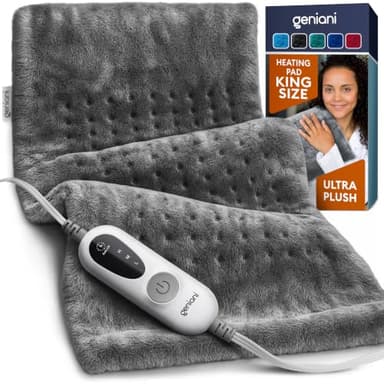
GENIANI Electric Heating Pad
Moist-heat capable with an auto-shutoff, which is the specification that decides whether a heating pad is safe to use lying down — and lying down is when you want it.
What it gets right
- Auto shutoff — the safety feature that matters if you fall asleep on it
- Moist-heat option penetrates better than dry
- Machine-washable cover
What it does not
- Corded, so your position is fixed
- Smaller than the XXL pads
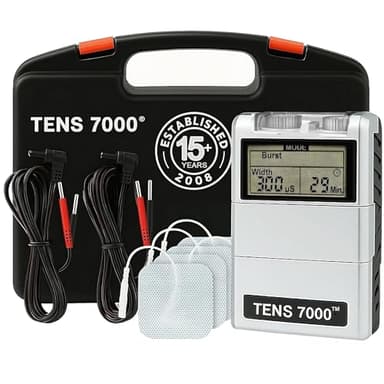
Price as of October 21, 2026. #ad How we’re funded
TENS 7000 Digital TENS Unit
The unit clinics hand out, with manual control over pulse width and rate rather than a menu of preset programs — which is what you want once you know what setting helps.
What it gets right
- Manual pulse-width and rate control instead of fixed presets
- The long-standing clinic default, so accessories are everywhere
What it does not
- Runs on a 9 V battery
- Manual control is only an advantage if you know what you are adjusting
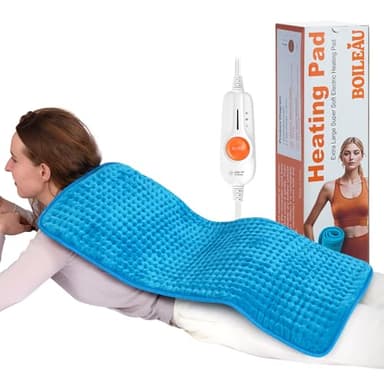
Boileau XXXL Electric Heating Pad (17 × 33 in)
Large enough to cover a whole lumbar region and both sides of it at once, which a standard pad cannot do — and area is the only heating-pad spec that changes the experience.
What it gets right
- 17 × 33 in covers the full lumbar span rather than a patch of it
- Multiple heat settings with auto shutoff
What it does not
- Bulky to store
- Takes longer to reach temperature
Common questions
Should I use a heating pad or a TENS unit for back pain?
It depends on the kind of back pain. If the muscle is stiff, achy, spasming or guarding, heat is the better first choice — broad warmth relaxes it in a way TENS cannot. If the pain is a specific spot or a nerve pain you want quieted drug-free, a TENS unit aimed at that area fits better. Many people use both at different times: heat to loosen a stiff back, TENS to mask a defined ache. Neither fixes the cause.
Can you use a heating pad and a TENS unit at the same time?
Not on the same spot at the same moment — heat can change skin resistance under TENS pads and the adhesive does not like getting hot, so run them separately. Using both across a problem is reasonable, for example heat to loosen a stiff back, then TENS later to quiet a defined ache. Follow each device’s own precautions, which differ: heat must not go over numb skin or an acute injury, and TENS is ruled out over a pacemaker, the front of the neck, and in pregnancy without guidance.
Does a heating pad or TENS work better for muscle spasm?
Heat, generally. A muscle in spasm is already contracting hard, and passive warmth lets it release without demanding anything of it. TENS can mask the pain the spasm causes but does not address the guarding itself. Start with heat for a spasming or guarding muscle; reach for TENS when what you want is to turn down a specific, localized pain while you get on with the day.
Sources
- 1.Massage Alleviates Delayed Onset Muscle Soreness after Strenuous Exercise: A Systematic Review and Meta-Analysis (PMC5623674) — scale of relief even for well-studied massage is modest
- 2.Percussion massage therapy and recovery from delayed onset muscle soreness — randomized controlled trial (PMC11979224)