Massage Guns
The Best Massage Gun for Runners
A gun can make a sore calf feel better right now and can earn a place in a warm-up, but it does not speed healing and it fixes nothing. Here is what actually reaches your own calves, hamstrings, quads and IT band on your own, where a gun is the wrong tool for a runner entirely, and the one to skip.
By Stephen V.Published
Disclosure:Grip & Gait earns a commission when you buy through links on this page, at no extra cost to you. It never changes what we recommend or the order we rank things in — here is exactly how we’re funded.
Quick picks
Ranked on published manufacturer specs and what they mean for the job, not on testing we have not done. Tap a row for the full reasoning. How we score.
| # | Product | Best for | Score | Price |
|---|---|---|---|---|
| 1 | 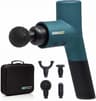 Ekrin Athletics B37v2 Massage Gun The angled handle reaches your own calves, hamstrings and mid-back without a second person, and the warranty is unusual in this category. | Reaching your own legs & back | 8.6 | $224.99 · View on Amazon Price as of October 21, 2026. #ad How we’re funded |
| 2 |  Bob and Brad C2 Massage Gun Light, and the only gun here whose maker publishes the depth numbers. The sensible first gun for most runners. | Best value for runners | 8.7 | |
| 3 |  Therabody Theragun Mini (3rd Gen) Pocketable enough to actually travel. A short handle cannot reach your own mid-back, so treat it as a second gun. | The gym bag and race kit | 7.2 | $219.99 · View on Amazon Price as of October 21, 2026. #ad How we’re funded |
| 4 |  TOLOCO Massage Gun (EM26) A real tool if the alternative is owning nothing. Loud, and a two-year purchase. | Cheapest that works | 6.8 | |
| ✕ |  Therabody Theragun Pro Clinic-grade duty cycle and price a runner never draws on. Buy it only if you treat other people. Skip this | The one to skip | 6.2 |
What a massage gun actually does for a runner
Running loads the same few muscles thousands of times a mile, so the soreness after a long run or a hard session is normal — and it is the thing most runners buy a gun to chase. It is worth being precise about what the tool does before you spend anything. A massage gun drives a head into muscle at speed. In a warm-up it can raise tissue temperature and briefly change how a muscle moves, and researchers have looked directly at whether that translates into faster times or bigger outputs for trained athletes in a study of massage gun and foam roller use during a warm-up — the honest reading is that the case for a measurable performance boost is modest and far from settled.
After exercise the picture is clearer, and more limited than the marketing suggests. A systematic review of percussive therapy found it can help acute and explosive muscle strength and has an effect on perceived pain, and a randomized controlled trial found percussion gave immediate, temporary relief in perceived soreness each time it was applied — without actually accelerating recovery in the days after eccentric exercise. Put plainly: a gun can make a sore calf feel better right now and can be a reasonable part of a warm-up, but it does not speed healing and it does not cure anything. Every pick below is judged against that frame, not against the promise on the box.
How we ranked these for running legs
Criteria before products, and for a runner the deciding questions are not the ones the marketing leads with. In order:
- Reach on your own legs and back. The whole point of self-treatment is doing it without a second person. A calf and a hamstring are reachable with almost anything; your own mid-back is not, and an angled handle is the one genuine ergonomic idea in the category that changes that.
- Weight. A gun you hold against your own hamstring while folded into a chair, or overhead against your shoulder, gets heavy fast. A lighter unit is the difference between finishing the session and giving up on it.
- Control at a low setting. Runners work close to the shin bone and the Achilles, where a gun that only knows one aggressive speed is a liability. A usable low speed matters more than a high one.
- Portability for race kit. A gun that lives at home is fine; a gun small enough to travel to a race is a genuinely different tool, and worth having as a second.
- Transparency and warranty.Bob and Brad publish the amplitude and stall-force figures the premium brands leave off their current US product pages, which is a small act of honesty worth ranking for — you can see what you are buying. Compare the fully specified C2 product page against the Theragun Prime page and the gap is obvious.
The muscles that actually matter for runners
Most running complaints trace back to a short list of muscles, and a gun is a reasonable tool for the broad, fleshy ones. The calves— the big gastrocnemius and the deeper soleus beneath it — take the landing load on every stride and are where most runners feel it first; work the belly of the muscle, staying well clear of the Achilles tendon at the back of the heel. The hamstrings respond well to a gun because they are large and easy to reach seated. The quads are the biggest, most forgiving target on the body and the easiest place to learn the tool.
The glutes and the hip matter more than runners give them credit for, because a weak or cranky hip is often the real story behind a knee or an IT band that hurts. That is also where the most common mistake lives. What runners call IT band painis felt along a band of dense connective tissue on the outside of the thigh — but the band itself is not muscle and does not lengthen when you hammer it. The productive targets are the muscles that tension it: the glute and the small muscle at the front of the hip. Treat those, not the rope down the side of your leg. The feet matter too, but a gun is the wrong tool for them, which is the next section.
How to actually use it on each running muscle
The technique is the same everywhere and it is boring on purpose: glide the head slowly along the length of the muscle, pause a few seconds on a tender spot, and let the machine do the work rather than pressing it in. Faster is not better and harder is not deeper. A couple of minutes per muscle is plenty, and if a spot is still screaming after that, you have found something to leave alone rather than something to attack.
Calves.Sit with the ankle across the opposite knee, or prop the foot on a chair, and run the head slowly up the meat of the calf from just above the ankle to just below the back of the knee. Keep off the Achilles tendon and the back of the knee itself. Point and flex the toes a few times as you work — a muscle moved through its range while it is treated gives up tension more readily than one held rigid.
Hamstrings. The easiest muscle on the body to reach with a gun: sit in a chair, lean forward, and run the head along the back of the thigh from behind the knee up towards the sit bone, staying on the soft muscle and off the bone at the top. Seated, you can straighten and bend the knee as you go, which helps the muscle let go.
Quads. Standing or sitting, work the front and outer thigh from above the knee up towards the hip, keeping clear of the kneecap. This is the most forgiving place to learn how hard is hard enough, because the muscle is thick and there is nothing delicate underneath it.
Glutes and hip. Standing, lean the working side slightly towards the gun and treat the meat of the buttock and the muscle at the side of the hip. This is the productive way to address what runners blame on the IT band, because you are treating the muscles that tension the band rather than the band itself.
When in your training week to reach for it
There are two honest windows. Before a run, a brief pass over the muscles you are about to load can raise their temperature and leave them feeling readier to move — the warm-up study above looked at exactly this, and while the case for a measurable performance gain is modest, a short pre-run pass is low-risk and some runners find it helps them feel loose. Keep it brief; a long, aggressive session before hard efforts is more likely to leave a muscle feeling dull than springy.
After a run, the value is comfort. The soreness that peaks a day or two after a hard session — the stiffness going downstairs the morning after a race — is the thing a gun most reliably softens, for a while. The research is consistent and unglamorous here: percussion makes sore muscle feel better each time you use it, and it does not shorten how long the soreness lasts. Treat that as permission to use it for comfort, not as a reason to expect to bounce back faster. What actually builds durable legs is sensible training load and sleep, and no device on this page substitutes for either.
Where a massage gun is the wrong tool
A gun is not the answer to every running ache, and we would rather say so than sell you one for a job it does badly. Three cases come up constantly.
The sole of the foot and the plantar fascia.A gun cannot generate the concentrated pressure the arch needs, and it skitters across a curved surface. A few-dollar spiked or firm ball rolled underfoot puts your whole body weight through one small point, which is exactly what that tissue responds to — and the evidence for foot pain points at loaded stretching and pressure, not percussion. If the arch or heel is your problem, start with plantar fasciitis, not a gun.
The shin bone.Shin splints are painful along the front and inner edge of the shin, and the instinct is to attack the sore spot. Do not percuss the bone or the tender edge of it — a gun belongs on the calf muscle behind and beside the shin, never on the bone or a painful stress reaction. Read shin splints and calf and shin pain before you point a gun anywhere near a sore shin, because used wrongly it makes the wrong things worse.
Any sharp, localized or worsening pain. Percussion is for muscle that is tight or generally sore, not for a specific point that is getting worse day on day. A pain that localizes to a bone, a joint line or a tendon and does not settle is a reason to stop buying tools and see someone. Nothing on this page treats an injury; it treats normal training soreness.
“Deep vein thrombosis, osteomyelitis; bone fracture or myositis ossificans; bleeding disorders; peripheral vascular insufficiency or disease; medications that thin the blood or alter sensations; pacemaker, ICD.”
A gun is one tool, not the whole kit
The runners who get the most out of a gun are the ones who know when to put it down and pick up something cheaper. For broad muscle like the quads and the whole back of the leg, a foam roller covers more ground per minute and costs a fraction of any gun — a gun is precise where a roller is broad. For the deep glute and the sole of the foot, a firm ball under your own body weight generates pressure a handheld motor cannot match. For the calf, a simple roller stick lets you set the pressure with your arms while you sit in a chair. None of these is a gadget upgrade over the gun; they are different shapes for different jobs, and a complete recovery kit is usually a gun plus a roller plus a ball rather than the most expensive gun on its own. The roller half of that kit is ranked in the best foam roller for runners.
If you arrived here with one specific complaint rather than general soreness, the faster route is recovery tools by runner problem, which maps Achilles, IT band, shin, plantar fascia and calf problems each to the cheapest tool that addresses them — and says plainly where no tool does.
And if you cross-train on the bike, the muscle demands reorder enough to change the recommendation: cycling loads the quads and glutes harder than running does, and adds a neck and upper-back problem running does not have. That ranking is in the best massage gun for cyclists.
Which massage gun for running, in one line each
- To reach your own legs and mid-back without help: the angled-handle Ekrin. The geometry is the reason to buy it, and the long warranty is a rare thing in this category.
- Best value and the sensible first gun:the fully specified Bob and Brad. Light enough for self-treatment on your own hamstrings, and its maker publishes the numbers the premium brands hide. Most runners should start here — see the best budget massage guns for the wider case.
- For race kit and the gym bag: the pocketable mini. A brilliant travel tool and a poor only-gun, because a short body cannot reach your own back.
- Lowest cost that still works: the budget ten-attachment unit, understanding it is loud and best treated as a two-year purchase.
Whatever you pick, technique beats hardware: slow passes, a couple of minutes per muscle, never on bone or a painful point. If you are new to the tool, read how to use a massage gun properly first, and if you want more depth for dense muscle, the best massage gun for deep tissue covers the trade-offs.
Every pick, in full
Specs below are the manufacturer’s own published figures, each linked to the page it came from. Where a maker does not publish a number, the table says so and names the page we checked — that absence is information too.
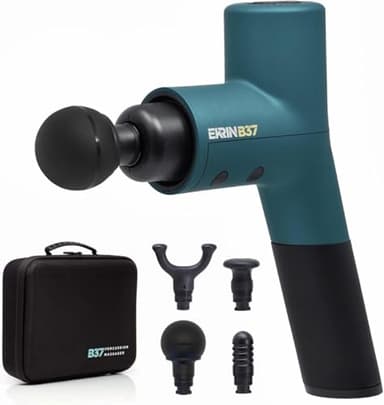
Price as of October 21, 2026. #ad How we’re funded
Ekrin Athletics B37v2 Massage Gun
The 15-degree angled handle is the one genuine ergonomic idea in this category — it is the difference between reaching your own mid-back and asking someone else to.
What it gets right
- Angled handle materially extends self-treatment reach
- Lifetime warranty is unusual at any price in this category
- Quieter than most mid-priced guns
What it does not
- Costs several times a fully-specified budget gun
- Heavier than the lightest premium handhelds
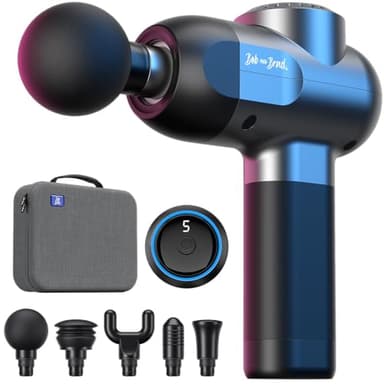
Bob and Brad C2 Massage Gun
The only gun in this roundup whose maker publishes all four numbers that decide whether it reaches the muscle — amplitude, stall force, speed range and noise — and the stall-force figure is higher than the premium units that hide theirs.
What it gets right
- Publishes amplitude, stall force, speed range and noise — the two market leaders publish none of the first three
- Published stall force of over 44 lb is higher than the figure Therabody publishes for the Prime
- 1.5 lb is light enough to hold overhead against your own shoulder without your arm giving out first
- FSA/HSA eligible, which quietly makes it cheaper again for a lot of buyers
What it does not
- 10 mm amplitude is genuinely shorter than a 16 mm premium stroke — that difference is real for glutes and thick back muscle
- No app, no pressure-feedback screen, no ecosystem
- Five fixed speeds rather than a continuous range
Price as of October 21, 2026. #ad How we’re funded
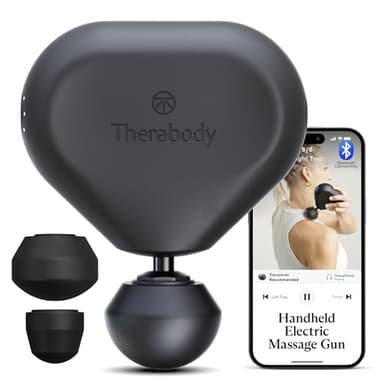
Therabody Theragun Mini (3rd Gen)
A genuinely pocketable gun that survives being thrown in a bag — the trade is that a short body has to give up stroke somewhere, and Therabody does not say where.
What it gets right
- Small enough to actually carry, which is the only spec that matters for a travel gun
- Simple three-speed operation
What it does not
- No published amplitude or stall force
- Priced like a full-size premium gun
- Short handle means you cannot reach your own mid-back with it
| Amplitude | Not published page we checked |
|---|---|
| Stall force | Not published page we checked |
| Speed range | 1,750–2,400 PPM source |
| Speed settings | 3 source |
| Weight | 0.9 lb source |
| Noise | Not published page we checked |
| Battery | 2.5 h source |
| Attachments | 3 source |
| Warranty | 1-year limited source |
| Dimensions | 116 × 135 × 96 mm source |
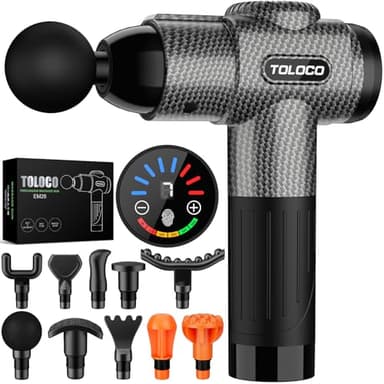
TOLOCO Massage Gun (EM26)
The cheapest gun worth owning, and the ten-attachment box is not the selling point the listing thinks it is — but if the alternative is not buying one at all, this is a real tool.
What it gets right
- Cheap enough that it is not a decision
- Ten attachments, of which you will use two
- Light enough for self-application
What it does not
- No published amplitude or stall force from the manufacturer
- Build quality is what the price implies — treat it as a two-year tool
- Loud relative to premium units
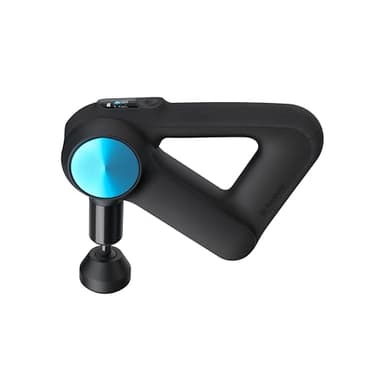
Therabody Theragun Pro
Built for a practitioner who runs it for hours a day across many bodies. For one person's own calves and shoulders it is the most expensive way to do a job a $70 gun does — which is why it is our skip.
What it gets right
- Rotating arm genuinely helps reach your own back
- Built for continuous professional use in a way the consumer models are not
What it does not
- The price gap over a fully-specified budget gun buys durability you will not consume at home
- Heavy in the hand for self-treatment
- Same unpublished-amplitude problem as the rest of the range
Common questions
Does a massage gun help running recovery?
It helps how you feel more than how fast you heal. A randomized controlled trial found percussion gave immediate, temporary relief in perceived soreness each time it was applied, without actually speeding recovery in the days after hard eccentric exercise. A systematic review found percussive therapy can help acute and explosive strength and reduce perceived pain. So a gun is a reasonable warm-up and feel-better tool for a runner, but it does not accelerate healing and it does not fix an injury.
Can I use a massage gun on my shins for shin splints?
Not on the shin itself. Shin-splint pain runs along the bone, and you never percuss bone or a tender stress reaction — that is how you make the wrong thing worse. A gun belongs on the calf muscle behind and beside the shin, at a low setting, to ease the muscular tension that feeds the problem. For the fuller approach read our pages on shin splints and calf and shin pain, and if the pain is sharp, localized to the bone, or getting worse, stop and see someone.
Do runners need an expensive massage gun?
No. The most useful features for a runner are reach, low weight and a usable low speed, and those are not the things extra money buys. The budget end of this category is where the depth numbers are actually published, so a well-specified cheap gun lets you verify what you are buying while a premium one often does not. Spend more only for a specific reason — an angled handle to reach your own back, or a pocket size for travel — not to hit harder.
Sources
- 1.Does Massage Gun or Foam Roller Use During a Warm-Up Improve Performance in Trained Athletes? (PMC12473898) — massage gun in a warm-up; performance case modest
- 2.The Effect of Percussive Therapy on Musculoskeletal Performance and Experiences of Pain: A Systematic Literature Review (PubMed 37020441) — systematic review of percussive therapy
- 3.Percussion massage therapy and recovery from delayed onset muscle soreness — randomized controlled trial (PMC11979224) — temporary soreness relief, no faster recovery
- 4.Bob and Brad — C2 massage gun product page — publishes amplitude, stall force, PPM, dB
- 5.Therabody — Theragun Prime product page — no amplitude or stall force published
- 6.Therabody — Product Safety & Precautions — contraindications, quoted above