Symptoms
Tight Neck and Shoulders
The most common complaint in this whole category and the one with the most places you must not put a tool. The front and sides of the neck are out entirely — what responds is the muscle behind and below.
By Stephen V.Published Updated
Disclosure:Grip & Gait earns a commission when you buy through links on this page, at no extra cost to you. It never changes what we recommend or the order we rank things in — here is exactly how we’re funded.
Work the muscle at the back and side of the neck where it meets the shoulder, the upper trapezius, and the area between the spine and the shoulder blade. Never the front or sides of the neck, and never the spine itself. A ball against a wall reaches all of it, costs almost nothing, and is more effective than anything motorized for the hardest spot.
What is usually going on
The upper trapezius runs from the base of the skull along the top of the shoulder. It holds the shoulder girdle up, and it does that all day whether you ask it to or not. Add a screen slightly too low, a phone held between ear and shoulder, or a bag on one side, and it holds harder.
The levator scapulae runs from the upper neck to the top inside corner of the shoulder blade, and it is the muscle most people are describing when they point at the spot where the neck meets the shoulder.
The rhomboids sit between the spine and the shoulder blade. That is the region behind the most-searched knot on the internet, and it is genuinely awkward to reach.
Which class of tool fits
| Tool class | Cost | Why it does or doesn’t work here | Verdict |
|---|---|---|---|
| Massage ball against a wall | Cost: Budget | The only tool that reaches under the shoulder blade. Stand with the ball between you and the wall, reach the opposite arm across your chest to slide the blade outward, and lean in.Where it fails: Not on the spine itself, and not high enough that it lands on the neck. | Start here |
| Massage gun (upper trap) | Cost: Mid-range | Your own upper trapezius is one of the few places you genuinely cannot apply body weight. A light gun reaches over the shoulder easily - and weight matters far more than power for that angle.Where it fails: Front and sides of the neck, never. Lowest setting near anything close to bone or the base of the skull. | Start here |
| Heat | Cost: Budget | Neck and shoulder tension is frequently guarding, and guarding responds to passive heat far better than to percussion. Cheap and asks nothing of you.Where it fails: Not unattended without auto shutoff. Not on an area with reduced sensation. | Start here |
| TENS unit | Cost: Budget | Pads on the muscle either side of the spine at the base of the neck, or across the top of the shoulder. Useful when the area is too sore to press on.Where it fails: Never on the front of the neck or over the carotid sinus. Not with a pacemaker or implanted defibrillator. | Sometimes |
| Foam roller | Cost: Budget | Across the UPPER back, using it as a fulcrum for thoracic extension. Genuinely useful for a rounded desk posture, and a different job from massage.Where it fails: Not on the neck. And the head needs support - letting it drop back over a roller strains the very thing you are treating. | Sometimes |
| Anything on the front of the neck | Cost: Budget | Nothing.Where it fails: Carotid arteries, jugular veins and the vagus nerve run there close to the surface. No tool, no setting, no exception. | Not for this |
What we would actually buy
Buy this first
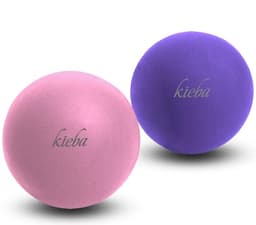
Kieba Massage Lacrosse Balls
The wall technique reaches under a shoulder blade, which is the hardest spot on the body to treat and the one nothing motorized can get to. Under ten dollars.
Price as of October 21, 2026. #ad How we’re funded
For your own trapezius
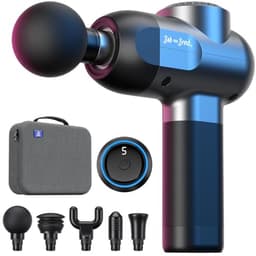
Bob and Brad C2 Massage Gun
1.5 lb published - the lightest full-size gun here - and weight is what decides whether you can hold it over your own shoulder for ninety seconds.
For guarding
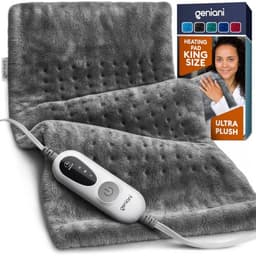
GENIANI Electric Heating Pad
Neck and shoulder tension is often a muscle holding protectively, and heat suits that in a way percussion actively does not.
The wall technique, in detail
This is the single most useful thing on this page and it costs eight dollars.
- Stand with your back to a wall, ball placed between you and the wall, positioned between your spine and the inside edge of your shoulder blade.
- Reach the opposite arm across your chest. That action slides the shoulder blade outward and opens the space underneath, which is what lets the ball get in there at all.
- Lean back into the ball and adjust how much weight you put through it by stepping your feet closer to or further from the wall. That is your intensity dial.
- Work slowly.Small movements, pausing on tender points for 30–60 seconds.
- Stay off the spine. Between the spine and the blade, never on the bone.
- Then move the shoulder through a few slow circles. Pressure then movement.
Using a gun on your own shoulder
The upper trapezius is one of the few genuinely good use cases for a massage gun, because you cannot get body weight onto it in any position.
Reach over your own shoulder with the gun, softest attachment, low speed. Keep it on the fleshy muscle between the neck and the point of the shoulder — not on the bony ridge of the shoulder blade, not up onto the neck, and not at the base of the skull.
This is also the position where device weight matters more than any other spec. Holding a 2.5 lb gun at that angle for ninety seconds is genuinely tiring; a 1.5 lb gun is not. That is why our pick here is the lightest full-size gun rather than the most powerful, and it is the same reasoning as the massage guns for older hands page.
“Avoid direct application to the face, throat, or genitalia. Neurologic conditions resulting in loss or altered sensation; bone fracture; bleeding disorders; medications that thin the blood or alter sensations; pacemaker, ICD.”
Two problems travel with this one often enough to have their own pages. If the ache is a band of pressure around the head by late afternoon, tension headaches has the nine-trial meta-analysis and the two spots that refer pain into a head. If you wake up with a clenched, tired face or the jaw aches when you chew, jaw pain and TMJcovers what belongs there — and it is not a percussion device. If you are weighing a gun against the passive kneading massagers sold for necks, massage gun vs handheld massager is the comparison.
The cause, which is not a purchase
A neck that tightens every week is reporting on something that has not changed: a monitor below eye level, a laptop with no separate keyboard, a phone held with a shoulder, a bag always on the same side, or a sleeping position.
Tools manage it and cost money. Raising a monitor costs nothing. We would rather point at the free intervention first, and the short-term reduction in tissue stiffness percussion produces is exactly that — short-term, and it will keep being short-term until the load changes.
If you want current rather than pressure for this region, the placement rules are stricter than anywhere else on the body and the wireless unit is — unusually — the right buy. The best TENS units for neck and shoulder pain sets out where the pads go, where they must never go, and what Cochrane is still assembling on the question.
If heat is what you reach for here — and for most people it is the first thing they try — the shape of the pad matters more than any number on the box, because a shoulder is a slope and a flat pad will not stay on it. The best heating pads for neck and shoulders covers which ones are cut for this region, and how thin the evidence for heat on a neck actually is.
Two shoulder problems are often filed under this page and are managed differently. If the pain is on the outside of the upper arm and worst reaching overhead or lying on it, read rotator cuff pain. If the shoulder has lost range in every direction and reaching behind your back went first, read frozen shoulder.
Common questions
How do you loosen tight neck muscles?
Work the muscle at the back and side-toward-the-back of the neck where it meets the shoulder, the upper trapezius, and the area between the spine and the shoulder blade. A ball against a wall reaches all of it. Never the front or sides of the neck, and never the spine itself. Follow pressure with slow shoulder movement.
Can you use a massage gun on your neck?
On the muscle at the back and side-toward-the-back, gently, with the softest attachment on the lowest setting — yes. On the front or sides, never: the carotid arteries, jugular veins and vagus nerve run there close to the surface, and Therabody explicitly advises avoiding direct application to the throat. Not at the base of the skull either.
How do you get to a knot between your shoulder blades?
A ball against a wall. Position it between your spine and the inside edge of the shoulder blade, then reach the opposite arm across your chest — that slides the blade outward and opens the space underneath. Adjust intensity by stepping your feet closer to or further from the wall. No massage gun head gets beneath the bone.
Why does my neck keep getting tight?
Because something in your day has not changed — a monitor below eye level, a laptop with no separate keyboard, a phone held with a shoulder, a bag always on the same side, or a sleeping position. Tools manage the symptom and cost money; raising a monitor costs nothing and addresses the load.
When should I worry about neck pain?
Pain radiating down an arm, numbness or tingling in the hand or fingers, weakness in a hand, neck pain with headache and fever, stiffness following any head or neck injury, dizziness or visual changes with neck movement, or pain that wakes you at night. Those need assessment rather than a tool, and several of them promptly.
Sources
- 1.Therabody — Product Safety & Precautions — quoted verbatim above
- 2.Acute Effects of Theragun Percussive Therapy on Viscoelastic Tissue Dynamics and Hamstring Range of Motion (PMC10499144)
- 3.The Effect of Percussive Therapy on Musculoskeletal Performance and Experiences of Pain: A Systematic Literature Review (PubMed 37020441)
- 4.Massage Alleviates Delayed Onset Muscle Soreness after Strenuous Exercise: A Systematic Review and Meta-Analysis (PMC5623674)